The good news: you don't need an expensive guitar to learn on, and you don't need lessons to start. The bad news: most beginners quit because they bought a $50 plywood guitar that physically hurts to play. Buy one decent instrument, a clip-on tuner, a pack of picks, and you're set for the next two years.
By Colin B. · Published May 8, 2026 · Last reviewed June 3, 2026
A solid acoustic setup is around $230-$300. The guitar is 80% of that, and a good one will last you decades.
We earn commission on qualifying Amazon purchases — see our
affiliate disclosure.
Price tiers and budget totals shown above are editorial estimates;
actual Amazon prices vary.
At a glance
Our top pick in each category
The fastest path through this guide — each best-starter pick by category.
Scroll for the budget and upgrade alternatives.
Don't buy a $50 guitar. The cheapest acoustics on Amazon look fine in photos but are physically painful to play, high action (the gap between strings and frets) means you have to press hard enough to bend the wood, and the necks are often warped out of the box. More beginners quit because of a bad guitar than for any other reason. Spend $200-$250 on a name-brand starter and you remove that excuse forever.
You don't need an acoustic-electric. Brands sell 'acoustic-electric' versions of every model (with a built-in pickup so you can plug into an amp). For your first year, skip it, you'll never plug it in, and the electronics add cost and one more thing to break. If you ever want to play live, buy the acoustic-electric version then.
You don't need lessons immediately, but you do need a structure. The guitar is one of the few instruments where YouTube + a beginner book + 20 minutes a day actually works. The people who quit are mostly the ones who 'just strum around' for two weeks with no plan. Pick one curriculum (we list our favorites below), do it in order, and don't jump ship for three months.
The single most important purchase. A good beginner acoustic has a solid (not laminate) top, a straight neck, and reasonable factory setup so the strings sit close to the fretboard. At the $200-$300 mark, three guitars dominate beginner recommendations: the Yamaha FG800, the Fender CD-60S, and the Taylor GS Mini. They each play differently, full-size dreadnoughts (Yamaha, Fender) are louder and project more; the smaller-bodied GS Mini is more comfortable, quieter, and travels well.
Best starter
Yamaha
FG800J Solid Top Acoustic Guitar
$259.99 as of Jun 22, 2026
★★★★★Our rating
The unanimous starter recommendation in every guitar forum and beginner-guitar guide for the last decade. Solid spruce top, full dreadnought body, well-built neck that arrives playable out of the box. Around $230. You will not outgrow this guitar in your first three years; many people never replace it.
What we like
Solid spruce top sounds dramatically better than laminate
Yamaha QC is reliable, every unit ships ready to play
Often available under $250, extraordinary value
What to know
Stock strings ship rough, restring before first session
★★★★☆Our rating· Only 11 left in stock - order soon.
The other consensus pick at the same price point. Solid mahogany or spruce top, dreadnought shape, very playable rolled fingerboard edges that are unusually friendly to new fingers. If the Yamaha FG800 is unavailable or you prefer a slightly warmer tone, this is the swap.
★★★★☆Our rating· Only 3 left in stock - order soon.
The 'smaller body, premium build' move. Around $700, much more refined than the $230 starters: better tone, dramatically easier to play, holds tuning longer. Worth it if you already know you stick with hobbies, or if the dreadnought shape feels too big against your body.
What we like
Travel-friendly size with full-bodied tone
Taylor build quality without the dreadnought price tag
Mahogany top adds warmth most players love instantly
What to know
Smaller body means less bass than full-size dreadnoughts
For kids, smaller-framed adults, or as a couch/travel guitar. 3/4 scale length means a shorter reach between frets and easier chord shapes. The same Yamaha build quality as the FG800 in a smaller package, around $170.
What we like
Sized right for younger players or smaller frames
Forgiving short scale length, easier on small hands
Under $150, low risk for a child's first guitar
What to know
Sound is appropriately smaller, not a forever guitar
An out-of-tune guitar is the single fastest way to quit. A clip-on chromatic tuner (clamps to the headstock, picks up vibration, displays the note) makes tuning a 30-second non-event. New strings every 3-6 months keep the tone alive; cheap factory strings are the reason a lot of new guitars sound dull. A peg winder with a built-in cutter turns restringing from a 30-minute chore into a 10-minute one.
Best starter
Snark
SN5X Clip-On Tuner
$22.30 as of Jun 22, 2026
★★★★★Our rating· In Stock
The default beginner tuner. Clips to the headstock, displays a clear note name and a needle, fast and accurate enough that you'll never need a more expensive option. Around $15, takes a coin battery, lasts forever. Almost every guitar teacher recommends this exact model.
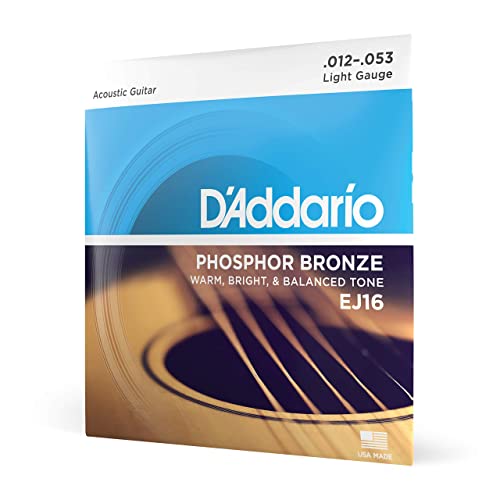
The default replacement set. Light gauge (.012-.053) is the right beginner choice, softer on the fingers, easier to fret, still loud enough on a dreadnought. Phosphor bronze gives a balanced, slightly warm tone that suits any beginner repertoire. Around $7 a set; buy a 3-pack and you're set for a year.
What we like
The default light-gauge acoustic string for a reason
Lasts ~3 months for casual players
Consistent across packs, sounds the same every set
What to know
Bright tone in the first hour, needs to settle
Not ideal for fingerstyle players wanting warmer tone
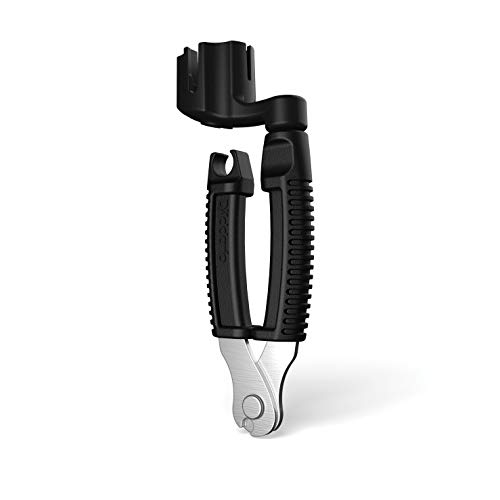
A peg winder with a built-in string cutter and a bridge-pin puller. All three are tasks you'll do every restringing, and a Pro-Winder turns a fiddly job into a five-minute one. Around $12. The single highest 'utility per dollar' tool on this whole page.
A pick (plectrum) is what you strum with. Pick thickness (measured in millimeters) has a huge effect on how the guitar sounds and feels: thinner picks (.46-.60mm) are flexible and forgiving, ideal for strumming chords; thicker picks (.88-1.0mm) are stiffer and better for picking single notes. Almost everyone tries a few thicknesses before settling on a favorite, which is why a variety pack is the right starter buy. A capo clamps across all six strings at a chosen fret, instantly raising the pitch of every chord, letting you play the same chord shapes in a higher key, which is how you accompany singers in their range.
Best starter
Dunlop
Jim Dunlop Acoustic Pick Variety Pack (12-pack)
$8.39 as of Jun 22, 2026
★★★★★Our rating· In Stock
A 12-pick assortment specifically curated for acoustic strumming, celluloid, Tortex, Ultex, and nylon picks ranging from .60mm to .88mm. About $7. Spend a week with it, find your favorite, then buy that one in bulk.
What we like
12 picks in varied thickness lets you find your feel
The capo every guitarist eventually owns. Spring-loaded, one-handed operation, made in the USA, lasts forever. Around $20. You'll want one within your first three months, most beginner songbooks indicate which fret to capo at, and a capo unlocks a huge swath of the popular-music repertoire that requires open chord shapes in a non-open key.
Whether you keep your guitar in a case or on a stand has a huge effect on how often you actually play. A guitar that lives on a stand in your living room gets picked up four times more than one that lives zipped in a case in a closet. The stand is the single highest-leverage 'consistency' purchase on this list. A strap is mostly relevant once you start playing standing up, but cheap straps cut into your shoulder, so it's worth getting one good one rather than three bad ones.
Best starter
Hercules
GS415B Acoustic Guitar Stand
$$
★★★★★Our rating
The stand professionals use. The 'Auto Grip System' (AGS) yoke locks around the neck when the guitar's weight settles in, meaning a curious cat or a passing kid can't tip the guitar out. Folds flat, foam contact points won't damage finishes. Around $40, lasts forever.
What we like
Auto-grab system locks the neck, guitar can't fall
Levy's M8POLY 2" Polypropylene Strap with Leather Ends
$6.99 as of Jun 22, 2026
★★★★☆Our rating· In Stock
Soft polypropylene that won't dig into your shoulder, with proper leather ends that grip the strap buttons rather than slipping off mid-song. Around $20. Levy's is the long-time independent strap maker that the touring crowd uses.
The two things that separate beginners who progress from beginners who plateau are: (1) consistent daily practice, even just 15 minutes, and (2) playing in time. A method book gives you something to work through in order so you're not just refreshing the same five chords forever. A metronome forces you to play steady, almost every beginner skips this and ends up with rhythm problems that take years to undo. You can use a phone app for the metronome, but a hardware unit on your music stand is harder to ignore.
Best starter
Hal Leonard
Guitar Method Complete (Books 1-3)
$28.04 as of Jun 22, 2026
★★★★★Our rating
The standard beginner method, used in guitar lessons across the country since the 1980s. Spiral-bound, takes you from open chords through scales, fingerstyle, and barre chords across three books bound as one. Includes online audio for every example. Around $25, replaces the first six months of paid lessons for the cost of one.
What we like
The classic beginner method used in schools worldwide
Compact, runs 400 hours on two AAA batteries, has loud-enough audible click and a tap-tempo button. Around $25. Sits on your music stand, doesn't ping you with notifications, and never needs charging. Optional only because phone metronome apps are free, but most people end up with the hardware unit anyway.
What we like
LCD shows the beat clearly even in dim rooms
Tap-tempo function syncs to whatever you're learning
Battery lasts a year of daily use
What to know
Speaker is tinny compared to mechanical metronomes
What actually happens in your first 30 days, sore fingertips, three chords that fight you, and the moment around week three when something clicks. A practical map of how progress unfolds, not a recipe.
The biggest gap between people who learn guitar and people who buy a guitar and quit isn’t talent. It’s understanding what the first month is supposed to feel like.
It’s supposed to feel hard. Your fingers won’t go where you want them. Three simple chords will take you longer than you expected. Your fingertips will hurt for two weeks. None of that is failure, it’s the universal experience that every guitarist alive went through, including the ones you watch on YouTube.
What follows is a realistic week-by-week of a beginner’s first month, assuming roughly 15 minutes of daily practice. If you do this, by day 30 you can play a recognizable song and you’ve ended the question of whether the hobby is going to stick.
Week 1: Three chords and a tuner
Day one is unboxing the guitar, clipping the tuner to the headstock, and getting all six strings in tune. That part is easy, the tuner does the work, and you’ll learn the string names (low to high: E, A, D, G, B, E) just by tuning over and over.
Then you sit down and try your first chord. Let’s say G. You read the diagram, you push your fingers down on three strings, you strum, and it sounds terrible. Buzzing, muted strings, maybe one or two notes ringing clearly. This is normal.
The fix is mechanical, not musical. Press the strings down with the tip of your finger, not the pad. Keep your fingers curved, like you’re holding a small ball. Press right next to the fret wire (the metal bar), not in the middle of the fret. Strum slowly and listen to which strings buzz; adjust the offending finger; strum again.
Spend week one on three chords: G, C, and D. That’s the entire goal. Don’t try a fourth. By the end of the week each chord should ring cleanly when you strum it slowly.
The transitions between chords will feel impossible. That’s the point of week two.
Week 2: The transition wall
Week two is when you discover that making a chord and moving between chords are different skills. You can play a clean G. You can play a clean C. But going from G to C takes you four seconds, and by the time you arrive your strumming has fallen apart.
Welcome to the wall. Every guitarist hits it. The fix is the boring practice you don’t want to do: drill the transition itself, in isolation, ignoring rhythm.
Try this for ten minutes a day this week. Set a metronome (or use the one in your tuner) to a slow click, 60 BPM is fine. On each click, switch chords: G, C, G, C, G, C. Don’t strum. Just place your fingers, lift, place again. The goal is for your hand to learn the shape transition with no other variable.
By the end of week two, G to C will take you under a second. G to D will be similar. C to D will be the slow one, that’s universal. Don’t worry about it; it’ll come.
Your fingertips also hurt this week. They might be slightly raw, even pink. That is exactly what’s supposed to happen, the skin is hardening into calluses. Don’t tape, don’t quit, don’t practice for an hour to “push through”, just keep doing 15 minutes a day. By the end of the week the pain stops being notable.
Around day 18-22, something happens that surprises every beginner.
You sit down to practice. You strum G, clean. You strum C, clean. You go from G to C and your hand just knows. No conscious thought, no four-second placement. The transition that took you two weeks of drilling is suddenly automatic.
This is the click. From here, everything is faster.
Use it. Pick one easy three-chord song (“Knockin’ on Heaven’s Door” is the canonical first song for a reason) and try strumming it along with the original recording. It will be slow and ragged. You’ll lose your place. You will stop, restart, get embarrassed even though no one’s listening. Do it five times in a row anyway.
By the end of week three, you can play a recognizable song. It is not good, but it is recognizable. A non-musician hearing it would identify the song. That’s a real milestone, the gap between “no song” and “first song” is bigger than the gap between “first song” and “tenth song.”
Week 4: Strumming patterns and a fourth chord
Week four is when you learn that what your right hand does matters as much as your left. The simple “down-down-down-down” strum you’ve been using is fine for practice but doesn’t sound like real songs do.
The first strumming pattern to learn is the universal “down, down-up, up, down-up.” It’s used in roughly half of pop songs. You will fall out of it, restart it, lose your timing. That’s fine. Same drill as before: slow metronome, hands on autopilot, no song yet, just the strum on a single chord until it stops feeling deliberate.
Add one new chord this week: Em (E minor). It’s the easiest chord on the guitar (only two fingers, no muted strings to worry about) and it pairs naturally with G, C, and D. Now you have four chords, which covers a meaningful chunk of every popular song ever recorded.
Try a four-chord song this week: “Stand By Me,” “Let It Be,” or “No Woman No Cry.” Don’t worry about the strum being perfect. Get through the song start-to-end, even badly.
What month two looks like
If you’ve done the above, by day 30:
You can play four open chords cleanly: G, C, D, Em.
You can transition between them in roughly the time of a beat.
You have one strumming pattern that mostly works.
You can play one or two simple songs end-to-end.
Your fingertips don’t hurt anymore.
That’s the actual outcome of an honest first month. It is not “playing guitar” in any romantic sense, it’s the foundation that makes playing guitar possible. The next month adds A, E, F (the painful one), and the first barre chord, and the songs you can play roughly triple.
The important thing right now is not to compare. Don’t open Instagram. Don’t watch a 12-year-old shred a Steve Vai cover. The relevant comparison is: did you, today, sit down with a guitar for 15 minutes? If yes, you are exactly on track.
What to not do in your first month
A few classic beginner traps to avoid:
Don’t restring the guitar yet. Factory strings are stiff, but learning to play on stiffer strings actually builds finger strength faster. Wait until month two.
Don’t buy more gear. No second guitar, no amp, no effects, no fancy capo. The variable that matters is hours, not equipment.
Don’t practice for an hour twice a week. Two hours total spread across two days is dramatically less effective than 15 minutes a day for two weeks.
Don’t skip ahead. If JustinGuitar’s Beginner Grade 1 has 12 lessons, do them in order. The ‘this is too easy’ lessons are the ones that fix the bad habits you don’t know you have yet.
The first month is about endurance and consistency, not performance. If you finish it, you’ve done the hard part, the part where most people quit. Everything that comes after is just hours.
Save your money
What you don't need yet
Beginners get pressured to buy a lot of stuff that doesn't help them play
better. Here's what we'd skip on day one.
An amp — You bought an acoustic. Acoustics are designed to be heard unplugged. An amp is for electric guitars or for acoustic-electrics played live. You don't need either yet.
Effects pedals — Pedals are for electric guitars. Acoustics use them rarely, and only at the live-performance level. Skip for at least your first year.
A second guitar — It's tempting after three months. Resist for six. The variable that improves your playing is hours, not instruments.
Expensive headphones for 'silent practice' — Acoustic guitars are already quiet enough for an apartment. If neighbors are an issue, a felt strum mute is $8 and works.
Online lesson subscriptions in your first month — JustinGuitar.com is free and considered the gold standard. Spend zero on instruction until you've worked through his Beginner 1 course end-to-end.
A humidifier — Useful for solid-wood guitars in dry climates after one year of ownership. Not a beginner-week purchase. Your $230 starter is fine in normal indoor humidity.
First week
Your first seven days
A short, real plan to get from gear-on-doorstep to actually playing.
Order the guitar, the tuner, and the pick variety pack. Don't order anything else yet, you don't know what you actually need. · Buy
When the guitar arrives, clip the tuner to the headstock and tune all six strings to standard tuning (low to high: E A D G B E). Do this before every practice session, including your very first. · Action
Practice transitioning between G, C, and D for 10 minutes. Don't strum a song yet, just train your fingers to move between the shapes cleanly. · Action
Try every pick in the variety pack across one practice session. Set aside the two or three that feel best in your hand and ignore the rest. · Action
Pick one easy song with G, C, and D and play along, slowly. Suggested first songs: 'Knockin' on Heaven's Door,' 'Wonderwall' (no capo for now), 'Bad Moon Rising.' · Learn
Set a 15-minute daily practice timer for the next 30 days. Consistency beats intensity. Fifteen minutes a day for a month produces dramatically more progress than three two-hour sessions on weekends. · Action
FAQ
Common questions
How much should I spend on my first guitar?
Around $230 is the right floor for a real instrument. Below that, the quality drops sharply, pickups warp, frets aren't level, and the guitar will fight you every time you pick it up. The Yamaha FG800 and Fender CD-60S are the two consensus starter picks at this price. Don't go cheaper; the discount you save is the reason most beginners quit.
Should my first guitar be acoustic or electric?
Whichever genre you want to play. If your favorite music is folk, country, singer-songwriter, or fingerstyle, start acoustic. If it's rock, blues, or metal, start electric. The 'acoustic is harder so it builds your fingers' advice is partially true but also irrelevant, you'll quit if you don't enjoy what you're playing. Pick the instrument you want to hear.
Do I need lessons, or can I learn online?
Most beginners can get to an intermediate level entirely through free online resources. JustinGuitar.com is the universal recommendation, Justin Sandercoe has built the most complete free beginner curriculum in any instrument. After 6-12 months, a few in-person lessons to fix bad habits is high-value. But you don't need lessons in week one to get started.
How often do I need to change strings?
Every 3-6 months for casual players, more often if you play daily or sweat a lot. The signs strings are dead: they look dull or grimy, sound 'thuddy' instead of bright, and stop holding tuning. New strings make a $250 guitar sound like a new $400 guitar, it's the cheapest tone upgrade available.
How long until I can play a real song?
About two weeks for a 3-chord song played slowly, three months for it to sound listenable, six months for it to sound good. The chord transition is the hard part, your fingers physically learning to move between G, C, and D is what your first month is about. Once that's smooth, songs unlock fast.
My fingertips really hurt. Am I doing something wrong?
No, that's universal. The skin on your fingertips is going to develop calluses over the first 2-3 weeks of regular practice, and that process is mildly painful. Don't tape your fingers, that delays the calluses. Practice 15 minutes, take a break, come back later. By week three the pain is gone. By month two you can play for an hour without thinking about it.
Should I tune by ear or use a tuner?
Use a tuner for at least your first year. Tuning by ear is a real skill, but it's a separate skill from playing, and an out-of-tune guitar will make every song you play sound bad and discourage practice. A $15 clip-on tuner removes the problem entirely. You'll naturally develop the ear over time.
JustinGuitar (Justin Sandercoe) — The most respected free beginner curriculum on the internet. Start with 'Beginner Grade 1.' Whatever you read elsewhere will eventually point you back here.
Marty Music (YouTube) — Best-in-class song tutorials. When you want to learn a specific song, search 'Marty Music [song name]' first.
Paul Davids (YouTube) — More technical than JustinGuitar, gear, theory, technique deep-dives. Great for after your first year.
Ultimate Guitar — The biggest free chord/tab database. Use the 'Chords' tab (not 'Tabs') and filter by user rating.
Reddit, r/guitarlessons — Active community for beginner questions. Excellent 'post a video, get feedback' culture. Search before posting.
Reddit, r/AcousticGuitar — More gear and instrument-focused than r/guitarlessons. Best place to research before buying a second guitar.
Acoustic Guitar magazine — Long-running publication covering technique, gear reviews, and lessons. Their beginner sections are thoughtful and ad-light.
As an Amazon Associate, JustBeginning earns from qualifying purchases.
We may also earn commission from other affiliate programs linked on this
page. Editorial recommendations are independent; we don't choose
products based on commission rates.
Product prices and availability are accurate as of the date and time
indicated and are subject to change. Any price and availability
information shown on Amazon at the time of purchase will apply.
Our top pickYAMAHA FG800J Solid Top Acoustic Guitar


 Best starter