An acoustic upright piano costs $3,000+ and weighs 400 pounds. The good news: a $500 digital piano with weighted keys plays close enough that no beginner will outgrow it for years. The trick is buying the right one, and not all 'digital pianos' are actually pianos.
By Colin B. · Published May 8, 2026 · Last reviewed June 21, 2026
A real beginner piano setup is around $550-$750. The keyboard is most of it; everything else (stand, bench, pedal, headphones) adds up to about $200.
We earn commission on qualifying Amazon purchases — see our
affiliate disclosure.
Price tiers and budget totals shown above are editorial estimates;
actual Amazon prices vary.
At a glance
Our top pick in each category
The fastest path through this guide — each best-starter pick by category.
Scroll for the budget and upgrade alternatives.
Make sure it has 88 fully weighted keys. This is the single most important spec, and it's where cheap 'digital pianos' lie. A real piano has 88 keys, and they have weight to them; pressing them takes a small amount of force, the way an acoustic piano does. 'Touch sensitive' is not the same as weighted. 'Semi-weighted' is not the same either. If a $200 keyboard claims to be a piano, it has 61 plastic keys, and you will outgrow it in three weeks. Skip it.
You don't need an arranger keyboard, MIDI controller, or synth. Big-screen keyboards with rhythms, accompaniment styles, and 500 sounds are a different category of instrument. Fun for songwriting, terrible for learning piano. A real digital piano has a piano sound, maybe a few alternates (electric piano, organ), and that's the right amount.
You don't need lessons immediately to get started, but you do need a method book or an app. Adults teaching themselves piano with no structure plateau within a month. Pick one curriculum (Alfred's, Faber's, or a paid app like Simply Piano), do it in order for at least 60 days before evaluating, and you'll be playing real music.
The single most important purchase. A real beginner digital piano has three things: 88 keys, fully weighted ('hammer action') key feel, and a piano sound that doesn't make you wince. Three brands dominate this category at the entry price: Yamaha (P-45/P-71), Casio (CDP/PX), and Roland (FP-10). They all play similarly enough that the right answer is whichever you can find in stock at $500-ish.
Best starter
Yamaha
P-71 88-Key Weighted Digital Piano
$429.99 as of Jun 22, 2026
★★★★★Our rating· In Stock
The unanimous starter recommendation. The P-71 is the Amazon-exclusive version of the P-45 (same piano, slightly cheaper). Full 88 weighted keys, Yamaha's signature piano sound, slim chassis that fits any apartment. Around $500 with a sustain pedal in the box. You will not outgrow this in your first three years.
What we like
Full 88 weighted keys, the non-negotiable spec for real piano training
Slim chassis fits any apartment without dominating the room
Includes a sustain pedal; add stand and bench and you're done
What to know
Built-in speakers underwhelm at volume; headphones solve this completely
No stand included; budget an extra $40 for the RockJam X-stand
★★★★☆Our rating· Only 16 left in stock - order soon.
The thinnest 88-key piano on the market. Casio's hammer-action keys feel slightly lighter than Yamaha's, which beginners often prefer. Runs on 6 AA batteries if you want to play unplugged at a friend's house. Same price range as the P-71. The right choice if your space is tight.
What we like
Thinnest 88-key digital piano on the market; fits any tight space
Battery-powered option lets you play anywhere without an outlet
What to know
Included sustain pedal is a button box; plan to upgrade to M-Audio SP-2
★★★★☆Our rating· Only 7 left in stock - order soon.
The next step up from the P-71. Better speakers (you'll actually like the sound in a room), a more refined piano voice, and a slightly more expressive key action. Around $700-$800. The right choice if you already know piano is sticking, or if you'll be playing in a room without headphones for the next decade.
What we like
Better built-in speakers that sound genuinely good in a room without headphones
More expressive key action and refined piano voice than the P-71
What to know
You won't learn faster on this; the upgrade is sound quality, not skill
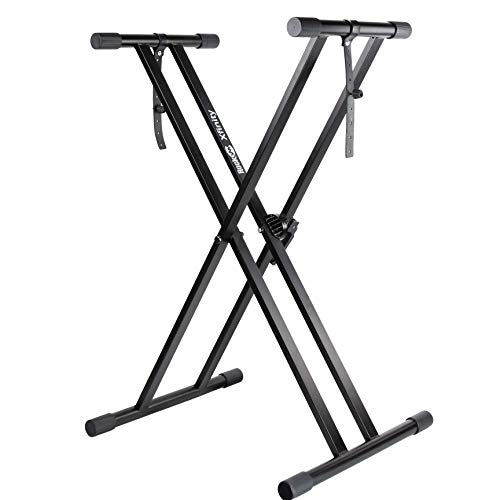
A digital piano on a coffee table is the wrong height by about six inches, which gives you wrist pain inside a week. The right setup is a dedicated stand at piano-height (~28-29") and an adjustable bench so your forearms come down level to the keys. Both are dirt cheap. The X-style stand and X-style bench are the standard.
Best starter
RockJam
Xfinity Heavy-Duty Double-X Keyboard Stand
$46.99 as of Jun 22, 2026
★★★★★Our rating
The default beginner stand. Double-X bracing means it doesn't wobble when you're playing fast passages. Pre-assembled, infinitely adjustable height, locking straps to keep the keyboard from sliding. Around $40, holds up to 132 lbs (you'd need three pianos to stress this).
What we like
Double-X bracing means zero wobble even during fast passages
Infinitely adjustable height with locking straps at around $40
What to know
Locking straps must be set before first use or the keyboard can slide off
★★★★☆Our rating· Only 16 left in stock - order soon.
Adjustable height so it works for kids and adults, padded enough to sit through a 30-minute practice without numbing your legs, folds flat for storage. Around $45. Cheaper benches are tinny and wobble; this is a small upgrade that you'll feel every day.
What we like
Adjustable height works for both kids and adults, solving the wrist-pain problem
Folds flat for easy storage; padded enough for 30-minute practice sessions
What to know
Cushion is firm; won't satisfy anyone who wants a plush seat
Two upgrades that make a $500 piano feel dramatically more like a real piano. The included sustain pedal on most starter pianos is a plastic 'box' the size of a remote control; it works but doesn't feel right. A real piano-style pedal solves that for $20. Headphones make a digital piano genuinely apartment-friendly, let you practice late at night, and let you hear the piano voice the way the engineers tuned it (the built-in speakers always understate it).
Best starter
M-Audio
SP-2 Sustain Pedal
$19.99 as of Jun 22, 2026
★★★★★Our rating· In Stock
The default upgrade pedal. Heavy-duty metal, real piano-style angled pedal feel, polarity switch so it works with any keyboard brand. Around $20. Every digital piano teacher recommends this exact pedal; it's universal because it just works.
What we like
Heavy-duty metal with a real piano-style angled feel, around $20
Polarity switch means it works with any keyboard brand out of the box
What to know
Polarity switch needs a flip if sustain is reversed (easy fix, easy to miss)
Closed-back design (no sound leaks to the room next to you), flat and accurate frequency response (the piano sounds the way it's supposed to), comfortable for long practice sessions. Around $100. Used in studios professionally; a bit overkill for piano practice in the best way.
What we like
Closed-back design with zero sound leakage for true apartment-friendly practice
Flat frequency response makes the piano sound exactly as the engineers tuned it
What to know
Overkill for casual use; a $50 closed-back alternative works fine too
Adults teaching themselves piano have two great method-book options: Alfred's Basic Adult All-in-One Course, and Faber Adult Piano Adventures. They take different approaches: Alfred's is more notation-heavy and methodical, Faber's is more song-driven and friendly. Either one works; the choice is taste. The thing that matters is picking one and finishing book 1 before bouncing to anything else.
Best starter
Alfred
's Basic Adult All-in-One Course Book 1
$24.11 as of Jun 22, 2026
★★★★★Our rating· In Stock
The standard adult-beginner method, used by piano teachers for forty years. Lesson, theory, and technique in one spiral-bound book. Around $25. By the end of book 1 you can read music in both clefs and play simple classical and pop pieces. The pacing is honest: you'll know if you're behind or ahead.
What we like
The forty-year standard: lesson, theory, and technique in one book
Methodical pacing shows clearly whether you're on track or falling behind
What to know
First 50 pages feel slow; the repetition is building reading, not performance
The friendlier alternative to Alfred's. Same scope (lesson + theory + technique) but with more pop and folk repertoire and online video walkthroughs included. Around $25. The right choice if Alfred's feels too dry, or if you learn better from videos than from text.
What we like
More song-driven than Alfred's, better for learners who need fun repertoire fast
Online video walkthroughs included for every piece in the book series
What to know
Lighter on music theory than Alfred's; may leave gaps if you skip supplementing
What actually happens in your first 30 days at the piano: the staff-reading wall, the first time both hands work together, and why the bench height matters more than the keyboard. A practical map of how progress unfolds.
The piano has a reputation as the hardest instrument to start. It isn’t, exactly, but it’s the instrument with the steepest first month. Two hands doing different things at the same time is a real cognitive challenge, and reading the staff is a separate skill from playing the keys.
The good news: the first-month wall is well-mapped. Every adult beginner hits the same milestones in roughly the same order. Knowing what’s coming makes it much easier to keep going through the parts that feel impossible.
Here’s the realistic week-by-week, assuming 15-20 minutes of daily practice and an open method book.
Week 1: Hand position and middle C
Day one is unboxing the keyboard, putting it on the stand at the right height, and finding middle C. That part is fast; middle C is the white key just left of the two black keys closest to the center of the keyboard. There are seven Cs total; the middle one is the one near the brand logo.
Then you sit at the bench and place your right hand in ‘C position’: thumb on middle C, then second finger on D, third on E, fourth on F, fifth (pinky) on G. Your hand stays put; each finger covers one key.
Almost everyone’s wrist sags downward in the first week. Your forearms should be parallel to the floor, your wrists flat (not bent up or down), your fingers curved like you’re holding a small ball. If your wrists hurt after a session, the bench is the wrong height. Adjust before the next practice.
Open your method book to page one and play the first piece. It will be five notes long, all in C position, right hand only. It will feel embarrassingly simple. Don’t skip it; the simple piece is teaching you to read, not to play.
Week 2: The staff is the wall
Week two is when you discover that playing and reading the staff are different skills. You can play a five-note melody in C position no problem if someone tells you the notes. You hit the staff (five horizontal lines, four spaces, notes sitting on each) and your brain stalls.
This is universal. The fix is repetition. Adults learn to read the staff in roughly six weeks of daily 5-minute drills, plus the reading you do while playing pieces in the method book.
A few mnemonics that actually help:
The lines of the treble staff (right-hand) are E-G-B-D-F (Every Good Boy Deserves Fudge).
The spaces of the treble staff spell F-A-C-E.
Middle C sits one ledger line below the treble staff and one ledger line above the bass staff.
By end of week two, sight-reading a single line of right-hand C-position music should take three or four seconds per note. By week six it’ll be one note per second. Don’t try to memorize the pieces; every time you replay something, force yourself to read it from the page. Memorizing skips the skill you’re supposed to be building.
Week 3: Left hand enters
Around the start of week three, the method book introduces your left hand. This is the second wall.
The left hand also gets a ‘C position’: pinky on the C below middle C, then up through D-E-F-G with thumb on G. It plays the bass clef, which is read differently from the treble (different lines, different mnemonics). For the first day or two, switching between staffs feels like reading two different alphabets.
The key insight: don’t try to play both hands together yet. Practice each hand alone, separately, until each hand can play its part fluidly. Only then put them together, and even then, expect the first attempt to be a disaster.
The first time both hands cooperate is one of the genuine endorphin moments in learning piano. You’ll know it when it happens. Most people get there in week three or four.
Week 4: Both hands together, slowly
Week four is when the real skill emerges. Your method book introduces a piece where the right hand plays a melody and the left hand plays a single note or chord per measure. Suddenly you’re using both halves of your brain at once, and the brain pushes back.
The trick is to slow down. Way down. If the piece is supposed to be played at 100 BPM, practice it at 50. Maybe 40. The temptation is to play at full speed badly; resist it. Beginner piano teachers will tell you, with extreme conviction, that slow practice is the only practice that works. They’re right.
By the end of week four, you should be able to play a simple two-handed piece end-to-end, slowly, with stops. It will not be musical. It will be mechanical. That’s the right milestone for week four.
What month two looks like
If you’ve done the above, by day 30:
You can read single-line right-hand music in C position fluently.
You can read single-line left-hand music in C position with mild effort.
You can play a simple two-handed piece slowly, with the hands cooperating.
You know finger numbers (1-5 from thumb to pinky) and which finger plays which note.
Your wrists don’t hurt anymore (or you’ve fixed your bench height, please).
That’s the actual outcome of an honest first month. Most pop song arrangements are still out of reach; most beginner classical pieces in your method book are now playable. The next month adds chords (instead of single bass notes), more keys (G position, F position), and your first piece in 6/8 time.
What to not do in your first month
Don’t skip ahead in the method book. The early simple pieces are building reading speed, not playing speed. Skipping them cripples your ability to read music later.
Don’t try to memorize. Read every piece from the page every time you play it. The reading skill is the long-term one.
Don’t practice for an hour. Two 15-minute sessions on the same day are dramatically more effective than one 30-minute session. Your brain consolidates what it learned during the breaks between practices.
Don’t watch yourself in a mirror. Common advice for some instruments; counterproductive for piano. Watch the music or watch your hands, not yourself.
Don’t play pieces you haven’t practiced both hands separately on. Trying to read both staffs at once before each hand can play its part alone is the fastest way to plateau.
The first month is a learning curve, not a performance arc. If you finish it, you’ve cleared the hardest pedagogical wall the piano has. Everything that comes after compounds on what you’ve built here.
Save your money
What you don't need yet
Beginners get pressured to buy a lot of stuff that doesn't help them play
better. Here's what we'd skip on day one.
An acoustic upright — $3,000+, 400 pounds, needs tuning twice a year. A digital piano is the right move until you've been playing for at least two years.
An arranger keyboard — Keyboards with 500 sounds, accompaniment styles, and rhythm tracks are different instruments. Fun for songwriting, terrible for learning piano.
A MIDI controller — MIDI controllers don't have built-in sounds; you need a computer and software. Solid for music production. Wrong tool for learning piano.
An external speaker / amp — The built-in speakers on a P-71 are fine for the first year. Headphones cover anything your speakers don't.
A second pedal — Most pieces in your first year use only the sustain pedal. The soft and sostenuto pedals come up in classical pieces at the late-intermediate stage.
Simply Piano / Flowkey premium subscription — Free YouTube + a method book covers the first 6 months. If you stick, a paid app is reasonable then. Don't commit a subscription before knowing if you'll practice.
First week
Your first seven days
A short, real plan to get from gear-on-doorstep to actually playing.
Order the keyboard, stand, and bench. Don't order anything else yet; you don't know what you actually need. · Buy
When the keyboard arrives, set up the stand at piano height (around 28-29 inches), put the keyboard on it, and sit at the bench with your forearms parallel to the floor. If your wrists bend up or down to reach the keys, the bench height is wrong. Adjust before you do anything else. · Action
Learn middle C. Find it on your keyboard (it's the C closest to the center, near the brand logo on a P-71). The white key just to the left of any group of two black keys is a C; there are seven of them on the keyboard. · Learn
Pick a method book and start at page 1. Don't skip ahead, even if the first lesson is single-finger melodies. Reading the staff is the actual skill being built; the music is just the vehicle. · Buy
Learn the first finger pattern: right-hand thumb on middle C, then five fingers covering C-D-E-F-G. Your hand stays put; each finger plays one key. This is the 'C position.' All your week-one music lives here. · Action
Practice 15-20 minutes a day, every day. Two hours on Saturday is dramatically less effective than 15 minutes a day. Consistency is the variable that compounds. · Action
By end of week one, you should be able to read a five-note melody on the staff and play it in C position with your right hand, slowly. That's the milestone: not speed, not both hands, not chords. Just one hand, five notes, staff-reading. · Learn
Yes. Every method book, every YouTube tutorial, every classical piece is written assuming a full 88-key range. You can technically learn the first three months of piano on 61 keys, but the moment you tackle anything written before 1900 or anything with a real bass line, you run out of keys. Buy the 88-key version. The extra $100-150 is the cheapest upgrade you'll ever skip and regret.
What's the difference between weighted and 'touch-sensitive' keys?
Touch-sensitive means the keyboard plays louder if you press harder, a basic feature on every keyboard since the 90s. Weighted (or 'hammer action') means the keys themselves have physical resistance, the way an acoustic piano does. Only weighted keys train the finger muscles you actually need to play piano. Don't confuse the two; manufacturers exploit the confusion.
Should I take lessons or learn online?
For your first 6-12 months, free online resources + a method book are enough for almost everyone. Adult method books (Alfred's, Faber's) are designed for self-teaching. After 6-12 months, a few in-person lessons to fix bad habits (especially hand position and wrist tension) is high-value. Don't pay for lessons in your first month; you don't yet know what you don't know.
How long until I can play a real song?
Two weeks for a simple right-hand melody, six weeks for two hands together on something basic, three months for a recognizable simplified version of a pop song. The big skill jumps are: reading the staff (week 4), playing both hands independently (month 2-3), playing chords (month 3-4), and putting it all together (month 4-6). Each unlock makes a huge new range of music possible.
How important is the bench height?
Critical. Wrong bench height is the #1 cause of wrist pain in adult beginners. Your forearms should be parallel to the floor when your fingers rest on the keys. If your wrists bend up or down to reach the keys, your tendons are fighting gravity for every note, and you'll develop pain inside two weeks. An adjustable bench is $45 and removes the problem permanently.
Can I practice with headphones late at night?
Yes; this is one of the biggest reasons to choose digital over acoustic. With headphones plugged in, the speakers cut out and you make zero noise outside your own head. You can practice at 2 AM in an apartment without bothering anyone. Get good closed-back headphones (we recommend the ATH-M40x); cheap earbuds make the piano sound like a toy.
Should I learn classical or pop?
Classical, mostly, for at least the first six months. Method books are notation-based and they use mostly classical and folk repertoire because that material teaches reading and technique most efficiently. After you can read and play simple two-hand pieces, branch into pop / jazz / whatever you actually love; that's also when you'll have the chord-vocabulary to do it well.
Pianote — Best paid online piano school. Free YouTube content is excellent starting point; paid program is genuinely high-quality if you stick past month two.
Piano With Jonny (YouTube) — Best jazz and pop chord-piano teacher on YouTube. After you can read music, his channel unlocks 'play any song you hear' skills.
Reddit: r/piano — Active community for technique questions and progress check-ins. Search the FAQ before posting; many beginner questions are answered there.
Faber Piano Adventures — Publisher site for the Faber method. Free supplemental material and video walkthroughs for every piece in the book series.
musicnotes.com — The biggest legal sheet music store. Search by skill level; 'easy' arrangements of pop songs are how most beginners build a fun-songs repertoire alongside their method book.
As an Amazon Associate, JustBeginning earns from qualifying purchases.
We may also earn commission from other affiliate programs linked on this
page. Editorial recommendations are independent; we don't choose
products based on commission rates.
Product prices and availability are accurate as of the date and time
indicated and are subject to change. Any price and availability
information shown on Amazon at the time of purchase will apply.
Our top pickYamaha P-71 88-Key Weighted Digital Piano


 Best starter