Drawing with pencil is the foundation every other visual art builds on. The barrier to starting is almost nothing: a pencil set, a sketchbook, and the willingness to put down bad sketches until the good ones start appearing. What separates beginners who improve from those who stall is daily practice with the right materials. Here's what you need.
By Colin B. · Published May 8, 2026 · Last reviewed June 20, 2026
Drawing is one of the cheapest creative hobbies to start. Low end: Staedtler pencil set ($20) + Strathmore sketchbook ($15) + erasers ($6) + KUM sharpener ($8). Typical adds Faber-Castell pencils and blending stumps.
We earn commission on qualifying Amazon purchases — see our
affiliate disclosure.
Price tiers and budget totals shown above are editorial estimates;
actual Amazon prices vary.
At a glance
Our top pick in each category
The fastest path through this guide — each best-starter pick by category.
Scroll for the budget and upgrade alternatives.
Paper quality matters from the first session. Good drawing paper (like Strathmore 400 Series) has a tooth that holds graphite evenly, erases cleanly without ghosting, and doesn't pill when you make corrections. Printer paper and cheap composition notebooks fight your pencil in ways you won't be able to diagnose. Buy one decent sketchbook before deciding you can't draw.
You need multiple pencil grades, not just a #2. A typical drawing uses three to six different hardness grades: hard pencils (H, 2H) for light guidelines and construction lines; middle grades (HB, B) for outlines and mid-values; soft pencils (4B, 6B, 8B) for deep shadows and expressive marks. A set that covers 2H through 6B gives you everything you'll use in your first year. A single grade is not a substitute.
The most common beginner mistake is trying to draw from imagination before learning to draw from observation. Observation drawing (looking carefully at a real object and drawing what you actually see, not what you think it looks like) is the skill that unlocks everything else. The brain has strong, wrong opinions about what objects look like. Drawing from life overrides them.
Drawing pencils are graded on a scale from hard (H) to black/soft (B). Hard pencils make light, precise marks; soft pencils make dark, expressive ones. A set that spans from 2H through 6B gives you the full range you need to practice every technique from tight architectural line work to loose gestural shading. The two sets below are the industry standard: one for beginners, one for people who want professional quality from day one.
Best starter
Staedtler
Mars Lumograph Drawing Pencil Set, 12 Grades
$19.98 as of Jun 22, 2026
★★★★★Our rating· Only 18 left in stock - order soon.
The Mars Lumograph is the most widely recommended beginning drawing set for good reason: 12 grades spanning 6H to 8B, consistent quality across the range, and a price (~$20) that makes practice feel low-stakes. Staedtler's bonded lead is break-resistant in everyday use. The included sharpener and eraser are functional until you upgrade them.
What we like
12 grades covers guidelines to deep shadows, everything a beginner needs
Break-resistant bonded lead holds up to student-level pressure and blunting
Under $20 makes daily practice feel genuinely low-stakes
What to know
Hard H grades rarely used early; most work sits in HB to 6B range
9000 Artist Graphite Drawing Set with Bag, 12 Grades
$32.42 as of Jun 22, 2026
★★★★☆Our rating· Only 10 left in stock - order soon.
The Faber-Castell 9000 is the gold standard for professional drawing pencils, used in ateliers, art schools, and illustration studios worldwide. The lead is finer-grained and more consistent than most competitors, which shows up in smooth gradients and cleaner lifted marks. The canvas roll bag is a practical bonus. Around $32.
What we like
Finer-grain lead produces noticeably smoother gradients than student sets
Canvas roll bag keeps grades organized and sharpened tips protected
What to know
At ~$32, overkill until you're committing to consistent daily practice
The sketchbook is where you spend all your time, and paper quality is felt immediately, in how the pencil glides, how shadows build, and whether the surface survives erasing. The standard 9x12 inch size gives you enough room to work without forcing oversized gestures. Smaller for portable practice; same size for studio work. Buy one you'll open daily, not one that feels too precious to make mistakes in.
Best starter
Strathmore
400 Series Sketch Pad, 9x12 inch, 100 Sheets
$17.49 as of Jun 22, 2026
★★★★★Our rating· In Stock
The Strathmore 400 Series is what art schools buy in bulk and what art students reach for first. Fine tooth surface accepts graphite evenly and erases without ghosting. Acid-free, so finished drawings don't yellow over time. 100 sheets for ~$15 means 100 chances to practice before you need to buy another. Spiral bound, stays open flat.
What we like
Fine tooth holds graphite evenly and erases cleanly without ghosting
100 sheets at ~$15 means plenty of paper for guilt-free practice
Acid-free so finished drawings don't yellow over time
What to know
Spiral binding catches on bags; bend it back flat before first use
At $10 with 100 sheets, this is the pure practice pad: open it without hesitation, fill pages aggressively, throw bad drawings away without guilt. The 100gsm paper handles pencil fine and accepts light erasing. When you're warming up or trying a new technique, this is the right thing to be drawing in.
What we like
At $10 for 100 sheets, cheap enough to fill pages without hesitation
100gsm handles pencil and light erasing fine for warmups and studies
What to know
Too thin for heavy erasing or wet media; keep it strictly for practice
Art Plus Sketchbook, Large (5x8.25 in), Hard Cover
$$
★★★★☆Our rating
For portable, daily-carry sketching, the Moleskine Art Plus is the standard choice: hardcover with elastic closure, 165gsm ivory paper, fits in a bag without bending. The paper takes pencil smoothly and erases cleanly. If your practice is primarily observational drawing on-the-go, this is the right format.
What we like
Hardcover with elastic closure survives daily bag carry without damage
165gsm ivory paper takes pencil smoothly and erases cleanly
What to know
'Large' is only 5x8.25 in, noticeably less room to work than a 9x12 pad
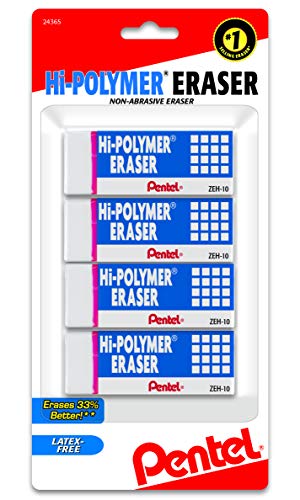
Drawing requires two different types of eraser, not one. A hard plastic eraser lifts graphite cleanly for corrections and hard edges. A kneaded eraser is soft and pliable: squeeze it to shape, dab or drag to lighten values, lift highlights, and blend without tearing the paper. Both live on your desk at the same time. Beginners typically buy one kind and spend months wondering why erasing is so difficult.
Best starter
Pentel
Hi-Polymer Block Eraser, Large, White, Pack of 4
$3.99 as of Jun 22, 2026
★★★★★Our rating· In Stock
The Pentel Hi-Polymer is the eraser that professional illustrators and design students reach for first. It erases graphite completely without smearing, doesn't leave colored residue, and doesn't damage paper surface. The large size gives you control over edge sharpness. Work the corner for precise lines, use the face for broad lifting. Around $5 for a 4-pack.
What we like
Lifts graphite completely without smearing or leaving colored residue
Large size: use the corner for precise edges, the face for broad lifting
What to know
Keep unused erasers sealed; exposed ones oxidize and lose effectiveness
The kneaded eraser does things a plastic eraser can't: lighten a shadow by half a stop without fully lifting it, lift a highlight by dabbing (not dragging), and blend a hard pencil mark into the paper tone. Mold it into any shape you need: a point for highlights, a flat edge for broad lightening. Essential for any drawing with tonal gradients. Under $6 for a 3-pack.
What we like
Molds into any shape for targeted lightening, highlights, and blending
Won't tear paper surface the way a hard eraser can on soft pencil marks
What to know
Needs regular cleaning: stretch and fold until fresh, or it stops erasing
Two things that separate a drawing that looks labored from one that looks confident: a proper point and smooth tonal transitions. Drawing pencils need a long, exposed graphite tip, not the blunt cone a standard office sharpener makes, letting you work with the side of the tip for broad strokes and the point for details. Blending stumps let you push graphite around on paper to build gradients that no amount of back-and-forth hatching can replicate.
Best starter
KUM
AS2M Long Point Pencil Sharpener
$7.95 as of Jun 22, 2026
★★★★★Our rating· In Stock
The KUM AS2M is the sharpener artists use. Two holes work in sequence: the first sharpens the wood casing to expose a longer graphite shaft; the second sharpens just the graphite tip to a fine point. The result is a long, strong point that gives you broad-stroke control with the shaft and precision with the tip. Around $8, comes with two replacement blades. Lasts years.
What we like
Two-stage system creates a long shaft for broad strokes plus a fine point
Compact, pocket-sized, lasts years with the included replacement blades
What to know
Use hole 1 before hole 2; reversing the order snaps the exposed lead
Blending stumps are tightly wound paper cylinders that smear and blend graphite on the page, the tool for building smooth gradients, softening hard edges, and pushing shadows into even mid-tones. The set of four sizes handles everything from large sky-gradient blending to fine detail work. Around $9. Once a stump is loaded with graphite, use it to build soft shadow areas without adding pencil.
What we like
Four sizes handle wide gradient blending down to fine detail work
A graphite-loaded stump deposits tone, useful for building shadows fast
What to know
Keep light-area stumps clean; a loaded stump darkens instead of blends
Pencil drawing has a shorter ramp than most people expect. You don't need to learn to 'draw from nothing': you need to learn to see. The skills that unlock everything else are observation and mark-making, and both improve fast with regular practice. Here's what your first weeks actually look like.
Most people who decide they can’t draw made that decision after a handful of disappointing attempts and concluded something permanent from it. What they actually learned is that drawing is a skill (not a gift) and that skills require repetition, not just effort.
The thing that makes pencil drawing different from most skills is that the obstacle is mostly perceptual, not physical. Your hand will do what your eye tells it to. The problem is that your eye is being overridden by your brain’s strong, wrong opinions about what things look like. The work of learning to draw is the work of learning to actually look.
The first exercise: a value scale
Before you draw anything representational, do this.
Draw a row of nine rectangles, about an inch wide and half an inch tall each. The first box gets the lightest mark you can make: barely touching the paper with a 2H or HB pencil. The last box gets the darkest mark you can produce: heavy pressure with a 4B or 6B, going over it multiple times. The seven boxes between them should form a smooth gradient from light to dark, each step noticeably darker than the one before.
This exercise teaches two things simultaneously: how your pencil grades map to tonal values, and what it feels like to vary pressure deliberately. Most beginners use one pressure level without knowing it. The value scale forces intentional variation.
Redo this exercise at the start of every session for your first two weeks. It takes four minutes and every time you do it you’re reinforcing the most fundamental skill in drawing.
Pick a simple object: your non-dominant hand, a sneaker, a crumpled piece of paper. Set it in front of you.
Now look at the object. Put your pencil on the paper and start drawing the outline, with one rule: do not look at your paper. Keep your eyes on the object the entire time. Move your pencil as your eye traces slowly around the edge of every curve and bump.
The result will look like a child’s scribble, or possibly a surrealist nightmare. That’s correct.
What blind contour is teaching your hand is to respond to what the eye is actually seeing rather than what the brain is supplying as a shorthand. When you draw a hand from memory, your brain provides a symbol: a palm rectangle with five fingers, roughly evenly spaced, roughly even in length. That symbol is wrong. Every real hand has different proportions, different finger widths, different knuckle placements. Blind contour forces contact with the real thing.
Do this five times with the same object. Then do a regular drawing of the same object: look at it, look at your paper, draw normally. The regular drawing that follows a series of blind contours is almost always more accurate than the drawing that comes first.
Learning to see value
The most common failure in beginner drawings is lack of tonal contrast: everything is drawn at the same middle-gray value, and the drawing looks flat and uncertain. Value (lightness to darkness) is what makes objects read as three-dimensional.
The way to fix this is to stop thinking about lines and start thinking about shapes of light and dark.
Pick an object with interesting light: a ceramic mug with a single light source, a crumpled piece of paper, a piece of fruit. Look at it and identify three zones:
Light areas: the face of the object turned toward the light source
Mid-tones: the gradual transition from light to shadow
Shadows: the areas turned away from the light, plus the cast shadow on the surface
Draw the shadows as flat shapes first (blocked in with a 4B or 6B) before you worry about edges or details. Then add mid-tones. Leave the lightest areas as untouched paper (the paper is your brightest white). Details come last, over the value structure.
This light-to-dark approach is the opposite of how most beginners work (outline first, shade after). Building value from the shadow up produces drawings that feel grounded and three-dimensional even when the edges are rough.
Daily practice of 20 minutes outperforms weekly sessions of two hours. Not slightly. Significantly. The neural connections that control fine motor control and observational accuracy build through repetition over time. A daily practice keeps those pathways active; a weekly session lets them go quiet between uses.
What to do in 20 minutes:
Value scale warm-up (3 minutes): the nine-box gradient
One observational drawing (15 minutes): pick one object, draw it
One small note: what did you get right? What would you change if you drew it again?
That’s it. You don’t need a dramatic practice regimen. You need consistency.
The “what would you change” question matters more than it sounds. It turns a passive session into deliberate practice: you’re explicitly identifying what your skill gap is, which means the next session addresses it rather than just repeating the same comfortable moves.
When it starts working
Somewhere between your tenth and twentieth drawing, something shifts. You start to see value shapes before you see lines. You instinctively reach for a softer pencil when you need a darker mark. You look at your hand and see a collection of planes in light rather than a shape you have a symbol for.
That’s the transition from drawing symbols to drawing observations. It doesn’t arrive all at once, and it doesn’t arrive on a schedule. But it does arrive.
When it does, the next phase opens up: perspective, proportion, form construction, figure drawing. Each of those is its own practice loop, with its own exercises and its own moment of clicking. The pencil you’re holding right now is the entry point to all of it.
Save your money
What you don't need yet
Beginners get pressured to buy a lot of stuff that doesn't help them play
better. Here's what we'd skip on day one.
Charcoal (vine or compressed) — Charcoal is looser, messier, and better for gestural figure drawing than careful observational sketching. It's a genuinely different medium with different techniques. Learn to draw in graphite first; charcoal rewards understanding of tonal value that graphite teaches more directly.
A drawing board or easel — Working flat on a table is fine for your first months. A drawing board (clip board-style or angled) becomes useful when you're working large or doing sustained figure drawing sessions. Not needed at a sketchbook scale.
Fixative spray — Fixative (like Krylon or Lascaux) sets graphite so it doesn't smudge on finished drawings. Useful when a drawing is complete and you want to archive it safely. Irrelevant until you have drawings worth archiving.
A lightbox or tracing paper — Lightboxes are for tracing and transferring, legitimate tools but not for learning to draw. The skill you're building is observation and translation from eye to hand. Tracing is a bypass, not a ramp.
Mechanical pencils for drawing — Mechanical pencils (0.5mm, 0.7mm) are useful for precise technical work and note-taking, but the fixed-width mark limits the tonal range and expressive mark-making that traditional drawing pencils give you. Learn the full range of wood-cased pencils first.
Premium sketch paper by the sheet — Individual sheets of Strathmore Bristol, Fabriano, or similar high-end paper are purchased when you have a specific drawing you're committed to making on quality stock. At the learning stage, you want a pad with many pages, not precious individual sheets that discourage experimentation.
First week
Your first seven days
A short, real plan to get from gear-on-doorstep to actually playing.
Do a value scale before drawing anything. Draw a row of nine boxes. Fill box 1 with the lightest mark your softest pencil makes without pressing. Fill box 9 with the darkest mark you can make. Fill the seven boxes between them as an even gradient from light to dark. This single exercise teaches you how your pencil grades map to tonal values, the foundation of everything that follows. · Action
Try blind contour drawing: pick a simple object (a hand, a shoe, a coffee mug). Look only at the object, not your paper, and draw the outline as your eye traces around it. Don't lift the pencil. It will look terrible. That's the point: you're training your eye-hand coordination and breaking the habit of drawing what you think things look like versus what you actually see. · Action
Draw the same object five times in a row. Sphere, coffee mug, a crumpled piece of paper: it doesn't matter. Drawing something once is guessing; drawing it five consecutive times forces you to look harder and notice what you got wrong. The fifth drawing in a series is almost always better than the first. · Action
Watch Proko's 'How to Draw: Fundamentals' and Will Kemp's value and shading videos. Both are free on YouTube and cover the same material you'd get in a first-semester drawing class. · Learn
Proko: Drawing Fundamentals · The clearest drawing fundamentals instruction on YouTube. Start with his gesture drawing and structure series.
r/learnart · Active community with a resource wiki and regular critique threads. Good for honest feedback on your work.
Draw for 20 minutes every day rather than two hours on weekends. Frequency of practice matters more than duration; the neural pathways that control mark-making build through repetition over time, not marathon sessions. Open the sketchbook daily. Draw anything. · Action
FAQ
Common questions
What grade pencil should I start with?
Start with HB or B for your first lines; it's roughly equivalent to a #2, dark enough to see clearly, light enough to correct. For shading, reach for 2B and 4B. For deep shadows, 6B. For light guidelines and construction, 2H or 4H. The key is developing the habit of grade selection: don't draw everything in one grade.
Should I draw from photos or real life?
Real life when possible, photos when necessary. Drawing from life trains you to observe three-dimensional space, light direction, and surface texture in ways a flat photo compresses. Photos are convenient for complex subjects you can't pose indefinitely (people, animals) and for building a reference library. Both are legitimate; real life is better for skill building.
What should I draw first?
Simple objects with interesting shapes: a crumpled piece of paper, a sneaker, a ceramic mug, your own hand. These give you real light and shadow to observe, hold still indefinitely, and are complex enough to be challenging without being overwhelming. Avoid portraits until you can draw basic forms confidently; the face is hard to draw badly without noticing.
How do I get better at shading?
Three techniques to learn in order: hatching (parallel lines that imply tone through density), cross-hatching (two directions of hatching that build richer tone), and blending (using a stump to push graphite into smooth gradients). The key is working from light to dark, always. You can add graphite; you can't easily remove it. Build your darkest shadows last.
How long before I'm any good?
Most beginners who draw daily notice significant improvement within 30-60 days. 'Good' is a moving target; you'll improve faster than you think early on, and the curve flattens as the challenges get more subtle. The honest answer: if you draw for 20 minutes a day and study deliberately, you'll be drawing things you're proud of in two to three months.
Do I need to take a class?
Not necessarily. YouTube (Proko, Ctrl+Paint, Will Kemp) provides the equivalent of first-year drawing instruction for free. A structured class (community college, atelier, or online school like Watts Atelier) accelerates learning through feedback, which YouTube can't provide. If you can get critique on your work regularly, a class is worth it. If not, the free resources cover the fundamentals.
Proko (YouTube) — The most widely recommended free drawing instruction channel. His figure drawing, gesture, and anatomy series are the gold standard; his fundamentals playlist is the right starting point for beginners.
Ctrl+Paint — Free library of drawing and digital painting fundamentals. The 'Traditional Art Bootcamp' section covers value, form, and line, the same foundations that apply to pencil drawing.
Will Kemp Art School — Methodical free instruction on pencil drawing basics, especially good on value and shading. Written tutorials backed by video, well-structured for beginners working through techniques sequentially.
r/learnart — Active community with a resource wiki, regular skill-building threads, and critique posts. Post your work here for honest feedback; the community is constructive and good at diagnosing specific weaknesses.
Watts Atelier (Online) — Professional-level structured art instruction: figure drawing, anatomy, composition. Paid subscription, but the most rigorous systematic drawing curriculum available online. Worth it when you've outgrown the free resources.
As an Amazon Associate, JustBeginning earns from qualifying purchases.
We may also earn commission from other affiliate programs linked on this
page. Editorial recommendations are independent; we don't choose
products based on commission rates.
Product prices and availability are accurate as of the date and time
indicated and are subject to change. Any price and availability
information shown on Amazon at the time of purchase will apply.
Our top pickStaedtler Mars Lumograph Drawing Pencil Set, 12 Grades


 Best starter