Pour-over has a reputation for being precious — small ceramic cones, careful pours, grams instead of scoops. Most of that reputation is unearned. Here's what you actually need, where the one real expense is (the grinder), and the long list of things you'll be told to buy that you genuinely don't need.
By Colin B. · Published May 8, 2026 · Last reviewed July 14, 2026
The wide range is almost entirely the grinder. A hand grinder keeps you under $150; a Baratza pushes the kit to $330. Both make good coffee.
We earn commission on qualifying Amazon purchases — see our
affiliate disclosure.
Price tiers and budget totals shown above are editorial estimates;
actual Amazon prices vary.
At a glance
Our top pick in each category
The fastest path through this guide — each best-starter pick by category.
Scroll for the budget and upgrade alternatives.
The grinder is the most important purchase in this entire setup. A $10 plastic V60 with a good burr grinder makes better coffee than a $200 Chemex with a blade grinder. Blade grinders chop beans unevenly — uneven grounds extract unevenly, and uneven extraction tastes bitter and muddy. If you're going to spend money anywhere, spend it on the grinder.
You need a gooseneck kettle. Not because pour-over is fussy, but because a regular kettle pours too fast and too chaotically to control. The technique is about where the water lands and how slowly you pour. A gooseneck is what makes that possible. This is non-negotiable if you want your coffee to taste like pour-over and not like drip.
Buy whole beans and grind immediately before brewing. Pre-ground coffee loses most of its aromatic complexity within 30 minutes of grinding. Pour-over is a gentle extraction method that depends on fresh, consistently ground coffee — it has less margin for error than a drip machine, which compensates with pressure and volume.
The dripper holds the filter and coffee and sits over your cup or server. The three names you'll keep seeing are the Hario V60 (cone, single hole, requires controlled pour), the Kalita Wave (flat-bottom, three small holes, more forgiving), and the Chemex (hourglass glass carafe, thicker filters, cleaner cup). For beginners, start with the V60 — not because it's the easiest, but because the entire pour-over community teaches with it. Every tutorial, every recipe, every troubleshooting thread is written for the V60. Learn on what there's the most help for.
Dripper — what's the difference?
A few common shapes, each making a different trade.
Hario V60
Conical dripper, single large hole. The community standard.
Shape
Cone
Hole
Single spiral opening
Filter type
V60 cone papers
Skill curve
Medium — pour speed and placement matter
Best for First-time pour-over brewers who want to tap into the largest community of tutorials and recipes
Tradeoff Less forgiving than the Kalita — inconsistent pouring shows up in the cup
The canonical pour-over dripper. More recipes, videos, and troubleshooting threads are written for this exact piece than for any other. The ceramic version holds heat better than plastic — useful when you're pouring room-temperature-to-boiling water through it repeatedly. About $25. It will last decades.
What we like
More tutorials written for this than any other dripper — community backs you up
Ceramic holds heat better than plastic for consistent brew temps
About $25 and will outlast every other piece of gear you own
What to know
Pour speed and placement matter — less forgiving than the Kalita Wave
Brews identically to the ceramic. The V60's performance comes from the spiral ridges, cone geometry, and filter paper — not from what the cone itself is made of. If you want to spend $10 to try pour-over before committing to the full kit, start here.
What we like
Brews identically to the ceramic — spiral ridges do the work, not the material
About $10 — cheapest way to try pour-over before committing to the full kit
What to know
Loses heat faster; rinsing with hot water before each brew is more critical here
A completely different experience than the V60. Chemex's thick proprietary filters remove most of the oils that give V60 its texture, producing a clean, bright, almost tea-like cup. The glass hourglass carafe looks like a design museum piece. The right choice if you're making coffee for two or three people at once and want something that looks good doing it.
What we like
Thick filters remove oils for a clean, bright, almost tea-like cup
Brews 2-4 cups at once — the right choice for making coffee for company
Iconic design that looks as good on the counter as it performs
What to know
Proprietary filters and different recipes — V60 technique doesn't transfer
This is where the money goes, and where people make the biggest mistake. A blade grinder — the spinning-blade type that looks like a tiny food processor — chops beans unevenly, producing a mix of fine powder and large chunks. Pour hot water through that and you get over-extracted bitter coffee from the fines and under-extracted sour coffee from the chunks, simultaneously. A burr grinder crushes beans between two abrasive surfaces set to a precise gap, producing consistently sized grounds. Consistent grounds extract evenly. Buy a burr grinder; skip anything with a spinning blade.
Best starter
Baratza
Encore ESP Coffee Grinder
$199.95 as of Jun 22, 2026
★★★★★Our rating· Only 12 left in stock - order soon.
The entry-level electric burr grinder the pour-over community has recommended for over a decade, now updated with more grind settings. Push a button, wait 20 seconds, have consistent grounds. Baratza's customer service and repair support are exceptional — they sell replacement parts and will help you fix the grinder rather than replace it. Around $180.
What we like
One-push consistent burr grinding in about 20 seconds
Baratza sells replacement parts and helps you fix, not replace
The grinder the pour-over community has trusted for over a decade
What to know
Around $180 — most of your starter budget, but the right place to spend it
A hand grinder with burr quality that shouldn't exist at this price. Grind consistency approaches electric grinders costing three times more. The downside is physical: 25g of beans takes about 90 seconds of cranking. Quiet, portable, no electricity, under $60. The right buy if you're not ready to spend $180 on a Baratza but refuse to use a blade grinder.
What we like
Burr consistency approaching electric grinders that cost three times more
Under $60, quiet, portable, and needs no electricity
What to know
25g of beans takes about 90 seconds of hand cranking — tedious for large batches
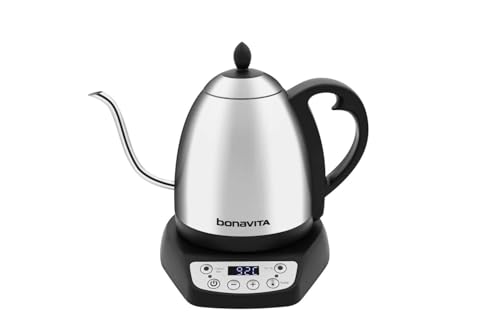
A gooseneck kettle is required. A regular kettle pours too fast and too wide — you can't control where the water lands or slow it to a steady stream over the grounds. Pour-over technique is built around precise, controlled pouring: starting at the center, spiraling outward, pausing, resuming. The gooseneck's narrow curved spout is what makes that possible. Temperature control is a strong secondary feature — 200-205°F for light and medium roasts, 190-195°F for dark — but an instant-read thermometer covers you if budget is tight.
Best starter
Bonavita
1L Digital Variable Temperature Gooseneck Kettle
$99.99 as of Jun 22, 2026
★★★★★Our rating· In Stock
Six preset temperatures, 1-degree precision, 1200 watts heats to temp in about 3 minutes. The gooseneck is genuinely narrow and pour-controllable. Solid, unsexy, and around $60. Most people brewing pour-over at home don't need anything more than this.
What we like
Six preset temps with 1-degree precision — heats to target in about 3 minutes
Genuinely narrow gooseneck spout for real pour control
Around $60 — solid and all you need for daily pour-over
What to know
Hold function can run a few degrees warm; verify once with a thermometer
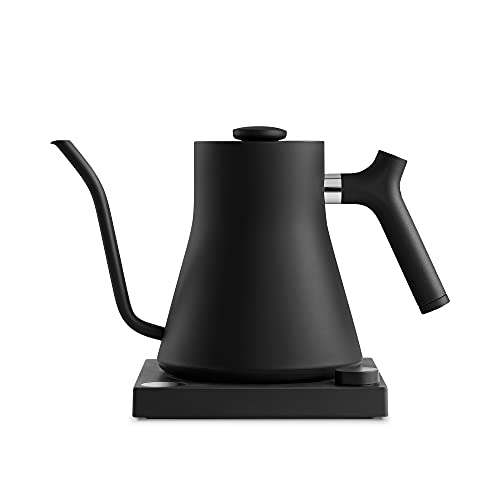
The object you leave on the counter because you want to look at it. Temperature accurate to ±1°F, holds for 60 minutes, has a built-in countdown timer. The spout pours beautifully. Worth it once pour-over becomes a daily ritual and you want gear that reflects that. Around $165.
What we like
Temperature accurate to ±1°F with a built-in countdown timer
Spout pours beautifully — the object you leave out because it looks right
What to know
Around $165 — worth it when pour-over is a daily ritual, not for beginners
You brew pour-over by weight, not by scoops. The standard ratio is 60g of coffee per 1 liter of water — about 1g per 15-16g of water for a single cup. Scoops introduce too much variability: grounds pack differently depending on roast level, grind size, and humidity. A scale also lets you track your pour speed in real time, which is how you build consistency. If you already own a kitchen scale, use it and just time on your phone. A built-in timer is the upgrade that makes it genuinely convenient.
Best starter
OXO
Brew 6 lb Precision Coffee Scale with Timer
$56.00 as of Jun 22, 2026
★★★★★Our rating
Built specifically for pour-over — 0.1g resolution, 6-lb capacity, and a built-in timer button you can hit without picking up your phone with wet hands. Display is large and easy to read in a kitchen. Around $55. If you already own any kitchen scale, use that for now and skip this.
What we like
Built for pour-over: 0.1g resolution and a built-in timer in one device
Large, easy-to-read display that works well in a kitchen
What to know
Aggressive auto-off can interrupt a long bloom; tap the scale to keep it awake
If you already have a kitchen scale, use it. If you need to buy one and don't want to spend $55 on a coffee-specific scale, this is $20 and works fine. Use your phone timer alongside it — the OXO's built-in timer is a convenience, not a necessity.
What we like
About $20 — perfectly functional if you refuse to spend $55 on a coffee scale
0.1g resolution handles pour-over ratios without issue
Paper filters are consumables, not gear — but the right ones matter. If you're brewing with a V60, use Hario's own filters. Generic cone filters are usually cut for a steeper angle and don't seat correctly in the V60's spiral ribs, which slows the drain unpredictably. The natural (unbleached, brown) filters don't require pre-rinsing for flavor. The white (oxygen-bleached) ones are fine too — just rinse them first with hot water to knock out any papery taste before you add your coffee.
Best starter
Hario
V60 Paper Coffee Filters, Size 02, Natural, 100ct
$8.01 as of Jun 22, 2026
★★★★★Our rating· In Stock
The tabbed natural filters seat perfectly in the V60 02 and don't add papery taste without pre-rinsing. A 100-count box lasts two to three months for a daily brewer. Cheap enough to always have a spare box.
What we like
Tab filters seat perfectly in the V60 02 — no papery taste without pre-rinsing
100-count box lasts 2-3 months for a daily brewer; cheap to stock up on
What to know
Size 02 only — won't fit the V60 01 or any other dripper
The white (oxygen-bleached) version produces a marginally cleaner cup than the natural filters. The trade-off: always rinse them with hot water before brewing or the papery taste comes through. Same price as the natural filters. Get these if you find the natural filters impart any off-flavor.
What we like
Produces a marginally cleaner cup than natural filters for sensitive palates
Same price as natural filters — no cost penalty for preferring them
What to know
Must rinse with hot water before every brew or papery taste comes through
Pour-over has a reputation for precision that makes it sound difficult. It's not. The technique is the same three moves repeated: pour slowly, pause, pour again. Here's what actually happens between your first cup and the one that finally tastes exactly right.
The single most important thing to understand before you brew your first cup is that pour-over has two variables that matter and one that almost everyone adjusts first by mistake.
The two that matter: grind size and ratio (coffee to water). The one people adjust first: pour speed. Pour speed does matter eventually, but it’s the third thing — and changing it before you’ve dialed in your grind and ratio produces confusing, unrepeatable results. Start with the basics. Get two numbers right. Then refine.
Here’s what your first week actually looks like.
Before your first brew: two numbers
Your ratio is 1g of coffee per 15-16g of water. For a standard single cup (around 250ml), that’s 15-17g of coffee. Start with 16g to 240g of water. Use a scale. Scooping introduces enough variability to make calibration impossible.
Your grind setting is medium-fine — coarser than espresso, finer than drip. If you have a Baratza Encore ESP, start at setting 18. If you have a Timemore C3 hand grinder, start at 22 clicks from zero. If you’re on a different grinder, find the middle of its range and move from there.
Water temperature: 200-205°F for a medium roast. Bring water to a full boil, then let it sit for 60 seconds. That’s close enough for your first week without a temperature-controlled kettle.
Write these numbers down before you start. You’ll want to compare them to what you use on day five.
Here’s the most important instruction for your first brew: follow one recipe and don’t improvise.
James Hoffmann’s V60 technique video (linked in the gear guide) is the one to start with — 20 million views, works as described. The skeleton is simple:
Put the filter in the dripper. Rinse it with hot water to remove papery taste and pre-heat the cone. Discard the rinse water.
Add your ground coffee. Set the dripper on your cup or server. Tare your scale to zero.
Start a timer. Pour twice the weight of your coffee in water over the grounds — with 16g of coffee, that’s 32g of water. This is the bloom. Pour slowly into the center, letting the water saturate the grounds without washing them down the sides.
Wait 45 seconds. Watch the coffee puff up and bubble. Fresh beans bloom dramatically; a bag roasted three months ago barely moves. Both will brew.
Resume pouring slowly in a spiral from center outward, pausing every 40-50g. Total target: 240g of water.
Total time from first pour to empty dripper: 3-4 minutes. That’s your target.
Drink the cup. Notice what it tastes like. Don’t judge it against anything yet — just notice.
What your first cup is telling you
Pour-over coffee gives clear diagnostic feedback once you know what to listen for. The two main failure modes point to opposite fixes.
Tastes sour, sharp, or thin — the coffee is under-extracted. Grind finer. Finer grounds give water more surface area and slow the drain, which means more contact time and fuller extraction. Start by moving your grinder one or two notches finer.
Tastes bitter, harsh, or hollow — the coffee is over-extracted. Grind coarser. Coarser grounds drain faster, reducing the contact time that pulls out the unpleasant compounds.
Tastes weak or watery — your ratio is off, not your grind. Add more coffee (try 18g to the same 240g water) before you touch the grind.
Brew time under 2:30 — grind is too coarse regardless of taste. The water moved through too fast.
Brew time over 4:30 — grind is too fine. The dripper choked.
The rule that makes this useful: change one variable between brews. Move the grind setting. Taste. Move it again if needed. Don’t change the grind and the ratio on the same brew — you won’t know which one mattered.
Brews 2–5: Finding your grind
By your second or third brew, you’ve moved your grind once based on taste and you have a direction. Now the practice is converging on a setting and learning to repeat the same brew consistently.
Two things you’ll notice in this stretch:
The bloom changes with freshness. Beans roasted last week bloom with so much CO2 they’ll puff up and overflow the filter if you pour too aggressively. Beans roasted five weeks ago barely bubble. The 45-second wait is correct for both; the bloom’s job is to let CO2 escape before your main pour, not to hit a visual cue.
Pour speed matters more than it looks. Pouring too quickly churns the coffee bed and creates channels — paths the water preferentially follows rather than distributing evenly through all the grounds. Pouring in a slow, steady spiral from center to edge, never directly down the filter walls, is the technique. You’ll feel when you’ve got the rhythm before you can articulate why it works.
By brew four or five, you’ll have a grind setting that produces a cup tasting neither sour nor bitter, a pour rhythm that feels natural, and a ratio you like. Write all three down — grind setting, coffee weight, water weight, brew time. That’s your recipe.
The trap at this point is wanting to change things: try a different bean, adjust the temperature, switch to a Chemex. Resist it for now. Brew the same beans with your dialed-in recipe ten times before changing anything.
Here’s why this matters: specialty coffee beans vary enormously in how they respond to extraction. A fruity Ethiopian light roast and a chocolatey Guatemalan medium roast want different grind settings, different temperatures, and slightly different ratios. If you change beans before you’ve built a baseline with one bag, you’ll spend another week calibrating from scratch and won’t know whether the change in flavor came from the beans or your technique.
Brew the same bag to completion. Taste it on day one versus day ten — you’ll notice how the coffee changes as the CO2 dissipates and the aromatics soften. On your last cup, you’ll have a genuine baseline for comparison when you open the next bag.
When it clicks
Somewhere around brew eight or ten, the routine stops feeling like a procedure and starts feeling like a morning. You stop checking the recipe. The bloom timing is intuitive. The pour speed is automatic. The cup tastes like something you’d order out.
That’s the threshold: not from bad coffee to good coffee (your first brew was probably fine), but from following instructions to understanding what you’re doing. At that point, changing beans, adjusting temperature, or trying a Chemex becomes genuinely interesting rather than more variables to manage on top of the ones you haven’t solved yet.
The pour-over community’s obsession with precision can make the hobby look intimidating from the outside. Inside it, the precision is just how you figure out what you like — and then repeat it on purpose.
Save your money
What you don't need yet
Beginners get pressured to buy a lot of stuff that doesn't help them play
better. Here's what we'd skip on day one.
Specialty water or a water filter — Filtered tap water is fine for your first 50 brews. If your tap water tastes fine to drink, it'll make fine pour-over. Mineral content optimization is a variable for much later — after you've dialed in grind and ratio.
A coffee refractometer — Used to measure extraction yield by percentage. A legitimate tool for serious home brewers. Also costs $100+ and requires understanding your baseline before the number means anything.
An airtight canister with a CO2 valve — Useful once you're buying beans in bulk. For the first few months, buy less coffee more often — a 250g bag used in two weeks doesn't need special storage.
A coffee subscription — Great eventually. Not yet. Spend your first few weeks buying single bags from a local roaster so you can taste the same beans repeatedly and learn what a well-extracted cup from that specific coffee should taste like. Constant variety is a distraction when you're still learning to dial in.
A separate server or carafe — You can brew directly into your mug. A server is useful for Chemex or large V60 batches, but unnecessary for a single cup.
Multiple drippers — Own one dripper, learn it completely, then consider another. Switching between a V60 and a Kalita Wave before you understand either one just resets your calibration.
First week
Your first seven days
A short, real plan to get from gear-on-doorstep to actually playing.
Rinse your paper filter before every brew — pour hot water through it, let it drain into the sink, discard. This removes papery taste and pre-heats the dripper so it doesn't steal temperature from your brew. · Action
Start with 16g of coffee and 240g of water. That's a 1:15 ratio — the standard starting point. Weigh both. Don't scoop. · Action
Follow James Hoffmann's V60 technique for your first ten brews. Don't improvise. His 20-million-view YouTube tutorial is the de facto beginner reference — the bloom timing, the pour pattern, the target brew time. · Learn
Taste your first cup deliberately. Sour or sharp? Grind finer. Bitter or harsh? Grind coarser. Weak or watery? Add more coffee, not less water. Change one variable between brews. · Action
Brew the same recipe every day for five days before changing anything. By day five you'll have muscle memory for the bloom timing and pour speed, and a reliable baseline to compare against. · Action
FAQ
Common questions
How much does it cost to start brewing pour-over coffee?
The minimum effective setup is around $133: a Timemore C3 hand grinder ($55), a Bonavita gooseneck kettle ($60), a V60 plastic dripper ($10), and filters ($8). If you already have a kitchen scale, you're done. Add a Baratza Encore ESP and an OXO scale and you're at around $330 — that's the typical kit for someone committed to pour-over as a daily practice.
Do I really need a burr grinder? My blade grinder seems fine.
Yes. Here's the honest version: blade grinders feel fine when you're using a drip machine, which compensates for uneven grounds with heat, pressure, and volume. Pour-over strips those compensations away. A blade-ground cup through a V60 tastes noticeably muddy and bitter once you've had a burr-ground cup from the same beans.
What coffee should I buy for pour-over?
A medium roast, whole bean, roasted within the past 3-4 weeks. Light roasts are more complex but less forgiving — their brightness reads as sourness if your extraction is slightly off. Dark roasts tend toward bitterness at the temperatures pour-over uses. Medium is the best place to calibrate. Any local roaster works; Counter Culture, Intelligentsia, Onyx, and Blue Bottle are solid online options.
What water temperature should I use?
200-205°F for most medium roasts — just off a full boil. Light roasts can handle full boiling water (212°F); dark roasts extract more cleanly at 190-195°F. Without a temperature-controlled kettle, bring water to a full boil and let it sit for 60 seconds — that's close enough to 200°F to start.
How long should a pour-over take?
Total brew time from first pour to last drop should be 3-4 minutes for a V60 at standard grind. Under 2:30 means your grind is too coarse — water is running through too fast. Over 4:30 means your grind is too fine — water is choking and over-extracting. Brew time is your most reliable diagnostic tool.
What is a bloom and do I need to do it?
The bloom is a small initial pour of hot water — about twice the weight of your coffee — followed by a 30-45 second pause. CO2 trapped in fresh coffee degasses during that pause; if you skip it and just pour everything at once, the CO2 creates uneven channels through the grounds and extraction suffers. Yes, you need to do it. It takes 45 seconds. Fresh beans bloom dramatically with visible bubbling; older beans barely move at all.
James Hoffmann (YouTube) — The clearest, most scientifically grounded coffee channel on the internet. His V60 technique video is the de facto beginner reference. His grinder comparison videos will save you money.
r/Coffee — Active, knowledgeable community. The wiki is good. Search before posting — most beginner questions have detailed answers already.
Barista Hustle — Professional-level coffee education, free. Articles on extraction theory, brewing ratios, and sensory training. More technical than you need immediately, invaluable once you're past the basics.
Counter Culture Coffee — Learn — One of the best specialty roasters in the US also publishes detailed brewing guides. The V60 and Chemex recipes are clean and well-tested — a good second opinion after Hoffmann.
Sweet Maria's — Primarily a green bean retailer for home roasters, but their library section has thorough equipment and brewing guides. Opinionated and useful.
As an Amazon Associate, JustBeginning earns from qualifying purchases.
We may also earn commission from other affiliate programs linked on this
page. Editorial recommendations are independent; we don't choose
products based on commission rates.
Product prices and availability are accurate as of the date and time
indicated and are subject to change. Any price and availability
information shown on Amazon at the time of purchase will apply.
Our top pickHario V60 Ceramic Coffee Dripper, Size 02


 Best starter