Paramotoring is the most accessible form of powered flight. Strap an engine to your back, run across a flat field, and you're airborne. No airport, no runway, no pilot's license required in the US. The entry cost is steep, the learning curve is real, but once you're in the air you'll understand exactly why people organize their whole lives around this sport.
By Colin B. · Published June 7, 2026 · Last reviewed June 7, 2026
Garmin inReach Mini 2
— Garmin inReach Mini 2: satellite SOS from anywhere. The safety device every solo pilot should carry.
Yaesu FT-70DR Handheld Radio
— Yaesu FT-70DR handheld radio: stay in contact with your instructor during training and in the air.
Budget total
$5000
Typical total
$8000
Budget $5,000-$8,000 for a full beginner setup: a used EN-A wing plus a new entry-level paramotor. Add $1,500-$2,500 for a certified instructor course. There is no cheap way in, and cutting corners on safety gear is a bad trade.
We earn commission on qualifying Amazon purchases — see our
affiliate disclosure.
Price tiers and budget totals shown above are editorial estimates;
actual Amazon prices vary.
At a glance
Our top pick in each category
The fastest path through this guide — each best-starter pick by category.
Scroll for the budget and upgrade alternatives.
Book a certified instructor course before buying anything. A qualified PPG instructor will assess your weight, strength, and local flying conditions and tell you exactly which wing size and motor thrust you need. Buy before training and you risk buying wrong. The USPPA lists certified instructors at usppa.com.
Your wing is a dealer-only purchase, not Amazon, not eBay. EN-A certified paramotor wings must be sized to your all-up weight (you plus motor plus gear). Have your instructor choose the model and size. A used wing in good condition from a reputable PPG dealer costs $800-$1,500 and is the right call for year one.
The motor can and should be new if your budget allows. Unlike a wing, an engine is something you want full service history on, fresh gaskets, and no mystery repairs. New entry-level paramotors from established brands run $4,500-$6,500 and come with a warranty.
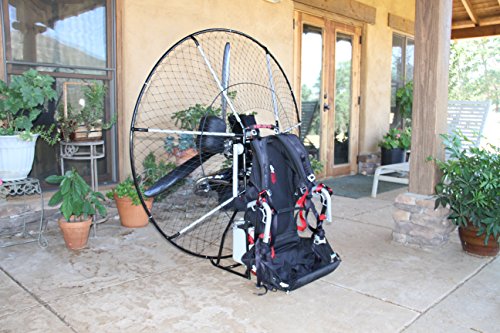
The paramotor is the engine-and-frame unit you strap to your back. It's the most expensive piece of gear and the one that stays with you longest. Foot-launch paramotors (where you run to take off) are where most beginners start. They weigh 55-80 lbs, are carried on a harness, and produce roughly 130-200 lbs of thrust. Engine reliability and US dealer support matter most when choosing a brand. If a part breaks mid-season, you want someone stateside who can ship next day.
Paramotors — what's the difference?
A few common shapes, each making a different trade.
Foot-Launch
You run to take off wearing the motor. The standard starting point.
Weight
55-80 lbs
Takeoff run
10-20 feet
Launch site
Any flat field
Best for Most beginner pilots; flexible takeoff from any open area
Tradeoff Physically demanding launch; requires running under full load
Trike / Quad
Wheeled cart carries motor; you taxi to take off instead of running.
Weight
80-130 lbs total
Takeoff
Roll on wheels
Launch site
Longer runway needed
Best for Pilots with physical limitations or those who want relaxed launches
Tradeoff Needs longer, clearer runways; heavier to transport
Best starter
BlackHawk
125 Powered Paraglider PPG
$$$$
★★★★★Our rating
BlackHawk is one of the few paramotor brands with consistent US distribution, and the 125 is their practical entry unit. The Kestrel frame fits most pilots comfortably, the engine is proven for reliability, and BlackHawk's domestic parts availability means a broken piece doesn't strand you for weeks. A sensible first buy if you want to avoid import logistics.
What we like
US-based distribution means domestic parts and service without import waits
Kestrel frame is proven comfortable for 2-3 hour cross-country sessions
125cc engine provides reliable thrust for pilots up to roughly 220 lbs
What to know
Lead times stretch 4-8 weeks; order before booking your training course
Heavier than some European competitors; check that weight suits your build
The BH90 uses a smaller 90cc engine in the same Kestrel frame, making it the right fit for lighter pilots or anyone who wants a more compact setup. Less raw thrust than the 125, but for pilots under 170 lbs flying in calm conditions the weight savings on the motor unit are meaningful. Same domestic parts network as the 125.
What we like
Lighter motor unit reduces the physical load at launch significantly
Compact Kestrel 90 frame works well for lighter-framed pilots
Same US distribution and parts support as the larger BlackHawk lineup
What to know
90cc engine limits thrust; not for pilots over 170 lbs or high-altitude sites
Less power headroom for launching in marginal wind or carrying extra gear
BlackHawk bundles their paramotor with a matched paraglider wing, one of the few ways to buy both together from a single US source. You get compatible components, one support contact, and domestic parts availability. The tradeoff: the bundled wing may not be the EN-A model your instructor would choose for your weight and local site. Confirm wing specs with your instructor before ordering.
What we like
One purchase covers motor plus wing; simplifies the buying process significantly
Matched components from a single US source means simpler support
Package pricing is often better than buying motor and wing separately
What to know
Bundled wing may not be the EN-A your instructor would choose for you
Confirm wing size and rating with your instructor before ordering
A trainer kite is the best investment you can make before your first paramotoring lesson. Spend five to ten hours with a 2-3 meter power kite in an open field, and you'll arrive at training already understanding what an inflating canopy feels like, how to control it overhead, and how to recover from gusts. Your instructor teaches these skills on day one regardless, but arriving with them already wired compresses the first week significantly. HQ Kites makes the most widely used trainer kites in the PPG community.
Best starter
HQ Kites
HQ Rush IV 300 Power Kite
$$
★★★★★Our rating
The 3-meter Rush IV is the sweet spot for PPG ground-handling practice. Large enough to generate meaningful pull and teach you real canopy management, small enough to fly in a neighborhood park. HQ's Rush line is what most paramotor instructors point to when students ask what to buy before showing up.
What we like
3m is the instructor-recommended size for realistic PPG canopy practice
Rush IV's predictable inflation matches behavior of real motor wings
HQ is the most widely recommended trainer kite brand in the PPG community
What to know
Generates real pull in strong wind; stay in lighter conditions at first
Control bar setup is different from real wing brake toggles; transition takes adjustment
The 2-meter Rush is smaller and more forgiving than the 300, making it a good first kite if you've never handled a power kite before or if you have limited open space. Less pull means more margin for error while you build the basic muscle memory. Move up to a 3m kite once the control inputs feel natural.
What we like
Smaller and more forgiving than 3m kites; lower consequence for mistakes
Works in smaller parks and lower wind speeds than larger training kites
What to know
Less realistic PPG practice than a 3m kite; the pull is too light
You'll want to step up to the 300 once you have the basics down
The 3.5-meter Rush V Pro is the largest trainer kite most solo pilots can comfortably handle, and the bundle includes an instructional DVD that covers paramotoring-relevant kite skills in sequence. For anyone who wants to do serious pre-training practice, this bundle gets you to your first instruction day better prepared than most students.
What we like
3.5m generates the most realistic paramotor-level canopy feedback available
Instructional DVD included covers kite skills relevant to PPG ground handling
What to know
Generates significant pull in moderate wind; requires caution at first
Larger footprint needs more open space to safely fly and land
You need a full-face helmet for paramotoring. Not a bicycle helmet. Not an open-face motorcycle helmet. Full-face protection matters because you're flying close to the ground at 25-35 mph and a propeller strike or hard landing can reach your face. The helmet also protects your ears from hours of engine noise and wind. Buy one before your first training session. The helmets below are EN966 certified (the aviation sports standard) and purpose-built for paragliding and paramotoring.
Best starter
Generic (EN966 Certified)
Paramotor PPG Helmet with Noise-Cancelling Headset Support
$$
★★★★★Our rating
EN966-certified full-face helmet designed specifically for powered paragliding. Kevlar and glass fiber composite shell, EPS impact liner, and integrated connector ports for KENWOOD, YAESU, ICOM, and MOTO radios, which means this helmet is ready for instructor communication on day one of training. Detachable full-face visor and sizes from M to XXL.
What we like
EN966 certified, the aviation sports standard for paragliding helmets
Built-in radio connector ports for YAESU, KENWOOD, ICOM, and MOTO comms
Kevlar-fiberglass composite shell at a price that doesn't sting beginners
What to know
Generic brand with no repair or certification renewal network
Replace after any significant impact; don't reuse a compromised shell
EN966-certified superlight composite shell, detachable full-face shield, built-in noise-cancelling microphone, and a goggle strap holder. At around 820g it's genuinely lightweight for a full-face design. If you want a purpose-built helmet at the lowest credible price, this delivers the safety certification and comfort for a new pilot who isn't yet sure how many hours per year they'll log.
What we like
EN966 certified, lightweight at 820g, and lower cost than the comms version
Detachable full-face shield converts to open-face for ground handling in calm air
What to know
No integrated radio ports; you'll need an external headset adapter
Shield fastening hardware can loosen; check it before each session
Two instruments you need before flying solo: a satellite communicator (two-way SOS from anywhere, no cell coverage required) and a handheld radio (for instructor contact during training). A dedicated variometer (audible climb/descent indicator) is the next addition once you're practicing cross-country flight. The XCTracer Mini III is the variometer most paramotor pilots use, but it's sold through specialty dealers, not Amazon. Buy the two items below first; your instructor will guide you on vario choices during training.
Best starter
Garmin
inReach Mini 2
$249.79 as of Jun 22, 2026
★★★★★Our rating· In Stock
Two-way satellite messaging and SOS from anywhere on Earth with zero cell coverage. For a new pilot flying solo over rural terrain, this is the safety device that actually saves your life if you go down in a field miles from help. At 3.5 oz it clips to your harness and you stop noticing it. Buy it before your first unsupervised flight.
What we like
Two-way satellite SOS from anywhere on Earth, regardless of cell signal
3.5 oz clips to harness; you won't notice it until you really need it
Live GPS tracking lets someone at home follow your flight in real time
What to know
Monthly satellite subscription required ($15-65) for messaging features
Not a variometer; you still need a dedicated vario for climb-rate feedback
During training, your instructor needs to hear you and you need to hear them. Many schools supply radios; many don't. The Yaesu FT-70DR covers the VHF frequencies most PPG schools use, mounts on a harness chest strap, and is a proven brand in aviation radio. A Technician amateur license is required to transmit (one afternoon of free online study).
What we like
Covers VHF/UHF frequencies used by most US PPG schools and instructors
Compact and light; mounts cleanly on harness chest strap during flight
Yaesu is a proven brand in amateur and aviation radio communities
What to know
Requires amateur Technician license to transmit legally; get licensed first
Does not cover aviation VHF band; cannot contact ATC on 123.025 MHz
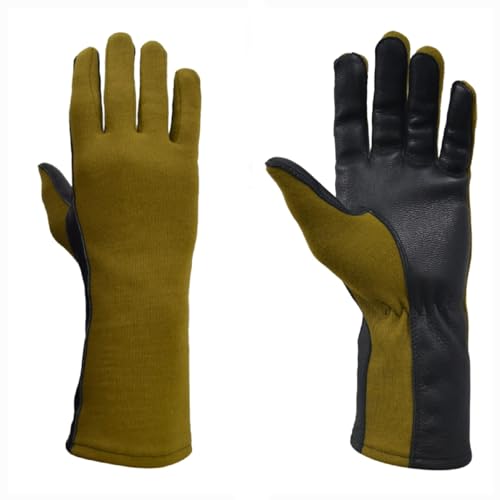
Paramotoring exposes your hands to hours of wind, cold, and vibration. The right gloves protect grip and dexterity without sacrificing tactile feedback on the brake toggles. Nomex, the flame-resistant material used in aviation and motorsports, adds protection in the rare event of an engine fuel issue. Flight gloves should fit snugly without restricting hand movement. Any glove that's too bulky will compromise your ability to feel and respond to brake pressure.
Best starter
SBL
South Beach Leather Nomex Flight Gloves
$$
★★★★★Our rating
Sheepskin leather exterior with Nomex lining, the classic combination for military and civilian flight gloves. The South Beach gloves have been on Amazon since 2017 with consistent reviews from pilots, maintenance crews, and aviation students. Comfortable across a full flight day, available in multiple sizes, and the Nomex lining provides the heat resistance you want near an engine.
What we like
Nomex lining provides fire and heat resistance near paramotoring engine
Sheepskin leather molds to your hands over several flights
Long-standing Amazon listing with consistent pilot and aviation reviews
What to know
Leather stiffens in cold weather; warm them before a cold morning launch
Size snug; a loose glove loses tactile feedback on brake toggles
A slightly more refined aviation glove with a palm-grip design optimized for control input precision. Available in black and olive drab. The leather and Nomex combination is the same as the SBL, but the cut is tighter through the fingers for pilots who want maximum dexterity when managing brake toggles and throttle simultaneously.
What we like
Tighter finger cut maximizes dexterity for brake toggle and throttle inputs
Leather and Nomex construction matches standard aviation pilot glove spec
What to know
Runs small; order a half-size up if between sizes
Less padding than the SBL; better for warm days than cold-morning flights
Paramotoring doesn't start in a store. It starts in a flat field with an instructor and a wing that won't stop trying to fly away. Here's what your first training course actually looks like.
Paramotoring has a reputation for being the simplest form of powered flight to get into, and in some ways that’s true. No airport. No tower clearance. No runway. You launch from a farmer’s field at dawn and you’re airborne. But simple to enter doesn’t mean simple to learn, and the training process has a specific shape that most people don’t know before they show up.
This is what your first certified training course actually looks like, from the first morning on the ground to the day you fly solo.
Days 1-2: The wing is trying to kill you (gently)
Before you ever touch a paramotor engine, you spend your first two days learning to handle the wing. This is called ground handling or kiting, and it’s the single most important skill in paramotoring. The motor is just thrust. The wing is what keeps you alive.
Kiting means controlling the canopy with your hands while you stand on the ground, walking forward and backward as the wind demands, feeling the pressure in the risers, keeping the wing overhead and stable. It sounds simple. It isn’t.
A paraglider canopy wants to do one of two things: fly, or collapse. Your job in the first two days is to develop the physical intuition to keep it in the middle state, overhead and pressurized, responding to your inputs. Most beginners spend these days looking like they’re losing a fight with a parachute. That’s correct. You are.
What you’re building in these days isn’t technique exactly. It’s a kinesthetic vocabulary. A sense of what the wing is telling you through the risers and brake toggles. Your instructor will give you verbal cues, and then stand back and let you figure out how they translate to the thing in your hands.
By the end of day two, you’ll be able to bring the wing up overhead, stabilize it, and walk with it controlled. This feels like nothing. It is, in fact, almost everything.
Days 3-4: Adding the engine
The motor goes on your back for the first time on day three. Nothing else changes. You wear the harness, you feel the weight, you practice ground handling with the full load on your shoulders.
This is where paramotoring gets physical. A foot-launch paramotor weighs 55-75 lbs. Running with that weight on your back while simultaneously controlling a wing overhead is awkward in a way you cannot simulate. The first few attempts at a launch run will feel chaotic. One leg is fighting the weight; the other leg is trying to accelerate; your arms are working the brake toggles; your brain is monitoring the wing overhead and the ground in front of you simultaneously.
The key insight instructors hammer on here: the wing comes up before you run. You inflate the canopy first, let it rise overhead and stabilize, feel it come overhead and forward, and only then do you accelerate into a run. Students who try to run and launch the wing at the same time are doing both badly.
Day four is typically low flights: two, three feet off the ground, hops more than flights, landing immediately after lift. These are not the launch you imagine. They’re confidence reps. You’re building the motor memory for the transition from running to flying so that by your first real flight it doesn’t feel foreign.
Days 5-7: Your first real flights
Somewhere in here, you fly. A real flight, climbing to altitude (typically 300-500 feet), flying a simple circuit, and landing.
The first flight is usually shorter than people expect: five to ten minutes, not an hour in the sky. The instructor wants you in the air, but they also want you to handle the landing while you still have energy and focus. Paramotoring landings are as important as launches, and they’re easier to manage early in the day before fatigue sets in.
What surprises most new pilots on their first real flight is how quiet it is. The engine is behind you and the wind muffles the mechanical noise. The world is very flat from 400 feet, and very large. The fields you drove past on the way to the launch site stretch out into a patchwork. You can see the road you came in on.
The technical challenges in flight are: throttle management (keeping altitude), brake input (steering), and situational awareness (knowing where you are relative to your landing zone). Instructors communicate by radio. Most schools have a second pilot or spotter on the ground watching you.
Days 8-10: Solo flight and what comes next
By the end of a typical ten-day course, you’re flying supervised solos. You’re in the air without the instructor actively coaching every input. You’re managing the wing, the engine, and the airspace yourself, with the instructor watching from the ground.
Solo doesn’t mean independent. You’re still flying within parameters the instructor set: a specific area, a ceiling, specific weather conditions that you and they have agreed are within your competence. The certification you earn from a USPPA course is a starting point, not a destination.
What you’ll leave with:
The ability to inflate and control a wing in moderate winds
The ability to launch, fly a circuit, and land reliably
An understanding of the weather and airspace rules for your flying site
A framework for making go/no-go decisions based on conditions
What you won’t have yet, and shouldn’t pretend to have, is judgment under unusual conditions. That comes from hours and from mentorship by more experienced pilots in your local community.
The right move after your training course is to find local pilots flying your region and join them. The paramotoring community is small and welcoming in a way that bigger sports often aren’t. People know the land, the local weather patterns, and the landowners who’ll let you use their fields. That local knowledge is worth more than any gear upgrade.
What you’ll probably get wrong (and that’s fine)
Every new pilot fails at the same handful of things. Here’s what’s coming:
Overcontrolling the wing on the ground. Beginners yank the brakes when the wing dips to one side instead of making small, early corrections. The wing oscillates, collapses, and lands on your head. The fix is small inputs early, not big inputs late.
Running too early on launch. Students start their run before the wing is overhead and pressurized. Result: the wing pulls backward instead of lifting you. You fall on your face. The fix is waiting a half-beat longer at the start of the run.
Throttle anxiety in flight. New pilots modulate the throttle constantly in flight, bobbing up and down, never settling into trim. Trim speed is your friend. Find it, use it, stop fiddling.
Landing long. Beginners are often too high on final approach and overshoot the intended landing zone. Conservative approach angles early. Learn to read your height above ground relative to your target.
None of these mistakes are character flaws. They’re the specific failures of someone building a new kinesthetic skill. Your instructor has seen all of them hundreds of times and is not judging you for any of them.
Save your money
What you don't need yet
Beginners get pressured to buy a lot of stuff that doesn't help them play
better. Here's what we'd skip on day one.
A trike or wheeled buggy — Learn foot-launch first. Trikes limit where you can fly and add thousands to your startup cost.
An electric paramotor — Current models offer 20-40 minutes of flight. Gas gives you 3-4 hours. Wait for the battery technology to mature.
A speed bar system — Speed bars trim the wing's leading edge for extra speed. You need stability and control before you need more speed.
A camera rig or GoPro mount — Fly 20-plus hours before adding any camera setup. You need full attention on flying, not framing shots.
A wing without instructor guidance — Wings must be sized to your all-up weight with gear. The EN-A your instructor recommends isn't necessarily what reviews suggest. Buy with guidance.
First week
Your first seven days
A short, real plan to get from gear-on-doorstep to actually playing.
Find a USPPA-certified PPG instructor near you. Do not attempt paramotoring without proper instruction. · Action
USPPA Instructor Finder · US Powered Paragliding Association. The national body for PPG training standards and certified instructors.
Book your intro training course before ordering any major gear. Most instructors give specific gear recommendations after evaluating your weight and local site conditions. · Action
Order a full-face EN966-certified helmet so it arrives before your training course. · Buy
Study US airspace. Most PPG flying is in Class G airspace below 400 feet AGL. Know where Class B, C, and D airspace starts near your flying site before you take off. · Learn
FAA SkyVector · Free sectional chart viewer. Learn to read airspace boundaries before your first flight.
Watch Chad Bastian's PPG Bible fundamentals series on YouTube. The best free resource for understanding ground handling, launches, and weather for new pilots. · Learn
FAQ
Common questions
Do I need a pilot's license to fly a paramotor in the US?
No. Paramotoring in the US is regulated under FAR Part 103 as an ultralight vehicle, which requires no pilot certificate. You still need to fly within altitude and airspace rules. A USPPA-certified training course is strongly recommended even though it isn't legally required. Flying without it kills people, and the community is not subtle about this.
How dangerous is paramotoring?
It has real risks, and most accidents are preventable. The leading causes are flying in unsuitable weather, launching without proper training, and flying near terrain or obstacles without the skills for them. With certified instruction and conservative decision-making in your first year, most pilots fly for years without incident.
How much does it cost to get started with paramotoring?
Budget $5,000-$8,000 for gear (wing, motor, helmet, safety equipment, electronics) plus $1,500-$2,500 for a certified training course. Using a quality used wing for your training year can reduce gear costs to $4,500-$6,000. Ongoing costs are modest: fuel, maintenance, and reserve parachute repacking every 180 days.
How long does it take to learn to fly a paramotor?
Most certified courses run 5-10 days covering ground handling, supervised flights, and emergency procedures. You'll fly supervised by the end of week one. Comfortable, confident solo flight typically takes 10-20 hours of airtime over several months. Most people reach that threshold within their first season.
Electric or gas paramotor for a beginner?
Gas, for now. Electric paramotors have improved but current models offer 20-40 minutes of flight versus 3-4 hours on gas. Training demands long sessions; landing early because the battery died is not ideal when you're still learning. Check electric options again in 3-4 years.
Can I fly a paramotor anywhere?
In the US, paramotors are legal in Class G uncontrolled airspace, which covers most rural areas below 1,200 feet AGL. You cannot fly in Class B, C, or D airspace around airports without clearance, and national parks are generally restricted. Learn to read sectional charts and check airspace before every flight.
USPPA — US Powered Paragliding Association. The national body for PPG training standards and instructor certification. Find a certified instructor here first.
APPI — Association of Paragliding Pilots and Instructors. International certification body used by many top US PPG schools.
PPG Bible (YouTube) — Chad Bastian's fundamentals series. The most thorough free beginner resource in the sport. Watch all of it before your training course.
Fly Paramotor (YouTube) — Practical how-to content from US pilots. Gear reviews, launch tutorials, and troubleshooting new pilots actually find useful.
r/paramotor — Active community. Good for gear questions, finding instructors, and reading reports from pilots flying your region.
FAA Part 103 — The actual regulation governing ultralight vehicles in the US. Short and readable. Know what it says before you fly.
As an Amazon Associate, JustBeginning earns from qualifying purchases.
We may also earn commission from other affiliate programs linked on this
page. Editorial recommendations are independent; we don't choose
products based on commission rates.
Product prices and availability are accurate as of the date and time
indicated and are subject to change. Any price and availability
information shown on Amazon at the time of purchase will apply.
Our top pickParamotor PPG Helmet with Noise-Cancelling Headset Support