Wushu is Chinese martial arts turned into spectacle — acrobatic kicks, flowing weapon forms, and the kind of physical control that makes every movement look effortless. Whether you train for competition or just for the sheer joy of it, the gear list is short and the learning curve is steep in the best way.
By Colin B. · Published August 9, 2026 · Last reviewed August 9, 2026
A uniform and a pair of Feiyue shoes is all you truly need to start. Weapons come later — most schools lend them for the first few months.
We earn commission on qualifying Amazon purchases — see our
affiliate disclosure.
Price tiers and budget totals shown above are editorial estimates;
actual Amazon prices vary.
At a glance
Our top pick in each category
The fastest path through this guide — each best-starter pick by category.
Scroll for the budget and upgrade alternatives.
Find a school first. Wushu is not a self-taught art — the acrobatic elements and weapon forms need a coach who can spot you and correct your positions. Many kung fu schools teach wushu-adjacent curriculum. If there's no wushu school near you, look for contemporary kung fu, Shaolin-style, or Chinese martial arts programs.
You don't need weapons on day one. The first several months of wushu training focus on basics: stances, kicks, jumps, and empty-hand forms (changquan). Your school will tell you when it's time to pick up a dao or jian, and many will lend practice weapons until then.
Flexibility matters more than strength. Wushu demands splits, high kicks, and deep stances. Start stretching daily now — even before your first class. The students who progress fastest are the ones who stretch consistently outside of training.
The gear
What you actually need
Uniforms
Wushu uniforms are designed for extreme range of motion — high kicks, deep stances, aerial techniques. Traditional training uniforms are loose-fitting cotton or linen with frog-button closures and elastic waistbands. Competition silk uniforms are a different animal entirely (flashy, tailored, expensive), but for training you want durable, breathable fabric that won't restrict your splits or butterfly kicks.
Best starter
ZooBoo
Vintage Chinese Wing Chun Kung Fu Uniform
$
★★★★★Our rating
A traditional-style training uniform in cotton with a mandarin collar, frog-button closure, and elastic-waist pants. The cut is loose enough for full splits and high kicks but structured enough to look sharp during forms practice. Available in multiple sizes and colors — dark blue and black are the most common training colors.
What we like
Cotton construction breathes well during intense training
Loose cut allows full range of motion for kicks and stances
A step up in construction with a cleaner cut and more refined stitching. The full suit (jacket and pants) is cotton-linen blend that holds up to frequent washing without losing shape. The mandarin collar and straight-cut jacket look polished for testing or demonstrations.
What we like
Cotton-linen blend holds shape after repeated washing
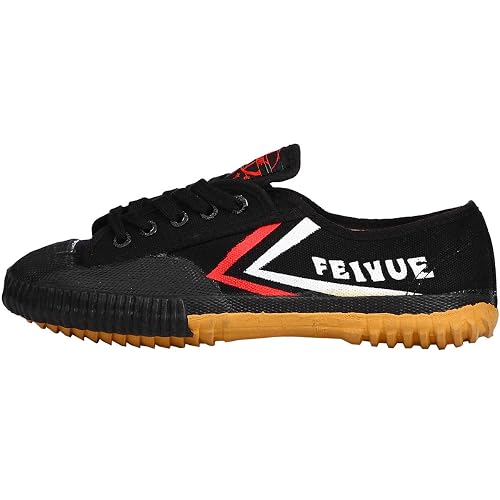
Wushu shoes need to be flat, lightweight, and flexible enough that you can feel the floor. The Feiyue is the classic — a canvas shoe originally made in Shanghai that's been used by martial artists (including Shaolin monks) since the 1920s. The thin rubber sole gives you ground feel for stances while providing just enough cushion for landing jumps. Running shoes, cross-trainers, and barefoot are all wrong for wushu — you need that specific combination of flat sole, ankle support, and grip.
Best starter
Feiyue
Budo Saga Feiyue Martial Arts Shoes
$
★★★★★Our rating
The authentic Feiyue — canvas upper, thin rubber sole, lace-up closure. This is the shoe that Shaolin monks train in, that parkour athletes adopted, and that wushu competitors wear in practice. The sole is thin enough to feel the floor during stances but padded enough to absorb jump landings. The canvas breathes, and the whole shoe weighs almost nothing.
What we like
Ultra-lightweight — feels like barely wearing a shoe
Thin sole provides excellent ground feel for stances
Canvas breathes during intense training sessions
What to know
Minimal cushioning — not great for high-impact landings on concrete
The updated Feiyue with slightly improved materials — same legendary flat sole and ground feel, with a more refined canvas upper and better rubber tread pattern. The modern version addresses some durability issues of the classic design while keeping the weight and flexibility that make Feiyues the go-to wushu shoe.
What we like
Improved rubber tread pattern for better grip
Updated canvas is slightly more durable
Same flat sole and ground feel as the classic
What to know
Still runs narrow like all Feiyues
Higher price than the classic for marginal improvements
Wushu weapon forms are divided into short weapons (dao/broadsword, jian/straight sword) and long weapons (gun/staff, qiang/spear). Most schools start students on dao or jian first because they teach blade awareness and wrist control. Training weapons for wushu are made with flexible, lightweight blades that bend during forms — the "whip" of a well-timed blade strike is part of the performance. These are strictly practice and competition weapons, not sharp.
Best starter
DaYe
Wushu Competition Broadsword (Dao)
$$
★★★★★Our rating
A lightweight wushu dao with a flexible, chrome-plated blade designed for contemporary wushu forms. The soft blade produces the characteristic "pop" sound during strikes and is safe for training. The stainless handle provides good balance. This is the type of dao used in competition-style changquan (long fist) and nanquan (southern fist) forms.
What we like
Lightweight flexible blade designed for wushu forms
Produces the classic wushu blade 'pop' sound
Stainless handle balances well for spinning techniques
What to know
Flexible blade requires correct technique — bad form = wobbly blade
Not suitable for traditional kung fu styles that use heavier dao
The jian (straight sword) is the "scholar's weapon" of Chinese martial arts — precise, elegant, and demanding of clean technique. This wushu-style jian has a flexible blade for contemporary forms and comes with a black dragon scabbard. Learning both dao and jian gives you the complete short weapon foundation.
What we like
Flexible blade suitable for competition-style jian forms
Includes scabbard for storage and transport
Good balance for precise thrusting and cutting motions
What to know
Jian forms are more technically demanding than dao
Blade flexibility makes it harder to control for beginners
A heavier, stiffer dao for traditional kung fu styles rather than contemporary wushu. Forged steel blade with more weight, which teaches proper blade control and builds wrist strength. Better suited for schools that teach Shaolin, hung gar, or other traditional styles where the dao is a functional training tool rather than a performance prop.
What we like
Heavier blade builds wrist and forearm strength
Forged steel is more durable than flexible wushu blades
Suitable for traditional kung fu curriculum
What to know
Too heavy for contemporary wushu forms — different training tool
Stiffer blade won't produce wushu-style 'pop' sounds
Beyond uniform, shoes, and weapons, a few accessories make your training more comfortable and organized. A sash (the traditional Chinese martial arts belt) holds your uniform together during vigorous movement and signals your rank in some schools. Interlocking foam mats provide cushioning for acrobatic work — aerial cartwheel, butterfly kick, and tornado kick landings are much easier on foam than on a bare gym floor.
Best starter
KungfuDirect
Kungfu Sash (108")
$
★★★★★Our rating
A 108-inch traditional kung fu sash in satin — long enough to wrap twice around your waist with a proper knot. Available in every traditional color (black, red, yellow, blue, white). The sash isn't just decorative: it keeps your jacket closed during kicks and spins, and in some schools the color indicates your training level.
What we like
108-inch length accommodates all waist sizes
Traditional satin material and construction
Available in all standard kung fu sash colors
What to know
Satin can be slippery — takes practice to tie securely
Some schools provide sashes and prefer you use theirs
1-inch thick interlocking EVA foam tiles with a tatami texture pattern for grip. Essential if you're practicing at home — wushu involves jumps, sweeps, and aerial techniques that are rough on bare floors and joints. Each tile is 24x24 inches; buy enough to cover your practice area. The interlocking design means you can expand or reconfigure as needed.
What we like
1-inch thick foam absorbs landing impact
Tatami texture provides grip for barefoot or Feiyue training
Interlocking tiles expand to any size
What to know
Heavy to move and store when assembled
Tiles can separate during aggressive lateral movement
Wushu training starts with stances, kicks, and flexibility — not the acrobatic flips you saw on YouTube. Here's what the first three months actually look like, from your first horse stance to your first empty-hand form.
The YouTube version of wushu is all butterfly kicks, aerial cartwheels, and sword forms that look like choreographed combat. The reality of your first three months is more like this: stances that burn your legs, kicks that won’t go above your waist, and a lot of stretching. It’s not glamorous, and it is exactly what your body needs before any of the flashy stuff becomes possible.
Here’s how it actually goes.
Month 1: Stances and basic kicks
The first thing your instructor will teach you is ma bu — the horse stance. Feet shoulder-width apart (or wider), knees bent to 90 degrees, thighs parallel to the floor, back straight. You hold this position. And hold it. And hold it.
Horse stance is the foundation of everything in Chinese martial arts. It builds the leg strength for deep stances, the core stability for kicks, and the mental endurance for long training sessions. Your quads will scream. Your instructor will say “lower.” This is normal.
The other fundamental stances you’ll learn in month one:
Gong bu (bow stance) — front knee bent, back leg straight. The basic fighting stance and the position you’ll spend most of your forms in.
Pu bu (crouching stance) — one leg fully bent, the other extended straight to the side. This is where your flexibility journey begins.
Xu bu (empty stance) — weight on the back leg, front foot touching the ground lightly. Teaches weight distribution and balance.
Xie bu (resting stance) — legs crossed, sitting on the back calf. Surprisingly difficult and common in southern styles.
Your instructor will drill these stances in combination — walk across the floor in gong bu, switch to ma bu, drop into pu bu, stand into xu bu. The transitions between stances are as important as the stances themselves. Wushu isn’t about holding positions; it’s about moving between them with precision and power.
Basic kicks start this month too. Front kick (zheng ti tui), side kick (ce ti tui), and the straight-leg swing kick that’s unique to Chinese martial arts. The kicks will be low. Your instructor will tell you to keep your leg straight and your toes pointed, and you’ll discover muscles in your hips that you didn’t know existed.
Month 1-2: The flexibility grind
Here’s the uncomfortable truth: wushu requires a level of flexibility that most adults don’t have. Front splits, side splits, and the ability to kick above your own head are eventual requirements — not immediately, but they’re where you’re heading.
Your school will build stretching into every class. Active stretching (kicking drills), passive stretching (holding splits positions), and dynamic stretching (swing kicks that gradually increase in height). The minimum is 15-20 minutes of stretching per class. Most serious wushu schools spend 30-40 minutes.
Stretch at home. This is the single most impactful thing you can do outside of class. Even 15 minutes of daily stretching — hip flexors, hamstrings, adductors, and shoulders — will accelerate your progress dramatically. The students who advance fastest are almost always the ones stretching daily at home.
A realistic flexibility timeline for an adult beginner:
Month 1: You can touch your toes. Front kicks reach hip height. Pu bu (crouching stance) requires support.
Month 3: Kicks reach chest height. Front split is within 6-8 inches of the floor. Pu bu is unsupported.
Month 6: Kicks reach head height. Front split is close to flat. Side split is within a foot of the floor.
Year 1: Full or near-full front splits. Side split approaching flat. Kicks at or above head height.
This timeline assumes daily stretching. Without it, roughly double these estimates.
Once your stances and kicks are presentable, your instructor will start combining them into sequences. A typical combination might be: gong bu punch → ma bu block → front kick → gong bu punch. These combinations are building blocks for forms.
Basic jumps enter the picture this month:
Teng kong fei jiao (flying front kick) — a straight jump with a slap kick at the peak. Your first aerial technique. It feels terrible the first time and acceptable by the tenth.
Ce kong fan (aerial cartwheel) — not yet. Your instructor may introduce the ground-based cartwheel and roundoff that lead to the aerial version later.
Carp kick-up (li yu da ting) — lying flat on your back and kicking up to standing. This is partly a strength move and partly a technique move, and wushu students drill it obsessively.
The jump training is where wushu separates from traditional kung fu. Contemporary wushu treats jumps as scored elements (like gymnastics), so your instructor will be specific about height, body position, and landing stance.
Month 3: Your first form
Forms (tao lu) are choreographed sequences of techniques — the “routines” of wushu. Your first form will be a simplified version of changquan (long fist), the foundational contemporary wushu style. It’ll be 20-30 movements long and take about 45-60 seconds to perform.
Learning a form happens in stages:
Learn the movements individually. Your instructor demonstrates each technique, you copy it, they correct your position. This takes several classes.
String movements together. Once you know the individual techniques, you connect them in sequence. The transitions between movements are where most beginners struggle — the form should flow, not stop-start.
Add power and speed. A form performed at learning speed looks nothing like a form performed at competition speed. Once you know the sequence, you gradually increase speed and intensity. The explosive power that makes wushu forms look impressive comes from proper stance transitions and hip rotation, not from arm strength.
Polish. Every hand position, every head turn, every foot angle matters. This is where wushu becomes art — the difference between a beginner form and an advanced form isn’t what movements they contain, it’s how precisely each movement is executed.
Your first form will take 2-4 weeks to learn and months to polish. That’s expected. Professional wushu athletes spend years refining forms they learned in their first year of training.
Not going low enough. In wushu, lower is almost always better. Deeper stances, lower sweeps, more compression in the legs. If your instructor keeps saying “lower,” they’re not being cruel — they’re being accurate. The visual impact of wushu comes from the contrast between explosive height (jumps, kicks) and grounded depth (stances, sweeps).
Soft hands. Wushu has specific hand shapes — fist, palm, hook, sword fingers — and beginners default to vague, floppy versions. Tighten your fist, extend your palm fully, make your hook sharp. Your hands are performing too.
Looking at the floor. Your eyes should follow your lead hand or face your imaginary opponent, never stare at the ground. Eye direction is a scored element in competition and a coached element from day one.
Skipping flexibility work. It’s boring. It hurts. It’s the single biggest factor in how fast you progress. Every wushu technique is easier with better flexibility: kicks go higher, stances go deeper, jumps get more air because your takeoff position is more efficient. Do the stretching.
Comparing yourself to the kids. Many wushu schools have children who started at age 5 and can do things that seem superhuman. They have years of training and the flexibility of youth. Your trajectory is different, and that’s fine. Adult beginners who train consistently for 2-3 years reach a level that impresses everyone who isn’t a competitive athlete — and that’s a remarkable achievement.
What to practice at home
Stances: Walk through gong bu, ma bu, pu bu, xu bu, and xie bu transitions for 10 minutes. Focus on depth and precise foot placement.
Kicks: 20 front kicks per leg, 20 side kicks per leg. Focus on height (within your current range) and keeping the supporting leg straight.
Stretching: 15-20 minutes of focused flexibility work — front splits, side splits, pike stretch, shoulder stretches.
Form review: Walk through your form at half speed, focusing on hand positions and transitions. Don’t practice at full speed until your instructor says the movements are correct — you’ll ingrain bad habits.
Wushu rewards daily practice more than most martial arts because so much of it is physical conditioning and flexibility. A 30-minute home session three times a week will noticeably accelerate your progress in class.
Save your money
What you don't need yet
Beginners get pressured to buy a lot of stuff that doesn't help them play
better. Here's what we'd skip on day one.
A competition wushu sword or spear — Weapons training starts 6-12 months in. Your hands and feet are your first tools — stances and kicks come before blades.
A full competition uniform (changquan suit) — Training clothes work fine for class. Competition uniforms are custom-fitted and only needed if you plan to compete.
Acrobatic training mats — Flips and aerials are advanced skills. Your school has mats for when you're ready. Focus on stances and basic kicks first.
First week
Your first seven days
A short, real plan to get from gear-on-doorstep to actually playing.
Find a wushu school or instructor — this art is nearly impossible to learn correctly from videos alone. · Action
Learn the five basic stances: horse, bow, empty, drop, and resting stance. · Learn
Practice holding horse stance for 30-second intervals to build leg endurance. · Action
Start basic kick drills: front snap kick, side kick, and crescent kick. · Learn
Begin a daily stretching routine — wushu demands flexibility you probably don't have yet. · Action
FAQ
Common questions
What's the difference between wushu and kung fu?
Wushu literally means 'martial art' in Chinese and is the modern, standardized competition form of Chinese martial arts. Kung fu is a broader term covering traditional fighting styles. Modern wushu emphasizes athletic performance — high kicks, aerial techniques, and choreographed forms — while traditional kung fu styles focus more on practical combat application.
Am I too old to start wushu?
No. Competition-level acrobatics favor younger athletes, but the core curriculum — stances, kicks, hand techniques, and forms — is accessible at any age. Many schools have adult beginner classes. Flexibility improves with consistent stretching regardless of starting age.
Do I need to be flexible to start?
No, but you'll need to develop flexibility over time. Wushu involves high kicks and deep stances that require hip, hamstring, and ankle flexibility. Most beginners can't do the splits on day one — that's expected. Daily stretching for 15-20 minutes alongside your training builds the range of motion you need.
Is wushu effective for self-defense?
Modern competition wushu prioritizes aesthetics and athleticism over combat application. It builds excellent coordination, speed, and fitness, but it's not optimized for fighting. If self-defense is your primary goal, consider sanda (Chinese kickboxing) which is the combat sport companion to wushu forms.
As an Amazon Associate, JustBeginning earns from qualifying purchases.
We may also earn commission from other affiliate programs linked on this
page. Editorial recommendations are independent; we don't choose
products based on commission rates.
Our top pickZooBoo Vintage Chinese Wing Chun Kung Fu Uniform

 Best starter