The best first car audio upgrade is usually not a giant subwoofer. It's a CarPlay head unit or a set of better front speakers with sound deadening behind them. Here's what to upgrade first, how to size an amp, why wiring kits matter, how to keep a factory radio, and the tools for a clean DIY install.
By Colin B. · Published November 18, 2026 · Last reviewed November 18, 2026
Rockford R165X3 front speakers, a 36 sq ft box of Kilmat deadening and a trim tool kit come to about $150. A typical first system adds a Pioneer CarPlay head unit and a Kicker Hideaway powered sub for about $700, plus a dash kit and harness for your car (often $30 to $60).
We earn commission when you buy through links on this page, including
Amazon. See our affiliate disclosure.
Price tiers and budget totals shown above are editorial estimates;
actual prices vary.
At a glance
Our top pick in each category
The fastest path through this guide — each best-starter pick by category.
Scroll for the budget and upgrade alternatives.
Decide what's wrong first. If you want CarPlay or Android Auto, start with the head unit. If music sounds thin or muddy, start with front speakers and sound deadening in the front doors. If you want bass you can feel, a powered subwoofer is the easiest add. Doing all three at once costs more and makes problems harder to track down.
Check what fits your car. Speaker sizes, dash openings and wiring vary by model. Crutchfield's vehicle fit tool tells you speaker sizes and mounting depth, and which dash kit and wiring harness you need. Newer cars with screens built into the dash may need a line output converter or a DSP instead of a new radio.
Buy real copper wire. Cheap amp wiring kits are copper-clad aluminum (CCA), which carries less current and gets hot. Oxygen-free copper (OFC) costs more but is safer. Size the power wire to your amp: 8 gauge for small amps, 4 gauge for most subwoofer amps.
Power numbers lie. Use RMS (continuous) watts, not peak watts. Match amp RMS output to speaker RMS ratings. A 50-watt RMS amp channel on a 60-watt RMS speaker is a good match. Peak power on the box is mostly marketing.
A new head unit (the radio) adds Apple CarPlay and Android Auto, better Bluetooth, a backup camera input and preamp outputs for adding amps later. Double-DIN units have a large screen and fit most cars from about 2000 to 2015. You'll also need a dash kit and a wiring harness for your car, and often an adapter to keep steering wheel controls. Newer cars with the screen built into the dash usually can't take a new head unit; use a line output converter or DSP instead.
Head units — what's the difference?
A few common shapes, each making a different trade.
Wired CarPlay
Plug in your phone for CarPlay or Android Auto. The best value.
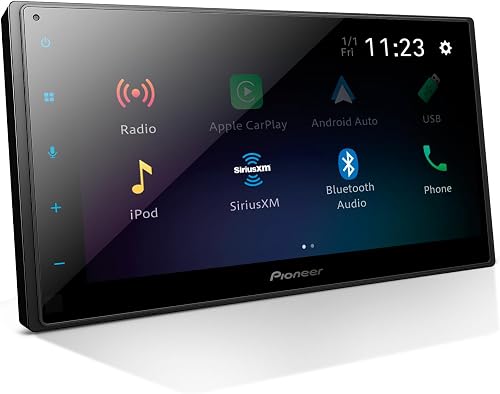
DMH-1600NEX 6.8" Capacitive Touchscreen Double DIN Receiver
$300.00 as of Nov 18, 2026
★★★★★Our rating· In Stock
A responsive capacitive touchscreen (like a phone, not the press-hard resistive kind) with wired Apple CarPlay and Android Auto, Bluetooth with an included microphone, and preamp outputs for adding an amp later. Sold by Amazon. About $300, 4.3 stars from 176 ratings.
XAV-AX3200 7" Media Receiver with CarPlay and Android Auto
$298.00 as of Nov 18, 2026
★★★★☆Our rating· In Stock
Wired CarPlay and Android Auto on a 7-inch screen with a shallow chassis that fits tight dashes, plus a rear camera input and three sets of preamp outputs. Sold by an authorized dealer. About $298, 4.3 stars from 399 ratings.
XAV-AX4000 7" Receiver with Wireless CarPlay and Android Auto
$448.00 as of Nov 18, 2026
★★★★☆Our rating· In Stock
Wireless CarPlay and Android Auto, so your phone connects as soon as you start the car. It's also Maestro ready, which keeps factory features in many cars. Sold by Drive In Car Audio. About $448, 4.5 stars from 194 ratings.
Factory speakers use thin paper cones and tiny magnets, so new speakers are the cheapest big improvement. Coaxial speakers have a tweeter built into the middle and drop into the factory hole. Component sets split the woofer and tweeter, so you can mount the tweeter high on the door or dash, which puts the music in front of you instead of at your knees. Match sizes and mounting depth to your car with a fit guide, and use speaker adapters and harnesses so you don't cut factory wiring.
Speakers — what's the difference?
A few common shapes, each making a different trade.
Coaxial
Tweeter built in. Drops into the factory hole in an hour.
A big step up from factory speakers that runs fine on head-unit power and sounds even better with an amp. Rated 55 watts RMS, with a factory-replacement design that drops into most cars. Sold by Rockford Fosgate. About $110 a pair, 4.6 stars from 9,539 ratings.
Prime R165X3 6.5" 3-Way Full Range Speakers (Pair)
$67.99 as of Nov 18, 2026
★★★★☆Our rating· In Stock
Rockford's budget factory replacement speaker, rated 45 watts RMS. It's the cheapest way to fix muddy factory speakers, and a good choice for rear doors. Sold by Rockford Fosgate. About $68 a pair, 4.5 stars from 12,777 ratings.
A component set with separate 1-inch tweeters and crossovers. Mount the tweeters high on the doors or dash for clearer vocals and a stage in front of you. Best with an amp. Sold by Creative Audio. About $160, 4.6 stars from 308 ratings.
Kicker's shallow-mount coaxial, useful in doors where deeper speakers hit the window track. Sold by Creative Audio. About $75 a pair, 4.6 stars from 2,736 ratings.
Door speakers can't play deep bass, so a subwoofer fills in the bottom octave. Powered subwoofers have the amp built in, fit under a seat or in a corner of the trunk, and take an afternoon to install. They won't rattle the neighborhood, but they make music sound full. A separate sub, box and mono amp gets louder but costs more and takes more wiring. Most powered subs connect to speaker wires or a head unit's sub output, plus power, ground and a remote turn-on wire.
A compact 10-inch powered sub in a tough aluminum enclosure that fits under many seats or in a corner of the trunk. A remote knob lets you adjust bass separately from volume. Sold by AVLeaderz. About $300, 4.2 stars from 162 ratings.
A slim 3-inch-tall powered sub for under a seat, rated 200 watts RMS. It's the cheap way to add bass to a factory system. Sold by Audiosavings. About $140, 4.4 stars from 3,684 ratings.
A very small powered sub for cars with little room under the seats. It won't shake the car, but it adds the bass that small factory speakers miss. Sold by Amazon. About $200, 4.4 stars from 284 ratings.
A 4-channel amp gives your speakers clean power, so they play louder without distortion. Look at RMS power at 4 ohms and match it to your speakers' RMS rating. If you're keeping the factory radio, a line output converter (LOC) turns its speaker wires into RCA signals an amp can use, and adds a remote turn-on wire. Set amp gains with a test tone and a multimeter, not by ear.
Best starter
Kicker
CXA360.4 4-Channel Full-Range Amplifier
$229.99 as of Nov 18, 2026
★★★★★Our rating· In Stock
A compact 4-channel amp that powers front and rear speakers, with built-in crossovers and bass boost. Enough clean power for aftermarket coaxials or a component set. Sold by AVLeaderz. About $230, 4.7 stars from 393 ratings.
KISLOC2 Stereo Line-Output Converter with Remote Turn-On
$19.99 as of Nov 18, 2026
★★★★☆Our rating· In Stock
Turns factory speaker wires into RCA outputs for an amp or sub, and creates the remote turn-on signal most factory radios lack. The cheap, proven way to add an amp to a stock radio. About $20, 4.5 stars from 6,453 ratings.
LC2i 2-Channel Line Output Converter with AccuBASS
$97.00 as of Nov 18, 2026
★★★★☆Our rating· In Stock
A premium line output converter that restores bass many factory radios roll off at high volume, and accepts up to 400 watts per channel from factory amps. The pick for adding a sub to a premium factory system. About $97, 4.6 stars from 3,881 ratings.
Sound deadening is butyl mat with a foil face. Stick it to the inside of the door skin behind the speaker and the door stops rattling and buzzing, so bass is tighter and road noise drops. For amps, buy an oxygen-free copper (OFC) wiring kit with an inline fuse. Cheap copper-clad aluminum (CCA) kits carry less current and run hot. Fuse the power wire within 18 inches of the battery.
Best starter
KILMAT
80 mil 36 sq ft Car Sound Deadening Mat
$69.95 as of Nov 18, 2026
★★★★★Our rating· In Stock
The best-selling butyl deadening mat. 36 square feet does both front doors and more, and it's thick and sticky enough to stop door panel buzz. Roll it on firmly. About $70, 4.8 stars from 26,911 ratings.
A small pack of butyl deadening sheets, enough to treat the area behind two front door speakers. Sold by Amazon. About $20, 4.7 stars from 5,889 ratings.
A true oxygen-free copper 4 gauge kit with 17 feet of power cable, a ground cable, an ANL fuse holder, RCA cables, remote and speaker wire. Rated for systems up to 1,500 watts. Sold by Skar Audio. About $78, 4.7 stars from 2,558 ratings.
A few tools make the difference between a clean install and broken clips. Plastic trim tools pry panels without scratching them. A ratcheting crimper makes solid connections every time, much better than cheap pliers-style crimpers. A multimeter checks for power, finds a good ground, and sets amp gains properly.
Best starter
Tresalto
5 PC Car Trim Removal Tool Kit
$9.97 as of Nov 18, 2026
★★★★★Our rating· In Stock
Nylon pry tools that lift door panels and dash trim without scratching paint or plastic, plus a clip remover. The cheapest tool in the job and the one you'll use most. About $10, 4.7 stars from 27,752 ratings.
A ratcheting crimper with four interchangeable dies for insulated, uninsulated and heat shrink terminals from 10 to 22 AWG. Consistent, solid crimps for harnesses and speaker wire. Sold by Amazon. About $55, 4.7 stars from 419 ratings.
Digital Multimeter, True RMS 6000 Counts, Auto-Ranging
$33.99 as of Nov 18, 2026
★★★★☆Our rating· In Stock
An auto-ranging true RMS multimeter for checking voltage, continuity and grounds, and for setting amp gains with a test tone. About $34, 4.6 stars from 20,364 ratings.
Car audio rewards patience. One clean upgrade at a time, done right, sounds better than a pile of gear thrown in over a weekend. Here's a four-week plan: learn your car, do the front speakers, add the head unit or a converter, then add bass.
The car is a hard place for sound: thin metal doors, road noise and speakers that point at your ankles. Each upgrade fixes one of those problems. Do them in order and listen after each one.
Week 1: Learn your car
Look up your car on Crutchfield and write down your speaker sizes, mounting depth, and whether your factory radio can be replaced. Search YouTube for “[your car] door panel removal” and watch it twice. Buy a plastic trim tool kit before you pry anything.
Disconnect the negative battery terminal before any wiring work. Some cars need a radio code after the battery is reconnected, so find yours first.
Pull the front door panels. Stick sound deadening mat to the outer door skin behind the speaker and around it, and roll it firmly. Then mount the new speakers with adapter brackets and a wiring harness, so you don’t cut factory wires. Use foam rings around the speaker to seal it to the panel.
Play a song you know well before and after. Most people are surprised by how much clearer the vocals are.
If your car has a replaceable radio, install a CarPlay or Android Auto head unit with the right dash kit and harness. Crimp or solder the harness at a bench, not in the car, and match every wire by color. Then it plugs in.
If you’re keeping the factory radio, install a line output converter now so you can add an amp next week.
A powered subwoofer under a seat or in the trunk is the easiest way to add bass. For a separate amp and sub, run the power wire through a firewall grommet with an inline fuse within 18 inches of the battery. Ground the amp to bare metal on the chassis with a short wire. Set the amp gain with a test tone and a multimeter, not by ear, to avoid clipping.
Disconnect the negative battery terminal before touching any wiring. · Action
Pull one door panel and look at the speaker, wiring and space behind it. · Action
Install front speakers with deadening on the outer door skin behind them. · Action
Watch a model-specific install video before you start each job. · Learn
FAQ
Common questions
What should I upgrade first?
For features, a CarPlay or Android Auto head unit. For sound, front speakers with sound deadening in the front doors. For bass, a powered subwoofer. Most people get the biggest improvement per dollar from front speakers and deadening.
Do new speakers need an amp?
No, but they sound better with one. Factory and aftermarket head units put out about 15 to 22 watts RMS per channel. Efficient speakers sound fine on that. A small 4-channel amp makes them louder and cleaner.
Component or coaxial speakers?
Component speakers have a separate tweeter you mount higher, usually on the door or dash, which puts the sound in front of you. Coaxials have the tweeter built in and drop into the factory hole. Use components in front and coaxials in back.
Can I keep my factory radio?
Yes. A line output converter turns the factory speaker signal into a signal an amp can use. For cars with heavy factory equalization, a DSP with high-level inputs does the same job and corrects the sound.
What's the difference between OFC and CCA wire?
OFC is oxygen-free copper. CCA is copper-clad aluminum, which is cheaper and carries less current at the same gauge. Use OFC for power and ground wires, or buy one gauge thicker if you use CCA.
JustBeginning earns commission from affiliate programs. As an Amazon
Associate, we earn from qualifying purchases. This costs you nothing
extra and doesn't change our recommendations.
Prices and availability are accurate as of the date and time
shown and can change; the price on Amazon when you buy is what
applies.
How this works.
Our top pickDMH-1600NEX 6.8" Capacitive Touchscreen Double DIN Receiver


 Best starter


