Quilling is rolling thin strips of paper into coils, pinching them into shapes and gluing them edge-up into flowers, cards and framed art. It's cheap, quiet and fits on a kitchen table. Here's which tool to start with, what paper width to buy, the glue that works, the eight basic shapes, and how to finish a first card in a weekend.
By Colin B. · Published November 19, 2026 · Last reviewed November 19, 2026
A beginner kit with a tool and mixed strips costs about $15. Add a circle sizer board, a fine-tip glue applicator, tacky glue, fine tweezers and an extra pack of 1/8 inch strips for about $40.
We earn commission when you buy through links on this page, including
Amazon. See our affiliate disclosure.
Price tiers and budget totals shown above are editorial estimates;
actual prices vary.
At a glance
Our top pick in each category
The fastest path through this guide — each best-starter pick by category.
Scroll for the budget and upgrade alternatives.
Start with 1/8 inch strips. That's 3 mm, the standard width for most patterns. It's easy to roll and holds its shape. Narrow 1/16 inch strips are for fine detail, and 1/4 inch and wider strips are for fringed flowers and 3D work.
A slotted tool is the easiest start. You slip the strip into the slot and turn, and the coil forms on its own. It leaves a small crimp in the center. A needle tool gives a cleaner center but takes more practice, so many quillers end up owning both.
Use very little glue. A tiny dot of tacky glue on a toothpick or pin holds a coil closed. Too much glue soaks the paper, shows as shiny spots and makes shapes slide. A fine-tip applicator bottle fixes most glue problems.
Plan your first projects small. A greeting card with three flowers and a few leaves takes an evening. Framed pieces and monograms can take 20 hours or more. Finish small pieces first so you build skill before you commit to a big one.
A kit bundles a slotted tool, a needle tool, tweezers, a circle sizer board and a few hundred strips. It's the cheapest way to try every tool and find out which you like. The tools in cheap kits are fine to learn on. The paper is often thinner than brand-name strips, so plan to buy better paper once you know you'll keep going.
Best starter
JUYA
Paper Quilling Kit, 960 Strips with 12 Tools and Glue
$23.80 as of Nov 19, 2026
★★★★★Our rating· In Stock
A popular all-in-one kit with slotted and needle tools, tweezers, a circle sizer board, a crimper and hundreds of strips in mixed colors. Enough to learn every basic shape and try a few patterns. Sold by JUYA Crafts. About $24, 4.7 stars from 743 ratings.
All-in-One Paper Quilling Kit, 2040 Strips, 22 Tools
$41.64 as of Nov 19, 2026
★★★★☆Our rating· In Stock
A much bigger kit with 3, 5 and 10 mm strips, a crimper, a fringer-style comb, boards and a full set of slotted and needle tools. Worth it once you know you like quilling and want to try wider strips and 3D pieces. Sold by YURROAD. About $42, 4.7 stars from 1,264 ratings.
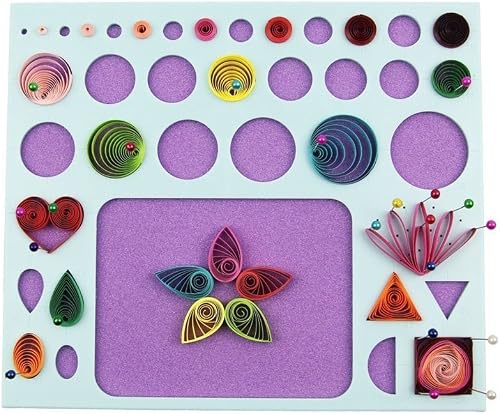
The slotted tool is the easiest way to roll a coil. A needle tool makes a cleaner center once your hands are steady. A circle sizer board is a plastic or cork board with holes from about 1/8 to 1 inch wide, so every loose coil comes out the same size. Fine-point tweezers let you place and glue small shapes without crushing them.
Best starter
sowaka
Paper Quilling Slotted Tools, 4 Pack
$5.29 as of Nov 19, 2026
★★★★★Our rating· In Stock
A set of slotted and needle tools in a few slot sizes. The finest slot grips 1/8 inch paper without tearing it and leaves a smaller crimp at the center than the thick tools in some kits. Cheap enough to keep one at every work spot. Sold by Floranea. About $5.29, 4.6 stars from 4,981 ratings.
A board with graded circle holes, shape guides and a cork-style work surface for pinning pieces. Drop a coil in, let it relax to fill the hole, and glue. It's the simplest way to make petals and leaves that match. Sold by YURROAD. About $7.99, 4.6 stars from 345 ratings.
Sharp, fine tweezers that pick up a tiny coil without squashing it and dip shapes into glue cleanly. Any fine-tip pair works, but a good one lines up at the tips and won't slip. Sold by kaverme. About $5.09, 4.5 stars from 13,764 ratings.
Precut quilling paper comes in packs of strips about 12 to 24 inches long. 1/8 inch, or 3 mm, is the standard width for most patterns. Look for text-weight paper with clean, even edges. Uneven strips roll into coils with ridges. Buy a mixed color pack first, then buy single colors you use a lot, like greens for leaves.
Best starter
YURROAD
Quilling Paper Strips, 1/8 x 15.4 in, 900 Pieces, 36 Colors
$10.99 as of Nov 19, 2026
★★★★★Our rating· In Stock
Evenly cut 1/8 inch strips, the standard width most patterns use, in 36 colors. The paper has enough body to hold a shape but rolls smoothly. A good restock once the kit strips run out. Sold by YURROAD. About $10.99, 4.7 stars from 1,838 ratings.
Quilling Strips Set, 720 Strips, 36 Colors, 3 mm x 54 cm
$7.99 as of Nov 19, 2026
★★★★☆Our rating· In Stock
A bulk pack of 3 mm strips in dozens of colors. Fine for practice coils and learning shapes, where you'll go through a lot of paper you won't keep. Save the better strips for finished cards. Sold by JUYA Crafts. About $7.99, 4.7 stars from 1,775 ratings.
Quilling needs thick white glue that grabs fast and dries clear. Regular school glue is too wet and soaks the paper. You only need a dot at a time, so a fine-tip applicator bottle with a metal tip helps a lot. Many quillers also keep a small puddle on a jar lid and pick it up with a pin or toothpick.
Best starter
Aleene's
Original Tacky Glue, Always Ready Bottle, 4 oz
$6.38 as of Nov 19, 2026
★★★★★Our rating· In Stock
Thick, quick-grab craft glue that holds coils closed in seconds and dries clear. It's the glue most quilling tutorials use. A 4 oz bottle lasts a long time at a dot per coil. Sold by Natural State Brands. About $6.38, 4.7 stars from 6,219 ratings.
A small squeeze bottle with a thin metal tip that puts down a pinhead dot of glue. Fill it with tacky glue and gluing shapes onto a card gets much neater. Sold by Tiger Space. About $9.29, 4.5 stars from 1,417 ratings.
Quilling is a handful of shapes used over and over. Learn to roll even coils and pinch eight basic shapes, and you can make most beginner patterns. Here's a week-by-week plan from first coil to a finished card.
Your first coils will be lumpy and uneven. Everyone’s are. By the end of the month they’ll match, and that’s what makes a piece look finished.
Week 1: Even coils
Slide the end of a 1/8 inch strip into the slot of your tool and turn the tool, not the paper. Keep the edges lined up so the coil stays flat. For a tight circle, glue the end right away. For a loose circle, slip it off, drop it into a circle sizer hole, let it open up, then glue the tail. Make 20 of each.
Every pattern uses the same shapes. Pinch one side of a loose coil for a teardrop. Pinch both sides for a marquise, the leaf shape. Pinch four corners for a square, three for a triangle. Press one side flat for a half moon. Practice until you can make five teardrops that look the same size.
Arrange five teardrops around a tight circle and glue the points to it. Add a few marquise leaves and a stem made from a strip glued on edge. Plan the layout on the card before gluing, then use a dot of glue under each shape. Tweezers help you place small pieces without crushing them.
Pick a simple pattern like a wreath, a monogram letter or a single large flower. Trace it lightly in pencil on cardstock. Make all the shapes first, then glue them in place from the center out. Let it dry overnight and put it in a deep frame or shadow box so the glass doesn’t press the paper.
Make a five-petal flower from teardrops around a tight circle. · Action
Glue two flowers and three marquise leaves onto a folded card. · Action
FAQ
Common questions
What paper width should a beginner use?
1/8 inch, or 3 mm. It's the standard width for patterns and books, rolls easily on a slotted tool and makes shapes that are big enough to handle. Try 1/16 inch once your hands are steady.
Slotted tool or needle tool?
Start with a slotted tool. It grips the strip so rolling is easy. The tradeoff is a small bent center. A needle tool gives a smooth, open center but you have to hold the strip in place while rolling, which takes practice.
What glue works best for quilling?
A thick white craft glue like Aleene's Tacky Glue. It grabs fast and dries clear. Put a small puddle on a lid and pick it up with a pin or toothpick, or use a fine-tip applicator bottle so you only use a dot.
How do I make coils the same size?
Use a circle sizer board. Roll a coil, drop it into a hole, let it relax to fill the hole, then glue the end. Use the same strip length every time, like a full 12 inch strip or a half.
Can I cut my own strips?
Yes, from text-weight paper with a paper trimmer, but precut strips are cheap and even. Cardstock is too thick for coils. Printer paper works for practice but tears more easily than quilling paper.
JustBeginning earns commission from affiliate programs. As an Amazon
Associate, we earn from qualifying purchases. This costs you nothing
extra and doesn't change our recommendations.
Prices and availability are accurate as of the date and time
shown and can change; the price on Amazon when you buy is what
applies.
How this works.


 Best starter