Good cameras are cheaper than ever and better than ever. The hard part isn't the gear; it's learning to see. Here's exactly what to buy, what to skip for now, and what to practice in your first month.
By Colin B. · Published May 9, 2026 · Last reviewed July 18, 2026
A solid beginner kit runs $650–1,000. The camera body is most of that cost; everything else is cheap. Cameras hold their value: if photography doesn't stick, you can sell for close to what you paid.
We earn commission on qualifying Amazon purchases — see our
affiliate disclosure.
Price tiers and budget totals shown above are editorial estimates;
actual Amazon prices vary.
At a glance
Our top pick in each category
The fastest path through this guide — each best-starter pick by category.
Scroll for the budget and upgrade alternatives.
Don't buy a full-frame camera yet. A $2,500 Sony a7C II will not make your photos better than a $750 APS-C mirrorless. The sensor size difference is real, but it only matters once you've developed an eye for light and composition, which takes months. Start with an APS-C body, learn to see, then upgrade if you still want more.
The kit lens that ships with your camera is better than you think. Beginner photographers almost always outgrow their eye before they outgrow the lens. Use the 18-55mm kit zoom for at least three months before you buy anything else. The one early exception: a fast prime (35mm or 50mm f/1.8) for low-light and subject separation. That purchase is worth it.
Don't buy based on brand loyalty. Canon, Sony, Fujifilm, and Nikon all make excellent APS-C mirrorless cameras. The more important question: which ecosystem do your friends shoot? Borrowing lenses is a major perk of being in the same system as people you know.
Your camera body is the most expensive decision you'll make, and it locks you into an ecosystem (lenses don't cross brands without adapters). For beginners, the differences between camera bodies matter less than marketing suggests. Any current APS-C mirrorless will outperform what most working pros shot on five years ago. What you actually want: a comfortable grip, fast autofocus, and a good kit-lens bundle. Everything else is noise.
Camera Body — what's the difference?
A few common shapes, each making a different trade.
Mirrorless (APS-C)
Compact, modern, best autofocus. The default starter pick in 2026.
Sensor
APS-C (1.5–1.6× crop)
Body size
Compact to mid-size
Lens ecosystem
Growing; all major brands
Best for Most beginners; travel; everyday and video shooting
Tradeoff Smaller sensor than full-frame; fewer legacy lenses natively
Bigger sensor, better low-light, expensive glass to match.
Sensor
35mm full frame
Body size
Mid to large
Lens ecosystem
Growing; lenses cost 2× APS-C
Best for Portraits, low-light work, photographers ready to invest seriously
Tradeoff Overkill for beginners; native glass is expensive
Best starter
Sony
ZV-E10 II
$1,098.00 as of Jun 22, 2026
★★★★★Our rating· In Stock
Sony's APS-C mirrorless sweet spot for beginners in 2026. The autofocus tracks subjects exceptionally well, so you're not hunting and losing shots while you're still learning. The ZV-E10 II has Sony's full E-mount lens ecosystem behind it, excellent video for content creators, and a tilting touchscreen that makes shooting from odd angles actually easy. Buy it with the 16-50mm kit lens.
What we like
Best-in-class subject tracking autofocus for the price
Sony E-mount gives you one of the biggest lens ecosystems
Tilting touchscreen makes vlogging and low-angle shots easy
What to know
No in-body stabilization, needs a tripod in low light
★★★★☆Our rating· Only 2 left in stock - order soon.
The smallest, lightest DSLR Canon makes, and still a genuinely capable camera. Battery life is outstanding: 1,000+ shots per charge versus 300 on most mirrorless. The Canon EF-S ecosystem has 20 years of affordable used glass behind it, and the optical viewfinder beats an electronic one in bright sun. Save money up front, but know you're buying into a mature format.
What we like
1,000+ shot battery life beats most mirrorless bodies by 3×
Enormous Canon EF-S used lens ecosystem, cheap glass everywhere
Optical viewfinder holds up better than EVF in bright sunlight
What to know
DSLR format is discontinued, no new Canon DSLR bodies coming
★★★★☆Our rating· Only 1 left in stock - order soon.
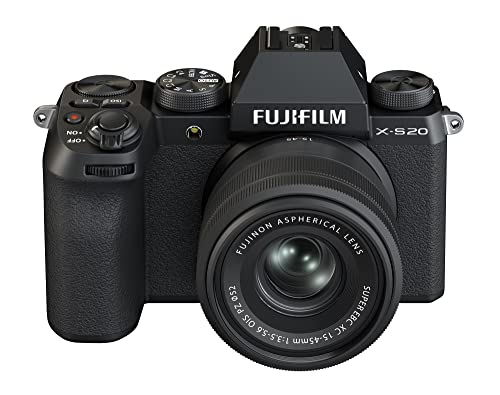
The step-up we'd point most photographers toward after six months. The X-S20 has in-body image stabilization, Fujifilm's beautiful film simulations (shoot JPEG and love it immediately), and a deep grip comfortable for longer shoots. The X-mount ecosystem is excellent. More capable than the ZV-E10 II in meaningful ways, once you're ready to notice.
What we like
In-body stabilization dramatically sharpens handheld and video shots
Film simulations produce beautiful JPEGs straight out of camera
Deep grip stays comfortable during long shooting sessions
What to know
Menu system has a steep learning curve compared to Sony or Canon
Pricier than the ZV-E10 II with fewer gains for true beginners
The kit lens (18-55mm or 16-50mm) bundled with your camera is underrated; use it for at least three months before buying anything else. When you're ready to add glass, the most valuable early purchase is a fast prime. A 35mm or 50mm f/1.8 is small, sharp, and lets in dramatically more light than a kit zoom. When you shoot a portrait at f/1.8 and the background goes soft and creamy, you'll understand immediately why photographers obsess over lenses.
Best starter
Sony
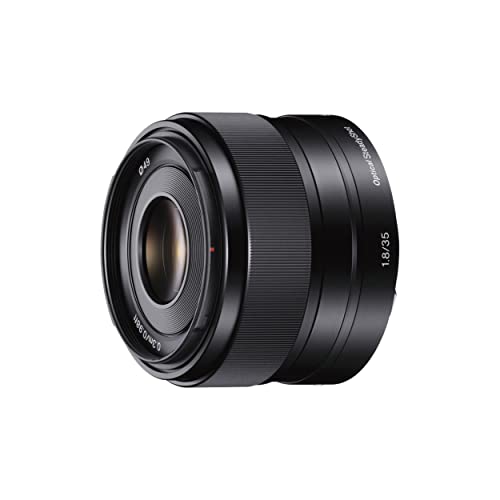
E 35mm f/1.8 OSS
$548.00 as of Jun 22, 2026
★★★★★Our rating· Only 17 left in stock - order soon.
The best lens upgrade for a Sony APS-C shooter who's outgrown the kit zoom. The 35mm focal length is close to what your eyes see, making composition intuitive. The f/1.8 aperture lets you shoot in dim restaurants, golden-hour parks, and indoor venues where the kit lens struggles. Optical stabilization (OSS) helps with handheld sharpness. Buy this within your first three months of shooting.
What we like
f/1.8 aperture unlocks dim restaurants, golden hour, and indoor venues
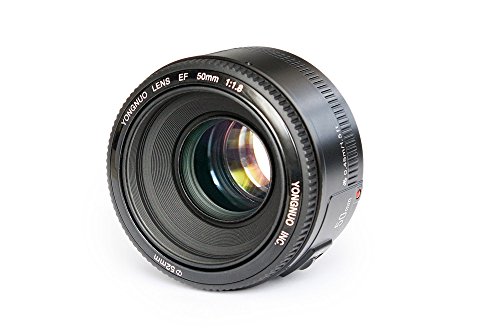
A third-party 50mm fast prime for under $60. Autofocus is slower than the Canon equivalent and optical quality drops at the corners wide open, but for a beginner who wants to understand what shooting at f/1.8 actually looks like, this gets you there at a fraction of the first-party cost. The right call if you're on a Canon DSLR body and want to experiment before committing to a $150 lens.
What we like
Under $60, cheapest way to experience real f/1.8 background blur
50mm on APS-C gives a flattering, versatile portrait length
What to know
Autofocus is noticeably slower than Canon's first-party lenses
Corner sharpness falls off at f/1.8; stop down to f/2.8 for crisp edges
The portrait lens. The 85mm focal length flatters faces, and f/1.8 produces background separation that makes subjects pop off the frame. On an APS-C body it behaves like a ~127mm equivalent, telephoto enough that you need distance from your subject (it keeps you from crowding people). Buy it when you've decided you love portraits and want to get serious about them.
What we like
85mm flatters faces, the classic portrait focal length for a reason
f/1.8 bokeh separates subjects cleanly from any background
What to know
Needs real distance from your subject; useless in tight indoor spaces
APS-C crop pushes it to ~127mm equivalent, limiting everyday versatility
Memory cards are cheap enough that there is no reason to cut corners, and the consequences of a cheap one are severe. Corrupted SD cards are not recoverable in any meaningful sense. Buy a name-brand UHS-I or UHS-II card with at least 100MB/s write speed. Buy two. Don't buy the 12-pack of no-brand cards on sale. This is the one category in photography where price optimization is a genuinely bad idea.
Best starter
SanDisk
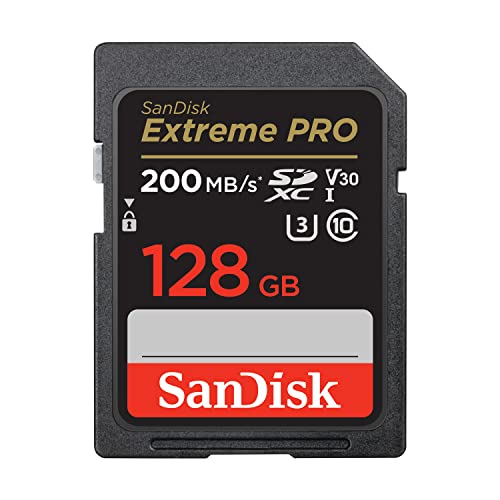
Extreme Pro SD 128GB
$46.78 as of Jun 22, 2026
★★★★★Our rating· In Stock
The reliable choice photographers reach for first. 200MB/s read, 90MB/s write: fast enough for burst shooting and 4K video on any current mirrorless. SanDisk's warranty and recovery software are real differentiators. Buy two: one primary, one in your bag as a backup. Label them.
What we like
200MB/s read handles burst shooting and 4K video without bottlenecking
SanDisk recovery software can rescue accidentally deleted photos
What to know
Costs more than off-brand cards; worth it, but the price gap is real
Waterproof, shockproof, and the fastest SD card in most consumer camera slots. If you're shooting outdoors in variable conditions (beach, trail, rain), the Sony Tough is worth the premium. Harder to accidentally crack or drop and lose than a standard card. The right choice for anyone who's going to be hard on their gear.
What we like
Waterproof and shockproof, survives beach, rain, and trail conditions
Fastest SD card in most consumer camera slots
What to know
Costs roughly 2× a SanDisk Extreme Pro for the same capacity
A camera bag is less about organization and more about protection. A $900 mirrorless body shouldn't bounce around in a regular backpack. You want a bag with at least one padded compartment that holds the body plus a spare lens, with room for personal items. Camera backpacks are better for hiking and all-day shoots. Slings are better for urban, run-and-gun shooting where you need quick access without taking the bag off.
Best starter
Lowepro
Fastpack BP 250 AW III
$148.99 as of Jun 22, 2026
★★★★★Our rating· In Stock
The camera backpack most photographers end up with eventually, so you might as well start here. Fits a mirrorless body, 2–3 lenses, a 15" laptop, and has a built-in rain cover. The rear-access panel means nobody can unzip it while it's on your back. Solid construction, no frills, designed to actually carry camera gear all day.
What we like
Fits body, 2-3 lenses, and a 15" laptop in one well-organized pack
Rear-access panel prevents bag-snatching in crowds
Built-in rain cover included, no separate purchase needed
What to know
Bulkier than a sling bag for quick street-shooting access
★★★★☆Our rating· Only 1 left in stock - order soon.
If you're carrying a single body and one lens and want quick access over your shoulder, a sling is the right call. This one holds a mirrorless body plus two small lenses, weighs almost nothing, and won't look out of place anywhere. Under $40. The right bag if your shooting is casual and you're not yet sure photography will stick.
What we like
Under $40 and weighs almost nothing when empty
One-shoulder sling allows fast camera access without removing the bag
What to know
Too small for a second lens or a laptop
Thin padding, not suitable for rough travel or checked luggage
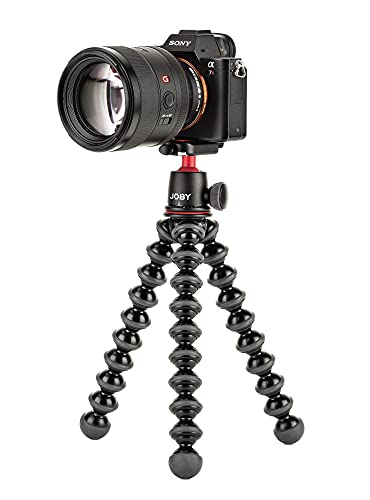
You don't need a tripod in your first month, but you will eventually want one. A tripod unlocks long exposures, sharp low-light shots, self-portraits, and stable video. The mistake beginners make is buying a $25 flimsy tripod that wobbles in a light breeze. A decent lightweight tripod in the $50-80 range is where beginner value lives. Go aluminum now; carbon fiber is for when you're hiking miles with a full kit.
Best starter
Joby
GorillaPod 3K
$$
★★★★★Our rating
The most creative tripod a beginner can own. Flexible legs wrap around railings, branches, poles, and fence posts, giving you compositions impossible from a traditional tripod. The 3K model handles most mirrorless bodies and smaller DSLRs. Lightweight enough to live in your camera bag and forget about until you need it. Not a full-height tripod replacement, but a better first buy for most people.
What we like
Flexible legs wrap around railings, branches, and poles for unique angles
Small enough to live permanently in your camera bag
What to know
3kg max load, not for heavy telephoto or gripped bodies
Not a replacement for full-height traditional tripod use
When you need fixed height for long exposures, self-portraits, or video on flat ground, a traditional tall tripod is the right tool. This one extends to 60 inches, has a smooth pan-and-tilt head, and costs around $25. Not glamorous, but it does the job and won't make your photos worse.
What we like
Extends to 60 inches, full standing height for portraits and video
Around $25, the cheapest functional traditional tripod available
What to know
Wobbles in any wind, unreliable for long exposures outdoors
Plastic components feel flimsy and won't survive rough handling
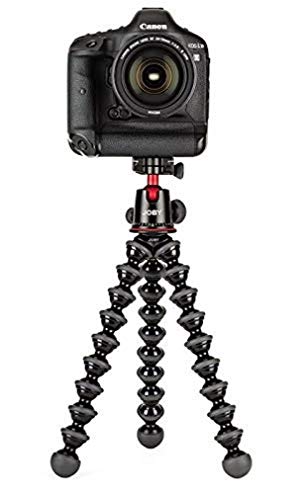
Handles heavier setups (up to 5kg) and is more stable on flat surfaces than the 3K. If you're shooting video and need a smoother ball head, or if you've added a heavier lens, this is the natural upgrade path. Same flexibility as the 3K with more headroom as your kit grows.
What we like
5kg capacity handles heavier lenses and gripped camera bodies
More stable on flat surfaces than the 3K, better for video work
What to know
Pricier than the 3K for gains most beginners won't notice yet
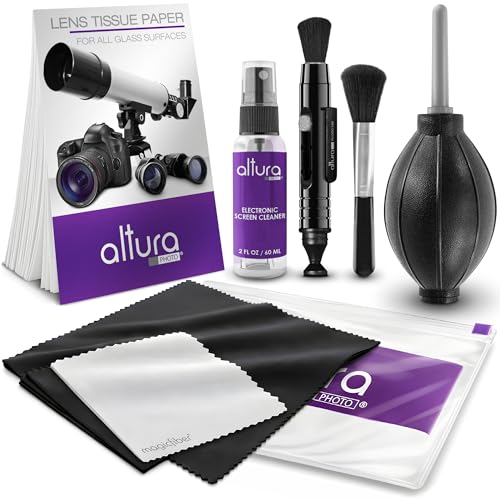
A lens cleaning kit and a spare battery are the only accessories you need to start. Total cost under $40. Your lens will accumulate fingerprints and dust faster than you expect; dirty glass causes soft shots and flare you'll blame on your technique. And a dead battery in the middle of a shoot is the kind of frustration you only experience once before buying a spare.
Best starter
Altura Photo
Camera Cleaning Kit
$15.98 as of Jun 22, 2026
★★★★★Our rating· In Stock
Microfiber cloths, a blower, a lens brush, and cleaning solution in one kit under $15. Clean your lens before each shoot; it takes 30 seconds and it matters more than you think. A blower removes sensor dust spots that show up as grey smudges on every photo taken at f/8 or smaller. This kit lasts a year.
What we like
Covers every cleaning task: blower, brush, microfiber cloth, solution
Blower removes sensor dust that ruins shots at small apertures
What to know
Cleaning solution bottles are small; need a refill after 6–12 months
Third-party batteries have a bad reputation they haven't deserved at this tier for years. Wasabi Power cells work in Sony bodies without error messages and run almost as long as first-party. A 2-battery + charger kit for under $25 means you never end a shoot early. If you're on Canon, search 'Wasabi Power LP-E17' for the equivalent.
What we like
Two batteries eliminate mid-shoot power failures entirely
Works in Sony bodies without compatibility error messages
What to know
Battery model is body-specific; easy to order the wrong one by mistake
Most beginners spend weeks in full-auto mode, wondering why their photos look wrong. Here's what actually happens, week by week, between picking up a camera and making a photograph you're genuinely proud of.
Photography has a reputation for being technically overwhelming. Aperture, ISO, shutter speed, white balance, RAW vs. JPEG: it looks like a subject you need to study before you can start. You don’t. The technical side is a small vocabulary with about a dozen words, and you’ll absorb it in a few hours of actual shooting faster than you would in days of reading.
The real challenge in your first month isn’t the gear or the settings. It’s learning to see. That’s the part nobody can hand you; it develops through repetition, attention, and looking at a lot of photographs. Here’s what the first month actually looks like.
Week 1: Get off Auto, one setting at a time
Your camera shipped with a big green Auto mode that makes every decision for you. Use it for your first few hours (that’s fine), but move off it by the end of your first week.
The right starting point is Aperture Priority (marked A or Av on your mode dial). In Aperture Priority, you control one thing: the aperture (how wide the lens opens, expressed as f/1.8, f/5.6, f/11, etc.). The camera handles shutter speed automatically. This single change gives you control over the most visually obvious variable in photography (depth of field), while keeping everything else automated.
Here’s what aperture actually does: a low f-number (f/1.8, f/2.8) means the lens is open wide, letting in more light and blurring the background. A high f-number (f/8, f/11) means the lens is partially closed, letting in less light but keeping more of the scene sharp. Portrait photographers often shoot at f/1.8 to isolate a face against a soft background. Landscape photographers often shoot at f/8 to keep everything in focus from the rocks at their feet to the mountains in the distance.
Set your camera to Aperture Priority. Shoot something at f/2.8 and at f/11. Look at both photos. The difference is immediately obvious, and now you understand the most important dial on your camera.
The other setting to adjust in week one is ISO, your camera’s light sensitivity. Low ISO (100, 200) produces clean, sharp images; high ISO (3200, 6400) introduces visible grain, called noise. In daylight, leave ISO on Auto or set it to 100. Indoors or at dusk, raise it until your photos are bright enough. You’ll learn your camera’s high-ISO limit within a few shoots; modern APS-C cameras are generally clean to ISO 1600 and acceptable to 3200.
Shoot 100 photos in your first week. Walk around your neighborhood or home. Don’t worry about subject or composition yet. You’re building the muscle memory of handling the camera, and 100 photos will teach you more about your specific body and lens than two hours of YouTube.
At the end of the week: pick your 5 best shots and write down what made each one work.
Week 2: The exposure triangle, and your first real composition decisions
By week two, you’ll have a feel for aperture and ISO. Now it’s time to add the third leg: shutter speed.
Shutter speed controls how long your sensor is exposed to light. It’s measured in fractions of a second: 1/2000s freezes a sprinting athlete; 1/60s is about the minimum you can handhold without blur; 1/4s in low light will show any movement in your frame as soft streaks. The classic use case for slow shutter speed is moving water: a waterfall shot at 1/4 second goes silky; the same shot at 1/1000s looks frozen and sharp.
To control shutter speed directly, switch from Aperture Priority to Manual mode (M on the dial) or Shutter Priority (S or Tv). In Manual, you set both aperture and shutter speed yourself and use your camera’s light meter (the bar in the viewfinder or on the screen) to tell you if you’re over or underexposed. Most photographers spend years in Aperture Priority and Manual, rarely touching Shutter Priority.
Spend an afternoon shooting in Manual. It will feel slow and frustrating. That’s correct. You’re learning to think about light. After two or three sessions in Manual, Aperture Priority will feel natural and intuitive in a way it didn’t before.
Composition in week two: Photography has a handful of composition principles that get repeated because they work: the Rule of Thirds, leading lines, foreground interest. The Rule of Thirds says to place your subject off-center rather than dead in the middle: imagine your frame divided into a 3×3 grid, and put your subject at one of the four intersections. Cameras can display this grid overlay on the screen; turn it on for your first few weeks.
More important than any specific rule: look at your feet before you look at your viewfinder. The biggest compositional mistake beginners make is standing where they were standing when they noticed the scene, instead of walking around it to find the best angle. Move closer. Get lower. Try the shot from the left, then from the right. The best angle is rarely the obvious one.
Every photographer you admire is obsessed with light. Not subject matter, not equipment. Just light. Understanding light is what separates photos that feel flat from photos that feel alive.
The golden hours (roughly 30–60 minutes after sunrise and before sunset) produce the warm, directional, low-angle light that makes landscapes, portraits, and street photography look cinematic. It’s not magic; it’s physics. Low sun creates long shadows, separation between objects, and warm color. Midday sun comes straight down, flattens faces, and creates harsh shadows under eyes and noses.
If you want to improve your photography faster than anything else in your first month: go out during golden hour once. Shoot the same subject you’ve been shooting in harsh midday light. Look at both. You’ll understand instantly why photographers get up at 5 AM.
Overcast light is the second thing to understand. Overcast skies diffuse sunlight into a huge soft source, perfect for portraits (no harsh shadows), flowers, and anything where you want even, detail-preserving light. Many photographers prefer overcast days for portraits over clear days for exactly this reason.
Direction matters more than source. Side light (light coming from the left or right of your subject) creates dimension and texture. Front light (light behind you, hitting your subject straight-on) is flat and documentary. Back light (light behind your subject, facing the camera) creates silhouettes, rim light, and lens flare, difficult but dramatic when it works.
Spend a day paying attention to nothing but where the light is coming from in every scene you encounter. Before you raise the camera, ask: where is the light? Is it hard or soft? What is it doing to shadows? This is the exercise that builds the eye.
By week four you’ll have several hundred photos. Now it’s time to edit, and more importantly, to cull.
Culling is the act of choosing your best work. Most working photographers keep roughly 1–5% of what they shoot. As a beginner, you’ll keep more, but getting comfortable throwing photos away is as important as taking them. The instinct to keep everything because “it might be useful” produces a 10,000-photo library you never revisit. A 300-photo library of only your best work is far more valuable.
Cull in rounds. First pass: delete anything technically broken (out of focus, badly exposed, wrong moment). Second pass: from what’s left, pick your best 20% based on composition and feeling. Third pass: from those, pick your favorites.
For editing software, start with what’s free. If you bought a Sony body, Sony Imaging Edge works fine for basic adjustments. The free version of Adobe Lightroom handles basic edits on a limited number of photos per month. Darktable is fully free, open source, and more capable than most beginners need. You don’t need to pay $15/month for Lightroom yet; do it when you know you’ll use it, not before.
The five adjustments that matter most for beginners: exposure (overall brightness), highlights (pull them down to recover blown-out skies), shadows (lift them to see into dark areas), clarity (local contrast, use sparingly), and sharpening. Those five cover 90% of what you’ll actually do in your first year.
Things you’ll do wrong (and that’s normal)
Photography has a short list of beginner mistakes so universal they’re almost a rite of passage:
Blurry photos from camera shake. Your shutter speed is too slow for handheld shooting. A rough rule: keep shutter speed at or above 1/(focal length). At 35mm, that means 1/40s or faster. At 200mm, 1/200s or faster.
Blown-out skies. You exposed for the foreground, and the sky turned white. Fix it with exposure compensation (dial it down) or shoot during golden hour when sky and ground are closer in brightness.
Missed focus on portraits. Your camera focused on the wrong eye, or on the nose, or on the background. Set your AF point manually, or use Eye AF if your camera has it. Always focus on the near eye.
Backgrounds that fight the subject. A pole growing out of someone’s head, a distracting sign, a cluttered wall. Look at the entire frame before shooting, not just the subject. Moving two steps left or crouching down often fixes it instantly.
Keeping bad photos out of loyalty. You worked hard to get that shot. The shot is still soft and poorly exposed. Delete it. It doesn’t get better with time.
Nobody watching cares about your mistakes. The better photographers around you have made every one of these and forgotten about it.
What to do in month two
A few things that change the slope of your improvement:
Find a constraint. Spend a week shooting only in black and white. Shoot only with a 35mm prime and don’t zoom with your feet. Pick one subject (doors, strangers, coffee) and shoot it exclusively for a month. Constraints force creative thinking in a way that unlimited freedom doesn’t.
Study photographs you admire. Pick a photographer whose work excites you (Vivian Maier, Henri Cartier-Bresson, Gregory Crewdson) and spend an hour looking at 50 of their images. Ask: where is the light coming from? Where is the camera positioned? What’s in sharp focus and what isn’t? What does the photo include and exclude?
Post your work and invite feedback. r/photocritique and most local photography clubs will give you direct, honest assessments. The feedback stings sometimes. It’s also the fastest way to break out of your own blind spots.
You’re not a beginner anymore at the end of month one. You’re a photographer with too-slow shutter speeds and a tendency to forget about backgrounds, which is a considerably more interesting thing to be.
Save your money
What you don't need yet
Beginners get pressured to buy a lot of stuff that doesn't help them play
better. Here's what we'd skip on day one.
A full-frame camera body — An APS-C mirrorless will produce better photos than you're capable of for the first year. Buy into full-frame when you've genuinely outgrown crop-sensor thinking. Not before.
A telephoto zoom lens (70-200mm, 100-400mm) — Expensive, heavy, and specialized. Learn fundamentals with a prime or kit zoom first. Wildlife and sports photographers need these; beginners exploring portraits and travel do not.
Lightroom or Capture One subscriptions — Both cost real money monthly. Start with the free software that ships with your camera (Sony Imaging Edge, Canon Digital Photo Professional) or use free Darktable. You'll know you want Lightroom once you've shot a few hundred photos and need organization.
An external flash or speedlight — Learning to find and use natural light is a more valuable skill than controlling artificial light. Don't buy a flash until you've hit the actual limits of natural-light photography.
Filters (ND, CPL, UV) — Polarizers and ND filters have legitimate uses for landscape photographers. But they add complexity and cost. Learn exposure without filters first; they're not going anywhere.
A carbon fiber tripod — The real benefit of carbon fiber over aluminum is weight savings you'll appreciate after miles of hiking with a full kit. You'll know you need one long before you actually do.
First week
Your first seven days
A short, real plan to get from gear-on-doorstep to actually playing.
Take your camera off 'Auto' and switch to Aperture Priority mode (A or Av on the dial). It's the fastest way to start making intentional photographs. · Action
Order two fast SD cards so they arrive before your first real shoot. · Buy
Learn the exposure triangle: aperture, shutter speed, and ISO. You don't need to memorize numbers; just understand how each one trades against the others. · Learn
Cambridge in Colour: Tutorials · The best free technical resource for beginners on the web. Start with Exposure and Depth of Field.
Shoot 100 photos of anything. Walk around your neighborhood, your home, the nearest park. Volume builds the eye faster than theory. · Action
Pick your 5 best photos from the 100. Study why those five are better than the other 95. · Action
Post one photo to r/photocritique or r/AskPhotography and ask for feedback. The honest response from other photographers is worth hours of reading. · Learn
r/AskPhotography · Beginner-friendly Q&A. No such thing as a dumb question here.
FAQ
Common questions
Should I shoot in RAW or JPEG as a beginner?
JPEG for your first few months. RAW files give you more post-processing latitude but require editing software to view at all. JPEGs are ready immediately and will teach you to get exposure right in-camera, which is a more valuable skill than fixing mistakes in post.
Should I get a mirrorless camera or a DSLR?
Mirrorless in 2026. The major manufacturers (Canon, Sony, Nikon, Fujifilm) have all shifted development to mirrorless. DSLRs are a mature format with no new bodies coming; you're buying a sunset ecosystem even if the used prices are attractive.
What's the real difference between a $700 and a $2,500 camera?
Low-light performance, autofocus speed, build quality, and weather sealing. None of these matter for your first year. The $700 camera will outperform your eye for a long time. The answer to every gear question in your first year is 'take more photos.'
How much storage do I need?
Start with two 128GB cards. 128GB holds roughly 3,000–5,000 JPEG photos or 1,500–2,500 RAW files, more than enough for a full day of shooting. The second card is your backup: carry it, use it when the first fills up, and replace the first if it starts acting unreliably.
Do I need to take a photography class?
Not immediately. Shoot for a month first; you'll come to class with real questions instead of abstract ones. A single half-day workshop after your first month is more valuable than one before you've touched the camera. Online resources (Cambridge in Colour, Tony Northrup's YouTube) cover the fundamentals for free.
How much does it cost to start photography?
A solid beginner kit (APS-C mirrorless + kit lens + two SD cards + a bag) runs $800–1,000 new, or $500–700 buying used. Cameras hold their value, so you can resell if it doesn't stick. Ongoing costs are low; the main one is editing software if you eventually want Lightroom.
Cambridge in Colour — The best free technical photography resource on the web. Tutorials on exposure, depth of field, sensors, lenses, and processing. Read the entire beginner section in your first week.
Photography Life — In-depth gear reviews, tutorials, and technique guides. Excellent for understanding what camera specs actually mean in practice.
Tony & Chelsea Northrup (YouTube) — Patient, opinionated beginner-to-intermediate tutorials. Tony's 'Photography Buying Guide' is the best gear overview for beginners.
Peter McKinnon (YouTube) — High-energy creative photography and video tutorials. More inspiring than technical. Watch to get excited about what's possible.
DPReview — The most thorough camera and lens review site. Exhaustive lab tests. Read the summary pages; the full reviews run 15,000 words.
r/photography — Large, active community. The wiki is an excellent starting point. Skip the gear-recommendation threads, prone to brand tribalism.
r/AskPhotography — Beginner Q&A. No such thing as a dumb question here. Search before posting; many common questions are thoroughly answered already.
r/photocritique — Post your work, get honest feedback. The fastest way to improve is to have your photos evaluated by people who know what they're looking for.
Strobist — David Hobby's seminal guide to off-camera flash. Skip entirely until you've spent 3-6 months shooting with natural light, then start at the beginning.
The Online Photographer — Mike Johnston's long-running photography blog. Slower pace, more reflective, focused on craft over gear. A good antidote to spec-obsession.
As an Amazon Associate, JustBeginning earns from qualifying purchases.
We may also earn commission from other affiliate programs linked on this
page. Editorial recommendations are independent; we don't choose
products based on commission rates.
Product prices and availability are accurate as of the date and time
indicated and are subject to change. Any price and availability
information shown on Amazon at the time of purchase will apply.


 Best starter