Making sausage from scratch sounds more complicated than it is. The whole system is a meat grinder, some casings, and a recipe you trust. The payoff is real control: the fat ratio, the seasoning, and the exact ingredients in every link you make.
By Colin B. · Published June 13, 2026 · Last reviewed June 13, 2026
A standalone grinder with stuffing tubes and a case of casings gets you started for $150-200. Add a dedicated stuffer later if the hobby sticks.
We earn commission on qualifying Amazon purchases — see our
affiliate disclosure.
Price tiers and budget totals shown above are editorial estimates;
actual Amazon prices vary.
At a glance
Our top pick in each category
The fastest path through this guide — each best-starter pick by category.
Scroll for the budget and upgrade alternatives.
Your grinder is your most important purchase, but you don't need the biggest one. A #8 grinder handles everything a home cook throws at it: 5-lb batches, two or three times a month. The upgrade to a #12 or #22 makes sense only if you're grinding 20 lbs at a sitting.
Don't skip the scale. Sausage seasoning ratios are by weight, not volume. A tablespoon of salt looks different in every spoon. A kitchen scale that reads to the gram is the most important cheap tool in your kit.
Fresh vs. cured sausage is a real distinction. Fresh sausage (bratwurst, Italian, breakfast links) is what most beginners make: grind, season, stuff, cook or freeze. Cured sausage (summer sausage, pepperoni, salami) requires curing salts, temperature control, and more process. Start fresh. Cured comes later.
The gear
What you actually need
Meat Grinder
The grinder is the heart of the whole operation. It chops the meat to your preferred texture and, with the stuffing tubes most models include, can fill casings directly. For home batches of 5-10 lbs, a #8 grinder is the sweet spot: powerful enough to handle partially frozen meat (which grinds cleaner), compact enough to store, and widely available with replacement parts. Go bigger only if you're processing a whole hog.
Meat Grinder — what's the difference?
A few common shapes, each making a different trade.
Standalone Electric
Dedicated power for 5-lb-plus batches. The right tool if you're serious.
Typical size
#8 (home) or #12 (semi-pro)
Batch capacity
5-20 lbs
Price range
$130-350
Best for Anyone making more than a couple batches a year
No electricity, small footprint, fine for 1-2 lb batches.
Batch capacity
1-2 lbs per session
Price range
$25-60
Best for Camping, very occasional use, or testing the hobby before committing
Tradeoff Arm fatigue on anything more than a pound or two
Best starter
LEM Products
#8 Big Bite Electric Meat Grinder
$506.00 as of Jun 22, 2026
★★★★★Our rating· In Stock
LEM is the reference brand for home meat processing, and the #8 Big Bite earns that reputation. It chews through 5-lb batches of partially frozen pork shoulder without complaint, and ships with two stuffing tubes and grinder plates for coarse and fine grind. The all-metal construction means it will outlast multiple sausage seasons.
What we like
All-metal construction handles partially frozen meat without jamming
Ships with stuffing tubes and coarse/fine grinder plates
LEM replacement parts are widely available if anything wears out
What to know
Pricier than budget grinders, though it lasts proportionally longer
Stuffing via grinder tube is slower than a dedicated vertical stuffer
Half the price of the LEM and capable enough for the occasional 3-5 lb batch. The motor runs hotter and won't handle partially frozen meat as confidently, so chill your meat fully before grinding. A reasonable first grinder if you're not sure sausage making will stick.
What we like
Half the price of mid-range grinders, solid entry-level performance
Includes multiple plates and stuffing tubes out of the box
What to know
Motor heats up on sustained use; rest between 5-lb loads
Plastic housing; treat it more gently than an all-metal grinder
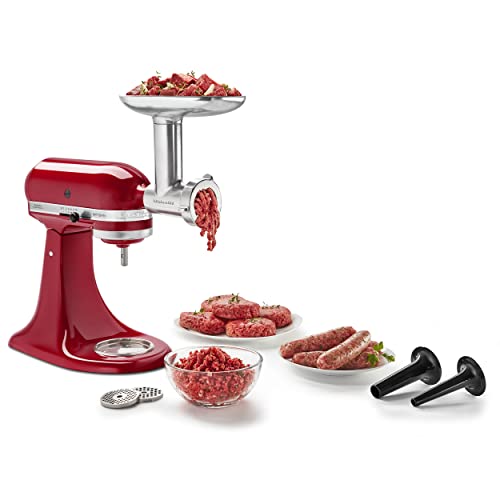
If you already own a KitchenAid stand mixer, this attachment turns it into a capable meat grinder for under $70. It grinds 2-3 lb batches cleanly, includes a coarse and fine plate, and stores flat. Not as powerful as a standalone grinder for larger batches, but a smart entry point if the mixer is already on the counter.
What we like
Under $70 if you already own a KitchenAid mixer
Clean metal construction, easy to disassemble and clean
What to know
Labors beyond 3 lbs; not for large batches or fully thawed fatty meat
Requires a KitchenAid stand mixer, so not a standalone option
Most meat grinders ship with plastic stuffing tubes, and those tubes work for your first few batches. The problem is that pushing meat through a grinder in reverse is slow and produces friction that warms the fat and hurts texture. A dedicated vertical stuffer (a cylinder with a piston you push down) moves meat into casings faster, with less air, and without the warming problem. Worth buying once you've made 3-4 batches and know you're hooked.
Best starter
LEM Products
5-Pound Vertical Sausage Stuffer
$229.99 as of Jun 22, 2026
★★★★★Our rating· In Stock
Five pounds is the right cylinder size for home batches: big enough to do a full pork shoulder without refilling, small enough to store easily. The stainless steel cylinder cleans up quickly and the hand-crank gear makes stuffing bratwurst-sized casings manageable solo.
What we like
Stainless cylinder and reliable hand-crank gear handle casings without blowouts
Includes multiple stuffing tubes for different casing diameters
What to know
Pricier than entry stuffers, though build quality justifies it
A 7-lb stainless stuffer at a more accessible price. The larger cylinder suits bigger batches, and Hakka Brothers has a reputation for reliability in home processing circles. A solid alternative to the LEM if you want to spend less on your first dedicated stuffer.
What we like
7-lb cylinder handles full batches without refilling
Stainless construction at a price well below the LEM
What to know
Heavier and bulkier than a 5-lb stuffer; tighter in small kitchens
Single-speed gear is workable but not as smooth as the two-speed LEM
Casings hold the sausage together and give it that satisfying snap when you bite in. Natural casings (made from animal intestines) are traditional and deliver the best texture. Collagen casings (edible manufactured collagen) are easier to work with: no soaking required, uniform size, and no fussing with knots. Start with natural hog casings for fresh sausage; switch to collagen if the prep work frustrates you.
Best starter
LEM Products
Natural Hog Casings
$13.99 as of Jun 22, 2026
★★★★★Our rating· In Stock
The standard casing for bratwurst, Italian sausage, and most fresh links. Sold packed in salt, they keep in the fridge essentially indefinitely, and the pack covers 25-40 lbs of sausage. Soak in water 30 minutes before stuffing. The natural snap when you bite is why people bother making sausage in the first place.
What we like
Traditional casing with the best snap and texture when cooked
Salt-packed; keeps in the fridge for years using portions at a time
What to know
Requires soaking before use and rinsing inside and out
Occasional natural weak spots can blow out if you overstuff
No soaking, uniform size, and no slipping ends. Collagen casings are edible, made from beef collagen, and ideal for beginners who want to focus on seasoning and technique without the prep of natural casings. Slightly chewier bite than natural, but they make a clean, consistent link every time.
What we like
No soaking or prep; load directly onto the stuffing tube
Uniform diameter every time for consistent link length
What to know
Less snap and bite than natural casings when cooked
Splits if moistened before use or stuffed too tightly
Sausage seasoning is salt, spices, and sometimes cure (for shelf-stable or smoked sausage). Pre-blended kits from dedicated suppliers are calibrated for the right salt percentage by weight and include the ratios for classic recipes. For beginners, a kit removes one variable from the process so you can focus on technique. Once you've made a few batches, you'll start tweaking ratios and eventually building your own blends.
Best starter
Hi Mountain Seasonings
Bratwurst Sausage Making Kit
$30.89 as of Jun 22, 2026
★★★★★Our rating· In Stock
Hi Mountain is the go-to for home sausage makers who want a reliable, well-tested starting point. The bratwurst kit seasons up to 24 lbs of meat, includes clear instructions, and produces a bratwurst that actually tastes like bratwurst. A confidence-building first batch before you start improvising your own blends.
What we like
Calibrated ratios take the guesswork out of your first batch
Seasons up to 24 lbs; excellent value for the meals it produces
What to know
Flavor profile is fixed; you're making their bratwurst, not your own
Kit-dependent approach delays building your own seasoning instincts
★★★★☆Our rating· Only 7 left in stock - order soon.
If you want to make cured sausages (summer sausage, snack sticks, cured breakfast links) or anything smoked at low temperatures, you need Insta Cure No. 1. This is sodium nitrite mixed with salt, and it prevents botulism growth during long low-temp smoking. Not needed for fresh sausage; required for any cured product.
What we like
Required for food-safe low-temperature smoked sausage
A small container lasts through many batches at the correct dose
What to know
Strictly measure by weight only; eyeballing is a food safety risk
Only needed for cured products; skip it for fresh sausage entirely
These two tools are non-negotiable. A kitchen scale that reads to the gram makes seasoning accurate (sausage salt ratios are by weight, and small differences matter). An instant-read thermometer tells you when fresh sausage is cooked to a safe 160°F internal temperature. Both cost less than $35 combined and earn their spot in your kit on the very first batch.
Best starter
Escali
Primo Precision Kitchen Scale
$25.00 as of Jun 22, 2026
★★★★★Our rating· In Stock
Reads to 1 gram up to 11 lbs, which covers everything in sausage making from weighing cure salts to weighing full pork shoulders. The tare function works reliably, the platform fits a large mixing bowl, and it has been a kitchen staple for years because it simply works.
What we like
Reads to 1g up to 11 lbs, right range for home sausage seasoning
Large platform fits a mixing bowl; tare function is accurate and reliable
What to know
Battery-powered; keep spares around for multi-hour sessions
11-lb max means weighing larger pork shoulders in two portions
A probe thermometer that reads in 3-4 seconds. Sausage is safe at 160°F internal; this tells you definitively when you're there. At under $15, there's no reason not to own one.
What we like
3-4 second read time, fast enough to check multiple links quickly
Under $15 and accurate enough for food safety decisions
What to know
No backlight on the basic model, harder to read in dim light
Single-point probe; check the thickest part of each link separately
Sausage making has one genuinely tricky moment and it lasts about ten minutes. After that, it's just grinding, seasoning, and watching your kitchen smell incredible.
Home sausage making has a reputation for being complicated, and it’s not completely undeserved. There are food safety considerations, a few pieces of equipment, and one moment with a casing that will humble you the first time. But the actual process, start to finish, fits in a Saturday morning. By lunch you’ll have a rack of links cooling on the counter and a very good reason to fire up the grill.
This is what your first batch actually looks like, step by step.
Before you start: the mise en place that matters
Sausage making is a cold-chain activity. Everything from the meat to your equipment to the mixing bowl should be cold. Fat that warms up smears rather than binds, which gives you a greasy, loose texture instead of the tight, snappy sausage you’re after. This is the single most important thing beginners don’t know.
The night before, put your meat grinder parts (or the whole standalone grinder if it fits) in the freezer. Cube your pork shoulder into 1-inch pieces and freeze them for 30-45 minutes before grinding, until they’re firm but not rock-solid. This is not optional.
While the meat chills, measure your seasonings by weight and set them aside. For a bratwurst kit, follow the kit’s ratios exactly on your first batch. Your instincts about salt will be wrong; the recipe’s won’t be.
Pull your meat out of the freezer when it’s firm at the edges but still pliable in the center. If your grinder has both a coarse plate (usually 3/8”) and a fine plate (1/4”), use the coarse plate first. You’ll grind twice on your first batch: once through coarse, then once through fine. This double-grind creates a tighter bind and a better texture for fresh sausage.
Feed the meat into the grinder a few cubes at a time, not in a rush. If the grinder starts to labor or squeal, stop and check for sinew or silverskin wrapping around the worm gear. Clear it out (a wooden spoon works) and continue. This is normal and happens to everyone.
After grinding, put the meat back in the refrigerator immediately. You want it below 40°F when you mix in the seasonings.
Add your measured seasonings to the cold ground meat and mix by hand for 2-3 minutes. You’re looking for the meat to develop a tacky, almost sticky texture; it clings to itself when you press a handful together. That stickiness is protein extraction, and it’s what holds the sausage together during cooking. Undermixed sausage crumbles. Overmixed sausage goes tough. Two to three minutes of vigorous hand mixing is the range.
Preparing your casings
If you’re using natural hog casings (the standard choice), pull a length out of the salt-packed container and soak them in cold water for 30 minutes. Then rinse the inside by holding one end under a running faucet, letting the water run through the full length. This removes the salt and any debris and makes them pliable for stuffing.
Don’t skip the rinsing step. An unrinsed casing will be stiffer, more prone to tears, and will taste like salt.
If you’re using collagen casings: don’t soak them at all. Load them directly onto the stuffing tube dry. Water makes them brittle.
Load a length of casing onto your stuffing tube by bunching it accordion-style, leaving about 3 inches dangling off the end. Tie a knot in the dangling end, or just leave it loosely tied. Don’t put your seasoned meat in yet.
Crank (or push) a small amount of meat through first to purge the air from the tube, then tie off or pinch the casing end, and start feeding meat. The goal is to fill the casing firmly but not to maximum pressure. Firm enough that the casing has no air pockets; loose enough that you can pinch and twist without bursting it.
You will burst a casing on your first batch. This is expected. It feels like failure. It isn’t. When it happens, pinch off the broken section, tie it off, and keep going. The link will be a little awkward but perfectly edible.
Once you’ve stuffed a length, twist into individual links by pinching and rotating every 5-6 inches. Alternate the direction of your twists (clockwise, then counterclockwise) to keep them from unraveling. Lay the finished links on a rack in the refrigerator uncovered for an hour; this dries the casing surface slightly and helps them hold their shape.
The test cook
Before you tie off the last of your batch, cook one link in a pan. This is your seasoning check. Cut into it at 160°F internal temperature, taste it, and decide if the seasoning needs adjustment before you finish the rest.
This matters because your scale, your technique, and your meat’s fat ratio are all variables that can shift the flavor slightly from what the recipe predicts. The test cook lets you catch it before committing to 5 lbs of under- or over-seasoned links.
Uneven link sizes. You’ll twist some fat and some thin. This is purely visual; they cook the same way. Consistency improves batch by batch.
A burst casing or two. Usually from overstuffing or a weak spot in the casing. Keep stuffing, keep cooking, move on.
A seasoning that’s close but not quite right. Maybe a little undersalted, maybe the pepper is louder than expected. Write it down, adjust on batch two. This is how you develop your own recipe.
Links that fall apart when you twist them. Usually under-mixing; the protein bind wasn’t fully developed. Two more minutes of hand mixing next time.
None of these produce inedible sausage. They produce second-batch lessons.
What to do with the batch
Fresh sausage is best cooked within 3-4 days or frozen immediately. Don’t refrigerate it for a week and then wonder why it smells off. Freeze in meal-sized portions, vacuum-sealed or in a freezer bag with the air squeezed out.
Cook fresh sausage low and slow: a skillet over medium with a tablespoon of water or beer, covered, for 10-12 minutes, then uncover and brown the outside. The internal temperature you’re cooking to is 160°F. An instant-read thermometer makes this a 3-second check instead of a guessing game.
The first batch is always the most instructive. You’ll know exactly what you want to change on the second one, which is how it’s supposed to work.
Save your money
What you don't need yet
Beginners get pressured to buy a lot of stuff that doesn't help them play
better. Here's what we'd skip on day one.
A smokehouse or dedicated smoker — Master fresh sausage first. Smoking comes after you've nailed the grind-and-season workflow.
Dry-curing chambers — Charcuterie and dry-cured salami require controlled humidity and months of aging. That's a different hobby.
A #22 or larger commercial grinder — Overkill unless you're processing whole animals. A #8 handles everything a home cook needs comfortably.
A vacuum sealer — Freezer bags work fine for 1-2 month storage. Get a sealer when you start making 10-plus lbs at a time.
Specialty casings (sheep casings, large beef middles) — Master hog casings first. Sheep casings for breakfast links and beef middles for bologna are easy upgrades once you have the basics down.
First week
Your first seven days
A short, real plan to get from gear-on-doorstep to actually playing.
Order your grinder and casings so they arrive by Saturday. · Buy
Chill your meat to 34-38°F before grinding. Partially frozen meat grinds cleaner and keeps the fat from smearing. · Learn
Cook one link immediately after stuffing to check seasoning before you tie off the rest. · Action
Freeze what you won't eat within 3-4 days. Portion into meal-sized bags before freezing. · Action
FAQ
Common questions
Do I need a sausage stuffer, or can I use the grinder tubes?
You can absolutely start with the grinder tubes that come with most grinders. They're slower and produce slightly more air pockets, but they work fine for your first few batches. A dedicated stuffer becomes worth it around batch four or five when you've confirmed you enjoy the process.
What's the right fat ratio for sausage?
Most fresh sausage recipes call for 70-80% lean meat and 20-30% fat. Pork shoulder (Boston butt) naturally runs around 75/25, which is why it's the default starting meat. Going leaner makes dry, crumbly sausage; going fattier makes greasy links.
Is home sausage making safe?
Yes, with basic food safety habits: keep your meat cold throughout the process, sanitize your equipment, and cook fresh sausage to 160°F internal temperature. The only additional step for cured or smoked sausage is adding curing salt (Insta Cure No. 1) to prevent bacterial growth during low-temperature smoking.
What's the difference between fresh and cured sausage?
Fresh sausage (bratwurst, Italian, breakfast links) is raw, must be refrigerated, and cooked before eating. Cured sausage (summer sausage, pepperoni, salami) uses nitrites and a curing process that extends shelf life and allows low-temperature smoking. Start with fresh. Cured is a separate, more involved skill set.
Can I use beef instead of pork?
Yes, though beef is leaner and requires you to add fat explicitly. All-beef sausage is traditional for hot dogs and some regional styles. Lamb is excellent for merguez. Pork is just the easiest starting point because the fat ratio is naturally right without extra calculation.
How much sausage does a 5-lb batch make?
About 5 lbs of finished links, give or take trimming and casing waste. Plan on 8-12 bratwurst-sized links from a 5-lb batch, or about 20-25 breakfast links. Freeze what you won't eat within 3-4 days.
The Sausage Maker — The go-to supplier for casings, cure salts, and seasonings. Their blog and recipe library is the best free educational resource for home sausage making.
Len Poli's Sausage Recipes — A classic free recipe library from an Italian-American sausage maker. Hundreds of tested recipes with clear weight-based ratios. Old-school site, totally trustworthy content.
r/sausagetalk — Active community. Good for troubleshooting texture issues and sharing batch results. The wiki has a solid beginner FAQ.
As an Amazon Associate, JustBeginning earns from qualifying purchases.
We may also earn commission from other affiliate programs linked on this
page. Editorial recommendations are independent; we don't choose
products based on commission rates.
Product prices and availability are accurate as of the date and time
indicated and are subject to change. Any price and availability
information shown on Amazon at the time of purchase will apply.
Our top pickLEM Products #8 Big Bite Electric Meat Grinder

 Best starter