Beginner's guide

So you're getting into Star Wars Unlimited

Star Wars Unlimited is the most playable TCG Disney has made. Fast to learn, surprisingly deep, and one of the rare card games where a $15 starter deck can genuinely trade wins against a $500 collection. Here's exactly what you need to start playing, and what to skip for now.

By Colin B. · Published June 11, 2026 · Last reviewed June 11, 2026

The 60-second version

If you only buy 3 things to start:

  1. Star Wars: Unlimited Two-Player Starter Set: Spark of Rebellion — The only box you need on day one. Two full decks, tokens, and a rulebook inside.
  2. Dragon Shield Matte Sleeves (100-pack) — Dragon Shield Mattes are the sleeve every TCG player lands on. Fits SWU cards perfectly.
  3. Ultra Pro Satin Tower Deck Box — The Ultra Pro Satin Tower holds your sleeved SWU deck and costs less than a booster pack.
Budget total
$30
Typical total
$75
A two-player starter set is about $30 and gets you playing immediately. Add sleeves and a deck box and you're at $60-75 for a proper full setup.

We earn commission on qualifying Amazon purchases — see our affiliate disclosure. Price tiers and budget totals shown above are editorial estimates; actual Amazon prices vary.

At a glance

Our top pick in each category

The fastest path through this guide — each best-starter pick by category. Scroll for the budget and upgrade alternatives.

CategoryTop pickPriceWhere to buy
Starter DecksFantasy Flight GamesStar Wars: Unlimited Two-Player Starter Set: Spark of Rebellion$$ See on Amazon →
Booster BoxesFantasy Flight GamesStar Wars: Unlimited Spark of Rebellion Booster Display (24 Packs)$$$ See on Amazon →
Card SleevesDragon ShieldDragon Shield Matte Sleeves (100-pack)$$ See on Amazon →
Deck BoxesUltra ProUltra Pro Satin Tower Deck Box$ See on Amazon →
PlaymatsGamegenicStar Wars Unlimited Hyperspace Game MAT XL$$ See on Amazon →
Before you buy anything

A few things worth knowing first

Start with a two-player starter set, not booster packs. Boosters are for expanding once you know the game. The starter gives you two complete, balanced decks and gets you playing in under 20 minutes.

Buy card sleeves before your first real game. SWU cards are printed on thinner stock than older TCGs, and they show wear fast without protection. Sleeved cards also shuffle dramatically better than bare cardboard. Budget $12-15 for a quality set.

The game rotates sets out of competitive play, but for casual home games it doesn't matter. If you want to play at a local game store (LGS) in competitive events, ask which sets are currently legal before buying older product.

The gear

What you actually need

Starter Decks

Star Wars Unlimited has one of the best entry points in the TCG market. The Two-Player Starter Set gives you two full 50-card decks, damage tokens, a rules reference, and a leader card for each deck. You can sit down and play within 10 minutes of opening the box. Each set features an iconic character matchup with contrasting play styles. Light-side decks favor resource development and board control; dark-side decks lean aggressive. Pick the set built around characters you love. The game is designed so starter decks can genuinely trade wins against upgraded collections.

Starter Decks — what's the difference?

A few common shapes, each making a different trade.

Spark of Rebellion

Luke vs. Vader. The original set with the widest player base and most table time at stores.

Era
Original Trilogy
Light side
Luke Skywalker
Dark side
Darth Vader

Best for Anyone who loves the original trilogy; easiest to find opponents

Tradeoff Older set, some cards less dominant in current competitive meta

Shadows of the Galaxy

Han Solo vs. Boba Fett. Faster, more aggressive gameplay with a Mandalorian-era flavor.

Era
Bounty Hunter era
Light side
Han Solo
Dark side
Boba Fett

Best for Fans of the Mandalorian arc; players who prefer aggressive styles

Tradeoff Fastest-paced of the sets; less forgiving of early mistakes

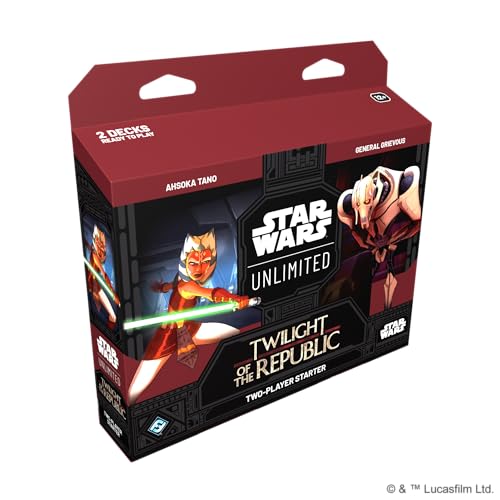
Twilight of the Republic

Yoda vs. Palpatine. Prequel-era matchup with strong current competitive meta presence.

Era
Prequel Trilogy
Light side
Yoda
Dark side
Palpatine

Best for Prequel fans; players heading toward competitive events

Tradeoff More decision points per turn; slightly steeper curve for beginners

Star Wars: Unlimited Two-Player Starter Set: Spark of Rebellion Best starter
Fantasy Flight Games

Star Wars: Unlimited Two-Player Starter Set: Spark of Rebellion

$$

Our rating

The only purchase you need to play Star Wars Unlimited. Two complete 50-card decks, damage tokens, a rules reference card, and the iconic Luke vs. Vader matchup. Open it, sleeve the cards, and you're playing in under 20 minutes. Spark of Rebellion has the largest player base, so you'll find opponents at almost any game store that carries the game.

What we like

  • Everything in one box: two decks, tokens, and rules included
  • Luke vs. Vader matchup, the most iconic pairing in the game
  • Largest player base means easiest to find opponents at game stores

What to know

  • Starter decks aren't tuned for competitive or ranked events
  • Contains one copy of each card; building multiple decks needs boosters
Star Wars: Unlimited Two-Player Starter Set: Twilight of the Republic Specialty pick
Fantasy Flight Games

Star Wars: Unlimited Two-Player Starter Set: Twilight of the Republic

$19.99 as of Jun 22, 2026

Our rating · In Stock

If the prequel era is your thing, Twilight of the Republic delivers Yoda vs. Palpatine. The leader cards from this set have strong meta representation, so if you plan to move into competitive play, the leaders you learn here are a genuine foundation for a tuned deck.

What we like

  • Yoda and Palpatine leaders see real competitive meta play
  • Prequel-era flavor for fans of the Clone Wars storyline

What to know

  • More complex than the original Spark of Rebellion matchup
  • Smaller player base than Set 1; harder to find at local stores

Booster Boxes

Booster packs are how you expand beyond the starter decks and build custom leader-deck combinations. Each booster contains a mix of commons, uncommons, and a guaranteed rare or better, plus a foil slot. A booster box (24 packs for most SWU sets) is significantly better value per pack than buying individually, and gives you a broad cross-section of a set's card pool. Wait until you've played 5-10 games with a starter before buying boosters so you know which leaders and mechanics you enjoy most.

Star Wars: Unlimited Spark of Rebellion Booster Display (24 Packs) Best starter
Fantasy Flight Games

Star Wars: Unlimited Spark of Rebellion Booster Display (24 Packs)

$88.74 as of Jun 22, 2026

Our rating · In Stock

A full booster box of 24 packs gives you a deep look at Set 1's card pool, with enough cards to start building your own decks around the leaders you enjoy. The first set has the most available community content, tournament history, and deck-building guides. A box is a much more satisfying experience than individual packs.

What we like

  • 24 packs per box: best per-pack value in the SWU product line
  • Set 1 card pool has the most community deck-building resources
  • Enough cards to build 2-3 distinct playable decks after opening

What to know

  • Random contents; you may not pull the specific rares you want
  • More expensive than buying only the singles you need via TCGPlayer
Star Wars: Unlimited Spark of Rebellion Prerelease Box (6 Packs) Budget pick
Fantasy Flight Games

Star Wars: Unlimited Spark of Rebellion Prerelease Box (6 Packs)

$$

Our rating

If a full display box feels like too much commitment, the Prerelease Box is the official 6-pack product. You get six booster packs from Set 1, a taste of the card pool, and a fair per-pack value without the full display outlay. Good for dipping in before committing to a full box, or for topping off your collection.

What we like

  • Official 6-pack product at better than single-pack pricing
  • Easy to grab multiple sets to compare card pools

What to know

  • Higher per-pack price than buying a full 24-pack display
  • Six packs won't get you enough cards to build a focused deck
Star Wars: Unlimited Twilight of the Republic Booster Display (24 Packs) Specialty pick
Fantasy Flight Games

Star Wars: Unlimited Twilight of the Republic Booster Display (24 Packs)

$41.96 as of Jun 22, 2026

Our rating · Only 8 left in stock - order soon.

The third set brings prequel-era characters with some of the most competitively represented leaders in the game. If you're heading toward serious play, Set 3 cards are worth having. The booster box is the best way to get broad exposure to the set's card pool at once.

What we like

  • Prequel-era cards with strong competitive meta representation
  • Clone Wars characters fill gaps in earlier set card pools

What to know

  • Pricier than older sets; demand keeps Set 3 prices elevated
  • Best value after you know which specific cards you're targeting
a couple of cds sitting on top of a table

Photo by Erik Mclean on Unsplash

Card Sleeves

Sleeves are non-negotiable. SWU cards show wear quickly without protection, and sleeved cards shuffle dramatically better than bare cardboard. Dragon Shield Mattes are the standard recommendation across every TCG community for one reason: they last. You need 100 sleeves for a single deck (50-card main deck plus your leader, base, and tokens). Standard size (63.5 x 88mm) fits all SWU cards.

Dragon Shield Matte Sleeves (100-pack) Best starter
Dragon Shield

Matte Sleeves (100-pack)

$11.97 as of Jun 22, 2026

Our rating · In Stock

The sleeve every serious TCG player ends up on. Dragon Shield Mattes have a matte back that survives thousands of shuffles without peeling or clouding. They fit SWU cards snugly without bunching, the matte finish makes fanning a hand effortless, and they come in every color imaginable.

What we like

  • Matte back survives thousands of shuffles without peeling or clouding
  • Snug fit for SWU cards with no bunching or fanning difficulty
  • Wide color range to match your deck's faction aesthetic

What to know

  • Pricier per sleeve than Ultra Pro or generic brands
  • Matte texture shows fingerprints; wipe with a cloth after heavy play
Budget pick
Ultra Pro

Standard Deck Protectors (100-pack)

$

Our rating

The budget-reliable choice. Ultra Pro Standard sleeves have been a TCG staple for decades. The clear back is less shuffle-smooth than Dragon Shield Mattes, but for a first deck while you're still learning the game, they're plenty good at roughly half the price.

What we like

  • Half the price of Dragon Shield for a deck you might rebuild often
  • Widely available in stores; easy to replace individual worn sleeves

What to know

  • Clear back clouds after 3-4 weeks of regular shuffling
  • Slightly loose fit compared to Dragon Shield; cards shift a bit
Star Wars Unlimited Darth Vader Art Sleeves (60-Pack) Specialty pick
Gamegenic

Star Wars Unlimited Darth Vader Art Sleeves (60-Pack)

$7.67 as of Jun 22, 2026

Our rating · Only 8 left in stock - order soon.

Officially licensed SWU character art on every sleeve, in a pack sized for a single 50-card leader deck with room for your leader and base cards. The Darth Vader design is the standout option for dark-side players. Tournament-legal and sized exactly for SWU cards.

What we like

  • Official SWU character artwork looks polished at game store events
  • Tournament-legal, sized exactly for Star Wars Unlimited cards

What to know

  • 60-pack covers one deck only; buy two to double-sleeve
  • More expensive than Dragon Shield with no durability advantage

Deck Boxes

A sleeved 50-card deck won't fit back into the starter set's cardboard box, so you need a proper deck box. The Ultra Pro Satin Tower is the default recommendation across the TCG space: it holds a full 100-sleeved-card deck, has a side compartment for dice and tokens, and costs under $15. This is not a category to overthink. Get a deck box, protect your sleeved cards from bending.

Ultra Pro Satin Tower Deck Box Best starter
Ultra Pro

Satin Tower Deck Box

$21.45 as of Jun 22, 2026

Our rating · Only 3 left in stock - order soon.

The default recommendation across every TCG community. Fits 100 single-sleeved cards, which is a full SWU deck with tokens and leader. The magnetic closure keeps cards secure without the friction that wears out snap-lid boxes. Comes in a wide range of colors and runs under $15.

What we like

  • Holds 100 single-sleeved cards, the standard SWU deck plus extras
  • Magnetic closure protects cards without wearing out from daily opens
  • Side dice tray is useful for SWU's damage counter tracking

What to know

  • Snug for double-sleeved decks; check dimensions if you double-sleeve
  • Plastic lid can crack if dropped; not as rugged as hard-case options
BCW Hinged Trading Card Box (100-Count) Budget pick
BCW

Hinged Trading Card Box (100-Count)

$7.70 as of Jun 22, 2026

Our rating · Only 4 left in stock - order soon.

The classic snap-lid clear plastic box that BCW has made for decades. Holds 100 standard-sleeved cards, costs around $2-3, and does the job without frills. If you need a deck box while you are still figuring out which deck to commit to, this is the right spend.

What we like

  • Under $3; the least you can spend for real card protection
  • Crystal-clear so you can see your deck color at a glance

What to know

  • Snap lid opens in a bag; not as secure as magnetic closure
  • No dice tray or side compartments, bare-minimum storage only

Playmats

A playmat is not strictly required to play Star Wars Unlimited, but it makes a real difference. SWU has a defined play area with a ground arena, space arena, and base zones. A themed mat prints those zones on the surface so new players don't have to agree verbally about where things go. At a game store or tournament, a playmat is expected. For home play, any padded surface works, but once you play on a proper SWU mat, you won't want to go back.

Star Wars Unlimited Hyperspace Game MAT XL Best starter
Gamegenic

Star Wars Unlimited Hyperspace Game MAT XL

$35.95 as of Jun 22, 2026

Our rating · Only 5 left in stock - order soon.

The officially licensed oversized mat (27.5 x 27.5 inches) designed specifically for Star Wars Unlimited two-player games. Features the Hyperspace art style from the game, with a non-slip rubber base that stays put during shuffling. Large enough for both players' full board states in the correct zone layout.

What we like

  • Officially licensed, sized specifically for SWU two-player games
  • Non-slip rubber base stays put during active shuffling and play
  • Hyperspace artwork looks sharp and is immediately recognizable at events

What to know

  • Large footprint at 27.5 x 27.5 inches; needs a real full-size table
  • Square format, not the standard rectangular mat; check your table first
Inked Playmats Vibrancy Playmat Specialty pick
Inked Gaming

Inked Playmats Vibrancy Playmat

$$

Our rating

A quality rubber-backed cloth playmat from Inked Gaming, a brand known for producing crisp printed gaming mats. The Vibrancy series has vivid artwork printed on a stitched-edge cloth surface over a non-slip rubber base. It is the right size for two players and cheaper than the official SWU mats.

What we like

  • Stitched-edge cloth surface with vivid print and non-slip rubber base
  • Cheaper than official SWU mats with comparable build quality

What to know

  • No zone lines printed; requires knowing the SWU play area layout
  • Pre-made art only; the full custom service is on inkedgaming.com
Going deeper

Your first month of Star Wars Unlimited

Most TCG beginners get lost in card text and deck theory before they've played ten games. Here's what actually matters in your first month of Star Wars Unlimited, in order.

Friends play cards, sharing snacks and drinks.
Photo by Sidral Mundet on Unsplash

Star Wars Unlimited has a learning curve, but it’s a shorter one than most TCGs. The rules fit on two pages. The card text is plain English. The game mechanics reward understanding tempo over memorizing edge cases.

The problem most beginners have isn’t the rules. It’s playing five games and immediately spiraling into deck-building theory before they can reliably make good decisions with the cards they already own.

This guide is about what to actually focus on in your first month, roughly week by week.

Week 1: Learn how turns work

Star Wars Unlimited uses an alternating action system. When it’s your turn, you take exactly one action (play a card, attack with a unit, use an ability, or pass). Then your opponent takes one action. You go back and forth like this until both players pass consecutively.

This is the thing that makes SWU feel different from other card games. Every decision happens in small slices. You’re never sitting there watching an opponent take a ten-minute turn while your board disappears. You always have options.

The five things to understand before your first game:

  • Leaders. Your leader card starts in a special zone and has a deploy cost. Before you deploy it, you’re using the leader’s passive or “epic action” for resources and board presence. Once you deploy it, the leader becomes a powerful unit on your side.
  • Bases. You and your opponent each have a base with hit points. The goal is to reduce your opponent’s base to zero. Units attack the base directly or fight each other.
  • Resources. At the start of each round, you put one card from your hand face-down as a resource. Resources pay for everything. There’s no mana flood; you’re always trading a card for a resource, so the decision is real.
  • Two arenas. Ground arena and space arena. Ground units can only attack ground units (and the base). Space units can only attack space units (and the base). Managing both arenas simultaneously is the core strategic challenge of the game.
  • Damage and defeat. Units have a power value (how much damage they deal) and a hit-point value (how much damage they take before being defeated). Damage resets between rounds.

Play your first five games with just these concepts. You will make mistakes. That’s fine.

Week 2: Understand your leader

By week two, you should focus exclusively on one leader. Not because the others aren’t interesting, but because SWU rewards depth over breadth. Every leader has a playstyle, and learning that playstyle deeply gives you better decisions than switching leaders constantly.

Pick the leader from your starter set that clicked for you in week one. Then ask: what does this leader want to do?

Some leaders want to go wide (lots of small units). Some want to go tall (a few powerful units). Some want to control the board; others want to race. The correct answer isn’t always “win fast” or “win slow,” it’s “do the thing your deck is built to do better than your opponent can stop it.”

A few patterns to watch for:

Your leader’s epic action timing. Every leader has a powerful ability called an epic action that you can use once per game after deploying. Don’t rush to deploy just to flip your leader. Watch for the turn when deploying immediately advances your plan or stops your opponent’s. The wrong deploy timing is one of the most common beginner mistakes, especially when you’re behind.

Your resource curve. Count what you’re playing on turns 1, 2, 3, and 4. Early turns should be spent developing your board and resources efficiently. Holding expensive cards you can’t play yet while doing nothing in the early game is a losing pattern in most SWU decks.

Knowing when you’re winning and when you’re losing. Look at both bases’ hit points. Look at both sides’ unit counts. The player with more board presence and a healthier base is winning. If that’s not you, your next decisions should change the game state, not maintain it.

Week 3: Play against different opponents

The starter set matchup (your fixed two decks against each other) teaches you the rules. Playing against someone with a different deck, built from booster cards, teaches you how the game actually works.

Find your local game store’s Star Wars Unlimited game nights. Most game stores that carry SWU run weekly or bi-weekly open play nights where you can show up with your starter deck and play against other players. You don’t need a competitive deck. You need a few games against leaders and archetypes you haven’t seen before.

What you’ll discover:

Aggro decks will show you how fast a game can end when you’re not used to it. The first time someone puts five units on the ground arena by turn three and attacks your base for 12 damage in one round, you’ll realize why board development matters.

Control decks will teach you patience. Watching someone systematically pick apart your board with removal cards is frustrating until you understand the resource investments required, at which point you start seeing the counterplay.

Combo decks will feel confusing but fair. SWU isn’t as combo-centric as some TCGs, but synergistic decks that set up in the mid-game exist and are worth understanding.

After three weeks of play, you’ll know which of these styles you want to build toward.

Week 4: Make your first upgrade

By week four, you have enough context to make a meaningful upgrade decision. One of two paths works well here:

Upgrade your current leader into a focused deck. Take the leader you’ve been playing and look up two or three community decklists built around that leader on SWUDB. You don’t need to copy them exactly. Pick five or ten individual cards that address the weaknesses you’ve been running into, buy the singles on TCGPlayer (usually $1-5 each for non-staples), and swap them in.

Open a booster box of a set you’re interested in. If you want the full card-discovery experience, a booster box of 24 packs gives you a wide cross-section of a set’s card pool at the best per-pack price. Open it with the knowledge from your first month and you’ll have real opinions about what’s useful in your deck.

Either path is valid. The key is doing it after a month of play, not before. You’ll spend your money more efficiently and build something you actually enjoy playing.

Save your money

What you don't need yet

Beginners get pressured to buy a lot of stuff that doesn't help them play better. Here's what we'd skip on day one.

  • Premium card binders — Sort your pulls into a basic binder first. You won't know which cards matter until you've played 10-15 games.
  • A full-set playset (4x of every card) — SWU deck construction caps most cards at 3 copies. A playset is a collector's goal, not a player's requirement.
  • Hyperspace foil singles — Foils and hyperspace versions are cosmetic with no gameplay advantage and often cost 5-10x the regular version.
  • Official SWU carrying case — A medium-size backpack with a basic deck box holds everything you need for a game store trip.
  • Multiple complete leader decks from day one — Learn one deck deeply before branching. The game rewards pattern recognition more than deck variety at first.
First week

Your first seven days

A short, real plan to get from gear-on-doorstep to actually playing.

  1. Order the Two-Player Starter Set. · Buy
  2. Order 100 card sleeves before you open the box. · Buy
  3. Watch a learn-to-play video covering leaders, units, events, the base, and the action system. · Learn
  4. Sleeve your cards and play your first game using the rules reference cards from the starter box. · Action
  5. Find your local game store and ask about Star Wars Unlimited game nights. · Action
  6. Check SWUDB for deck-building resources and tier lists after your first few games. · Learn
FAQ

Common questions

Do I need anything besides the starter set to play?

No. The Two-Player Starter Set has everything needed: two decks, tokens, and rules. You should add card sleeves ($12-15) before your first real game to protect the cards, but the game is fully playable straight out of the box.

How is Star Wars Unlimited different from Magic or Pokemon?

SWU uses an alternating action system where each player takes one action at a time, then passes. This makes every turn interactive rather than reactive. The resource system uses cards from your hand instead of land cards, which eliminates mana flood and mana screw entirely.

Can a starter deck beat a fully tuned competitive deck?

In a casual game, yes. The game is designed with this in mind. At a tournament level, tuned decks have real advantages. But in your first 10-20 games, the difference matters far less than understanding the action system and tempo decisions.

Which starter set should I buy?

Spark of Rebellion (Luke vs. Vader) if you want the most opponents and the most community resources. Twilight of the Republic if you love prequel characters and want leaders with strong competitive use. Either set is a complete, balanced introduction to the game.

How much does it cost to build a competitive deck?

Budget competitive decks run $40-80 in singles from TCGPlayer. Top-tier decks with sought-after rare leaders can run $150-300. A two-player starter plus targeted singles can often be upgraded to tournament-viable for around $50.

Can I play Star Wars Unlimited online before buying?

Yes. There's a free official online client (check the Atomic Mass Games site), and the SWU community runs games through Tabletop Simulator on Steam. Try online first if you want to test before committing to physical cards.

Going further

Where to next

Authoritative sources

  • Atomic Mass Games — Star Wars Unlimited — The publisher's official site. Rulebook downloads, tournament information, organized play, and product announcements.
  • SWUDB — Community deck database. Card search, tier lists, and deck-building tools. Essential once you're past the starter decks.
  • The Hyper Lounge (YouTube) — High-quality SWU strategy content. Deck techs, tier lists, and set reviews. The best beginner-to-intermediate video resource.
  • Star Wars Unlimited Official (YouTube) — Official channel with learn-to-play videos, competitive gameplay footage, and new set announcements.
  • r/starwarsunlimited — Active community for deck help, rule questions, and meta discussion. Beginners get a warm welcome here.