Locksport is the hobby and sport of picking locks for skill, not crime. It's a tactile puzzle where the feedback lives in your fingertips. The gear is affordable, the community is unusually welcoming, and most beginners pop their first lock within an hour of holding picks for the first time.
By Colin B. · Published June 7, 2026 · Last reviewed June 7, 2026
A starter pick set and a few practice locks gets you going for $40-80. A proper collection with quality picks and a pinning kit lands around $120.
We earn commission on qualifying Amazon purchases — see our
affiliate disclosure.
Price tiers and budget totals shown above are editorial estimates;
actual Amazon prices vary.
At a glance
Our top pick in each category
The fastest path through this guide — each best-starter pick by category.
Scroll for the budget and upgrade alternatives.
Don't overthink your first pick set. A 10-15 piece set with a hook, a short hook, a couple rakes, and a few tension wrenches is everything you need for the first six months. The $20 price difference between budget and mid-tier picks is irrelevant at this stage.
Start with practice locks, not real locks around your house. Transparent training locks let you see the pins moving in real time, which collapses the learning curve. Once you can open the training lock confidently, real padlocks feel straightforward.
Locksport is completely legal in most of the US and Canada. Owning picks is only illegal when you can prove intent to commit a crime. The community's cardinal rule: only pick locks you own or have explicit written permission to pick. Stick to that and you'll never have a problem.
The gear
What you actually need
Pick Sets
Your pick set is your most important purchase. A good set includes several hook profiles for single-pin picking, a few rakes for faster technique, and multiple tension wrenches. You'll use maybe 3-5 picks regularly; the rest cover edge cases. Most beginners start with raking to get that first open, then graduate to single-pin picking for harder locks.
Pick Sets — what's the difference?
A few common shapes, each making a different trade.
Flat Steel Handles
Budget-friendly, stiff picks. Fine for learning raking and basic technique.
Handle
Flat steel
Feedback
Minimal
Price
Lower
Best for Beginners who want to start without overthinking handle preference
Tradeoff No wrist rotation feedback; you feel pick angle with fingers instead
SouthOrd has been making picks in the US since the 1960s. The PXS-14 is their 14-piece flat steel starter set, covering short hooks, rakes, and tension wrenches in one kit. Flat steel handles give no wrist rotation feedback, but that's a minor tradeoff at this price point. The most accessible quality pick set on Amazon from a manufacturer with a real track record.
What we like
American-made by a locksmith supplier with six decades of experience
Amazon Prime eligible; arrives in days, not weeks from Canada
Flat steel is stiff and doesn't flex under normal picking pressure
What to know
Flat handles give no rotational feedback, takes getting used to
Thicker profile than premium picks; won't fit every tight keyway
Same 14-piece pick variety as the PXS-14, but the metal handles change the experience. You can feel the pick's orientation and flex in your hand, which matters a lot when single-pin picking on tighter locks. Once you've built a technique base and find flat steel limiting, the MPXS-14 is the natural next step.
What we like
Metal handles transmit pick position and flex to your hand clearly
Same proven SouthOrd 14-piece variety as the entry-level PXS-14
Better for single-pin picking where subtle feedback is everything
What to know
Bulkier handles won't fit every narrow keyway profile
Same pick profiles as the PXS-14, so upgrade only when handles matter
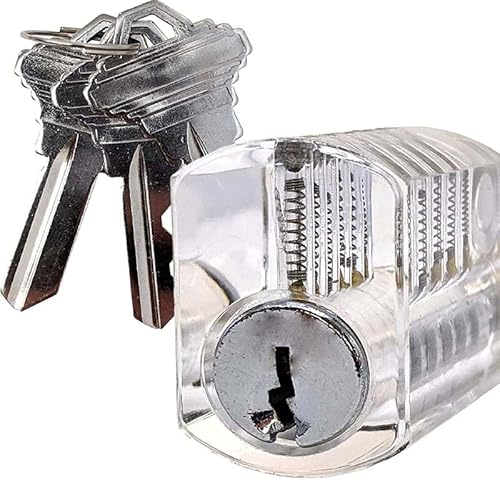
Practice locks are the consumable of locksport. Start with a transparent keyed padlock that shows exactly what your picks are doing to the pins inside, collapsing weeks of guesswork into one afternoon. Once you open it reliably, move to a 4-pin padlock, then 5-pin, then security pins. Budget $5-15 per lock; you'll accumulate several over your first year.
Best starter
Varspo
Transparent Practice Padlock
$32.99 as of Jun 22, 2026
★★★★★Our rating· Only 8 left in stock - order soon.
The clear acrylic body shows the pin stacks in real time as you pick. Watch a pin set when your hook lifts it to the shear line, watch it drop when your tension slips, and immediately understand why light tension works better than heavy. Twenty minutes with this lock teaches more than a week of blind picking.
What we like
Clear acrylic lets you watch pins set in real time as you pick
Immediately shows why light tension and lifting technique matter
Cheap enough to buy without overthinking the decision
What to know
Too easy once you understand the mechanism; purely a training tool
Acrylic body doesn't simulate the spring feel of real metal locks
The community's traditional first real padlock target. Four pins with loose tolerances, no security pins, and you'll open it in your first week. Cheap enough to buy three for blind practice once you stop needing to see the pins moving.
What we like
Four pins with forgiving tolerances, the ideal first real target
Cheap enough to buy several for varied blind practice sessions
Available at every hardware store for same-day pickup
What to know
No security pins, so it doesn't prepare you for harder locks
So easy it stops being a challenge after a few sessions
The locksport community's accepted intermediate target. Tighter tolerances than the Master Lock 140, five pins, and a genuine step up in required technique. When you open a 55/40 reliably, you're ready to move on to security pins and harder lock types.
What we like
Community-accepted next step after the Master Lock 140 progression
Tighter tolerances teach proper tension control by necessity
Real build quality you could actually use as a working padlock
What to know
Significantly harder than the 140; don't skip steps or you'll stall
Still no security pins; next challenge after this is quite different
Tension wrenches are half the pick: the piece that applies rotational pressure to the plug while your pick manipulates the pins. Most beginner sets include a small assortment, but a dedicated tension pack gives you the variety needed for tight keyways and unusual keyway profiles. The right tension (light, lighter than you think) makes more difference than any pick choice.
Best starter
ECSiNG
6-Piece Double Head Tension Wrench Set
$
★★★★★Our rating
Six double-headed tension wrenches in widths from 0.6mm to 1.2mm, covering virtually every pin tumbler keyway you'll encounter. Double-headed means each wrench has two different widths, one on each end, giving you 12 effective thickness options in a pocket-sized pack.
What we like
Six wrenches covering 0.6-1.2mm, the full range for common padlocks
Double-headed design gives two thickness options per wrench
Compact pack fits alongside any pick set in a carrying case
What to know
Thinnest sizes snap under heavy torque; keep your tension light
Less familiar brand than SouthOrd; check product reviews on order
A Y-shaped tension bar that some pickers prefer for deadbolts and lever locks where a standard L-shaped wrench blocks the keyway. A different technique and different feedback from the BOK/TOK wrenches you learn on first. Worth having once you move beyond basic padlocks.
What we like
Y-bar style works in keyways where L-shaped wrenches won't fit
Stainless steel with no sharp edges, good build for a specialty tool
What to know
Different technique from standard BOK/TOK tension; learn standard first
Not useful as a primary tension tool for typical padlock practice
Picking a padlock while holding it with one hand works, but it's awkward and limits your technique. A simple vise or lock stand frees both hands for picks and tension wrenches. Add a pinning mat and extra pins and you can re-pin your locks to different difficulties, turning a $10 Master Lock into an infinite puzzle generator.
Best starter
LocksportXPC
3-Skills Deluxe Practice Stand
$69.95 as of Jun 22, 2026
★★★★★Our rating· Only 6 left in stock - order soon.
A dedicated stand built for locksport practice that holds padlocks, cylinders, and practice boards. Frees both hands for your pick and tension wrench, and holds locks at the right angle for extended sessions without awkward grip fatigue.
What we like
Both hands free for picks and tension, removes one variable from practice
Holds padlocks and cylinders at the right angle for extended sessions
Built by a locksport-specific brand for this exact use case
What to know
Works best with standard padlock sizes; check fit for unusual formats
Primarily useful once you're practicing seriously enough to need both hands
A simple tray with indented cells that keeps tiny pins from bouncing across the room when you re-pin a lock. The cells hold driver pins, key pins, and spool pins separately so you can work methodically. Add a set of extra driver pins and you can re-pin any practice padlock to a new difficulty level.
What we like
Keeps tiny pins organized so re-pinning doesn't become a carpet search
Indented cells hold driver pins, key pins, and spools separately
Opens up the lock modification layer of the hobby
What to know
Skip entirely until you can pick your current locks consistently
Tiny pins still escape surfaces if you rush; work methodically
Most people assume picking locks is either impossible or instant. The reality is in between: with the right starting point, most beginners open their first real padlock within their first session.
Locksport has one of the steepest-feeling but fastest-collapsing learning curves in any hobby. The first 20 minutes feel mysterious and slightly absurd — you’re wiggling a bent piece of metal inside a lock and nothing is happening. Then something gives. The plug rotates. You look at the open padlock in your hand and feel like you’ve discovered a superpower.
This is what your first five hours actually looks like.
Hour 1: The mental model
Before you pick anything, you need to understand what you’re actually doing. Pin tumbler locks — the most common lock type in the world — work on a simple principle. Inside the plug (the rotating cylinder) sit a series of spring-loaded pin stacks. Each stack has a driver pin (pushed down by the spring) and a key pin below it. When no key is inserted, the driver pins cross the shear line and prevent the plug from rotating.
When the correct key is inserted, each key pin is lifted to exactly the right height so that the gap between the driver pin and the key pin aligns exactly at the shear line — all at once. The plug can now rotate.
Picking exploits a small mechanical imperfection: the pin chambers aren’t perfectly aligned. When you apply light rotational pressure with a tension wrench, the plug tries to rotate but is stopped by whichever pin is binding most. If you can lift that binding pin to the shear line, the plug shifts slightly and that pin “sets.” You then move to the next binding pin. Set all the pins, and the plug opens.
That’s it. That’s the whole secret.
If you have a transparent training lock, this is the hour to open it. Watch the pins as you apply tension, watch one set at a time, and feel the plug shift fractionally with each set pin. Twenty minutes here saves weeks of confusion later.
The Master Lock No. 140 is the community’s traditional first real target for a reason: four pins, loose tolerances, and no security pins. It’s forgiving enough that early technique mistakes don’t prevent you from opening it.
Here’s what to focus on:
Tension is everything. The most common beginner mistake is using too much tension. Your tension wrench should be almost light, a hint of pressure, not a push. If you’re forcing it, loosen up. The plug doesn’t need much help to rotate once the pins start setting; it needs you to not block it.
Find the binding pin first. Insert your pick and feel for the pin that doesn’t move freely. It’ll feel stiffer, more resistant than the others. That’s your binding pin. Lift it slowly until you feel the tiny click and the plug shifts fractionally. That’s a set pin. Move to the next binding one.
Raking is faster and more chaotic. A rake pick moves in and out with light upward pressure while you maintain tension. It sets pins somewhat randomly, and on low-security locks it works remarkably quickly. Most beginners open their first padlock by raking. It’s a real technique, not a cheat, and you should absolutely use it to get that first open on the 140.
Once you’ve raked it open five times, switch to single-pin picking. It’s slower, but it’s where the real skill lives, and it’s what opens the harder locks that raking can’t touch.
By hour four, something starts to happen. You stop thinking about the process consciously. Your fingers start reading the lock instead of your brain narrating it. Binding pins announce themselves without you having to search. Tension corrections happen automatically.
This is the tactile skill developing, and it develops faster in locksport than in most manual hobbies because the feedback loop is tight. Every pick movement produces immediate sensation. Every tension adjustment changes what you feel. The lock tells you what’s happening if you’re listening.
A few things to practice deliberately in hours four and five:
Pick the same lock multiple times in a row, immediately re-locking it after each open. The goal isn’t to open it once. It’s to open it until it feels easy. Until you know, without thinking, when the binding pin shifts and when you’ve set one versus over-lifted it.
Try picking with your eyes closed. It sounds harder, but it forces you to rely entirely on tactile feedback instead of looking at the lock for clues. Players who do this early develop feel faster than those who don’t.
Change your tension amount deliberately. Open the lock with heavy tension. Open it with featherlight tension. Notice how each approach changes the feel of the pins, which ones bind, how they set. Understanding how tension changes pin behavior is the insight that unlocks (intentional) your ability to approach unfamiliar locks.
After five hours, you can open a Master Lock 140 reliably by both raking and single-pin picking. That’s real competence. Most locks on residential doors (in North America, anyway) are comparable or easier than a mid-grade Master Lock.
The next step is deliberate progression:
Abus 55/40 or a similar 5-pin padlock with tighter tolerances
Security pins: spool and serrated driver pins that “false set” — they give you a fake click before the real shear line, designed to fool people who are just lifting and hoping
European cylinders: different keyway profiles, more pins, dimple variants — a whole new category of challenge
The community’s r/lockpicking Belt Ranking system grades locks from White Belt (Master Lock 140) through Red Belt (high-security Medeco, EVVA, ASSA Abloy). Most hobbyists spend months working through Yellow and Orange Belt targets. The competition scene runs through TOOOL chapters and Locksport International events.
The gear that got you started barely scratches the surface of what’s available. But the skill you’ve built in these first five hours will carry you to every lock that comes next.
Save your money
What you don't need yet
Beginners get pressured to buy a lot of stuff that doesn't help them play
better. Here's what we'd skip on day one.
High-security lock targets (Medeco, Mul-T-Lock) — These have security pins and tight tolerances. Work up to them; they'll be waiting when you're ready.
Dimple lock picks — A completely different pick geometry for a different lock type. Add these after mastering pin tumbler locks.
Bypass tools (jigglers, Lishi picks) — Useful for specific situations, not for learning fundamentals. Standard picks first.
An electric pick gun — Removes the skill entirely. Fun for a party trick, useless for developing real locksport technique.
A leather pick roll or custom carry case — The pouch that comes with your first set is fine. Buy a nice roll once you know which picks you actually carry.
Bump keys — A different technique, not locksport. Legal gray area in some jurisdictions and irrelevant to developing pick skill.
First week
Your first seven days
A short, real plan to get from gear-on-doorstep to actually playing.
Order a starter pick set and a transparent training lock at the same time. · Buy
Read the r/lockpicking community wiki. It has the best free beginner resource anywhere: lock rankings, technique breakdowns, and a legality guide by state. · Learn
r/lockpicking wiki · Community-maintained guide with lock rankings and technique breakdowns
Pick up a Master Lock No. 140D at any hardware store, or order one online. · Buy
Watch a LockPickingLawyer video for your first lock target. His technique walkthroughs are clear and beginner-friendly. · Learn
LockPickingLawyer YouTube · Most-followed locksport channel; good entry point for technique and lock reviews
Spend 20 minutes with the transparent lock, watching pins set as you pick. Then switch to your real padlock and apply what you saw. · Action
Open your first real padlock. Photograph it open. You've earned it. · Action
Find your local TOOOL chapter or join the online community. · Action
TOOOL chapter finder · The Open Organisation Of Lockpickers, with in-person meetings in many cities
FAQ
Common questions
Is locksport legal?
In most of the US and Canada, owning lockpicks is legal. A few states have statutes that can restrict possession without a locksmith license, though locksport practitioners are rarely prosecuted. Check the r/lockpicking wiki's legality section for your state. The universal rule: only pick locks you own or have explicit permission to pick.
How long does it take to pick my first lock?
Most beginners open a transparent training lock within 30-60 minutes of their first session. A real padlock (Master Lock 140) typically takes 1-3 sessions. The tactile skill develops faster than most people expect because the feedback is immediate and you can feel progress in real time.
Do I need a pick gun or electric pick?
No. Electric picks and snap guns are useful for professional locksmiths in a hurry but don't teach you anything. The hobby is about developing the skill, not just defeating the lock. Skip them entirely until you're specifically curious about bypass techniques.
What's the best YouTube channel for beginners?
LockPickingLawyer is the most popular and his opening segments explain specific techniques. BosnianBill covers picking methodology more deeply. Both are worth watching. Once you've progressed, search r/lockpicking for your specific target lock; someone has almost certainly picked it and posted a guide.
Can I pick locks I don't own?
No. The locksport community is emphatic on this: only pick locks you own or have explicit written permission to work on. The hobby's reputation depends on practitioners respecting this rule. r/lockpicking enforces it strictly and will remove posts that suggest otherwise.
What's the community like?
One of the friendlier hobby communities around. r/lockpicking is active and genuinely helpful. TOOOL has in-person chapters in many cities. Locksport International hosts competitions. The culture leans toward technical enthusiasm and mutual progression rather than gatekeeping newcomers.
r/lockpicking — The community hub. The wiki is the single best beginner resource: lock rankings, technique breakdowns, tool recommendations, and legality by state.
LockPickingLawyer (YouTube) — The most-watched locksport channel. His beginner technique series is the community standard for getting started.
BosnianBill (YouTube) — More technique-focused than LPL. Better once you have the fundamentals and want to understand lock mechanics more deeply.
Locksport International — Competition organizer and skills-ranking body. Check here when you're ready to compete or earn a recognized rank.
TOOOL at DEF CON — TOOOL runs a locksport village at DEF CON every year, a major annual gathering for the hobbyist community.
As an Amazon Associate, JustBeginning earns from qualifying purchases.
We may also earn commission from other affiliate programs linked on this
page. Editorial recommendations are independent; we don't choose
products based on commission rates.
Product prices and availability are accurate as of the date and time
indicated and are subject to change. Any price and availability
information shown on Amazon at the time of purchase will apply.