Radio-controlled planes reward patience and practice more than almost any other hobby. The gap between crashing on day one and flying confidently on day thirty is real but crossable. The right trainer plane, a solid radio, and two charged batteries are all you need to start. Here's exactly what to buy, and why the order matters.
By Colin B. · Published June 7, 2026 · Last reviewed June 7, 2026
An RTF trainer bundles the plane, radio, and basic charger for around $250. Add a proper standalone transmitter and extra batteries and you're in the $400-500 range where most serious beginners land.
We earn commission on qualifying Amazon purchases — see our
affiliate disclosure.
Price tiers and budget totals shown above are editorial estimates;
actual Amazon prices vary.
At a glance
Our top pick in each category
The fastest path through this guide — each best-starter pick by category.
Scroll for the budget and upgrade alternatives.
Spend 5 hours on a simulator before you ever launch. RealFlight Evolution costs $60 and will prevent three crashes. The muscle memory for stick inputs transfers directly to a real plane.
Buy RTF first. An RTF (Ready to Fly) package gives you plane, radio, battery, and charger in one box. Yes, a standalone transmitter is better long-term. But for your first day, RTF reduces the unknowns. Upgrade the radio after you know you're staying in the hobby.
Join the AMA before your first flight. Academy of Model Aeronautics membership ($95/year) includes liability insurance that matters if your plane visits someone's car. Local clubs require it, and clubs have flight instructors who will save your first plane.
The gear
What you actually need
Trainer Planes
Your first plane should be a foam high-wing trainer, full stop. The high-wing design self-levels in the air. Foam absorbs impact better than balsa. SAFE technology (Sensor Assisted Flight Envelope) on E-flite trainers adds electronic self-leveling and a panic recovery mode that returns the plane to wings-level at the push of a button. These are not gimmicks. They are why pilots who start on proper trainers keep flying, and pilots who start on cheap park flyers quit after two crashes. Don't try to start on something cool-looking. Start on something forgiving.
Trainer Planes — what's the difference?
A few common shapes, each making a different trade.
RTF (Ready to Fly)
Everything included. The right first purchase for most beginners.
Includes
Plane, TX, RX, battery, charger
Setup
Bind and fly same day
Best for
Complete beginners
Best for First purchase. No separate radio needed.
Tradeoff Bundled radio is entry-level; you'll likely upgrade it within a year
Plane with receiver. Needs a compatible transmitter you already own.
Includes
Plane + receiver only
Setup
Bind to existing TX
Best for
Pilots upgrading their fleet
Best for You already own a compatible transmitter (Spektrum DSM2/DSMX).
Tradeoff Saves money on the radio but requires an existing TX
PNP (Plug-N-Play)
Airframe and motor only. You supply radio, receiver, and battery.
Includes
Plane, motor, ESC, servos
Setup
Install your own RX and bind
Best for
Experienced builders
Best for Pilots with an established radio ecosystem.
Tradeoff Most flexibility, most setup work; not for first planes
Best starter
E-flite
Apprentice STS 1.5m RTF
$$$
★★★★★Our rating
The Apprentice has been training RC pilots for over a decade. SAFE technology gives automatic self-leveling and three flight modes: beginner, intermediate, and expert. The panic recovery button returns the plane to wings-level whenever you lose orientation. At 1.5m wingspan it's visible at distance and slow enough to correct mistakes. What flight instructors hand to students.
What we like
SAFE panic-recovery mode returns plane to level flight instantly
Three flight modes grow with your skill level over time
Foam airframe survives training crashes; replacement parts widely available
What to know
Needs a large open grass field; not a neighborhood park
Bundled TX is functional but not a long-term radio
A true RTF at under $200 with SAFE technology and three flight modes, same as the Apprentice but a smaller 1.1m wingspan. Better suited to calm parks and fields than the Apprentice. If you want the panic recovery button without spending full Apprentice money, start here.
What we like
SAFE panic recovery mode at under $200, same core tech as the Apprentice
1.1m wingspan flies well in parks; lighter than the full-size trainer
Pusher prop configuration protects the motor from ground strikes
What to know
More wind-sensitive than the larger 1.5m Apprentice; stay below 10 mph wind
Smaller battery means shorter flights; extras are worth having on hand
After 10-15 hours on a trainer, you want a plane that does more than circles. The Timber X has big tundra tires that take off from grass, gravel, or snow, and handles basic aerobatics. BNF format binds to a transmitter you already own. The step up that makes the hobby feel much bigger.
What we like
Tundra tires handle rough grass, gravel, and light snow takeoffs
Capable of basic aerobatics once you have 10-15 hours logged
Slower flight envelope stays forgiving compared to sport planes
What to know
BNF only: requires a Spektrum TX or an added ELRS receiver
Less stable than the Apprentice; orientation errors cost more here
Your transmitter is the one piece of gear you'll use for every plane you ever fly. Unlike a trainer you'll graduate from, a good radio follows you to your second plane, third, and tenth. Mode 2 (throttle on the left stick) is the North American standard. Buy Mode 2 unless you were specifically taught on Mode 1. Whatever radio you pick, it will shape which receivers you can use in every future aircraft, so this choice has real lock-in consequences.
Best starter
RadioMaster
Boxer M2
$$
★★★★★Our rating
The Boxer runs EdgeTX firmware, uses ExpressLRS long-range protocol, charges via USB-C, and costs $130. In two years it has become the goto recommendation for pilots who want a radio they won't outgrow. Works with virtually all modern receivers. The compact form factor feels like a game controller without sacrificing stick quality. If you're buying a standalone radio, this is it.
What we like
EdgeTX firmware is the modern open standard; active community updates
ExpressLRS delivers long range and low latency for the price
USB-C charging and hall sensor gimbals at under $130
What to know
Requires ELRS receivers in aircraft; Spektrum RTF planes need an adapter
EdgeTX has a learning curve if you've never used open firmware before
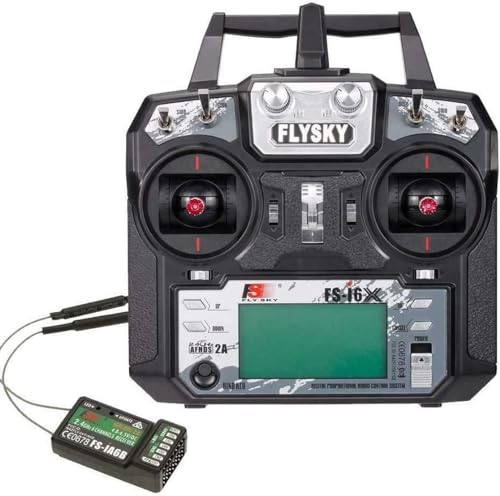
For $55 you get a 10-channel radio, an FS-iA6B receiver, and a charger. The AFHDS 2A protocol is reliable and the sticks feel decent for the price. Not a long-term radio, but if you're unsure you'll stick with the hobby, this gets you flying with a real radio before committing $130 to a Boxer.
What we like
Bundle includes receiver for under $55, genuinely hard to beat
10 channels is more than enough for planes and basic configurations
What to know
FlySky protocol locks you to FlySky receivers across all aircraft
Gimbals wear faster than premium options; feel degrades in 1-2 years
★★★★☆Our rating· Only 14 left in stock - order soon.
The full-size flagship with a touchscreen, hall sensor gimbals, multi-protocol module, and EdgeTX. Runs ELRS, Spektrum, and virtually every other protocol via the onboard multi-protocol module. If you fly planes, helis, and FPV quads, this is where serious hobbyists land.
What we like
Multi-protocol module talks to virtually every receiver protocol
Hall sensor gimbals stay calibrated longer than contact gimbals
Touchscreen simplifies model management across a large fleet
What to know
Overkill for one trainer; buy the Boxer and upgrade when you have 3+ planes
Heavier and larger than the Boxer; feels like the pro tool it is
LiPo (lithium polymer) batteries power almost every RC plane made in the last fifteen years. They pack more energy per gram than anything else, which is exactly what a plane needs. They also require more care than the AA cells in your remote. The rules: never discharge below 3.0V per cell, never charge over 4.2V per cell, store at half charge (~3.85V per cell) if you won't fly for a week, and always use a proper balance charger. Follow these rules and packs last three to five years. Ignore them and you'll have a puffed brick in six months.
Best starter
Zeee
3S 2200mAh 35C LiPo Battery (2-Pack, T Connector)
$27.99 as of Jun 22, 2026
★★★★★Our rating· In Stock
Two packs is the minimum to fly usefully: one in the plane, one on the charger. The 2200mAh capacity gives 8-12 minutes of flight on a trainer, which is plenty per session. Zeee makes genuinely quality cells at a realistic price, and 30C discharge handles trainers and mild sport planes without strain.
What we like
Two-pack means you always have a battery charged and ready to swap
2200mAh gives 8-12 min per flight on trainer aircraft
30C discharge handles trainers and mild sport planes without strain
What to know
Connector type varies; confirm EC3 or Deans matches your plane
Requires a balance charger, not a wall adapter (sold separately)
Two packs for under $25. The 1300mAh capacity gives 5-7 minutes per flight, lighter than the 2200mAh option and fine for calm trainer sessions. CNHL has earned a reputation for honest capacity ratings in the RC community. The XT60 connector is widely used; confirm it matches your plane.
What we like
Two-pack under $25; very affordable way to start your battery rotation
CNHL has earned RC community trust for honest capacity ratings
What to know
1300mAh means 5-7 min flights; you will need the second pack quickly
XT60 connector may not match your plane; cheap adapter required
If you're flying an E-flite or HobbyZone plane with a Spektrum Smart charger, this ecosystem is worth it. The battery reports state of charge, cycle count, and cell health directly to the charger display. The IC3 connector is the Horizon Hobby standard. The extra capacity extends flights to 12-15 minutes on trainer-class planes.
What we like
Smart protocol reports charge cycles and cell health to charger display
3200mAh extends flights to 12-15 minutes on trainer-class aircraft
What to know
Smart features only work with a Spektrum Smart-compatible charger
Higher cost per pack versus generic cells with similar capacity
A balance charger is not optional with LiPo batteries. A simple wall adapter that charges to a fixed voltage will eventually overcharge a cell and cause the pack to puff, overheat, or vent. A balance charger monitors each individual cell and brings them all to exactly 4.2V simultaneously. It is the single safety device that prevents a $40 battery from becoming a fire. Spend $40-80 on a real charger and skip any wall-plug system that comes free with a budget RTF kit.
Best starter
ISDT
Q6 Plus 14A 300W Smart Charger
$$
★★★★★Our rating
The Q6 Plus is the charger most RC pilots recommend to beginners. It handles 1-6S LiPo, LiFe, and NiMH batteries, has a clear backlit screen, and charges at up to 14A. It does the job correctly and will outlast three trainers. Compact enough to fit in a field bag alongside your batteries.
What we like
Handles 1-6S packs, covers every battery you'll own across the hobby
Clear display shows per-cell voltage during balance charging
Compact and field-portable; fits in most range bags with batteries
What to know
Requires a 12V power source; confirm the listing includes a supply
Single-port: charges one pack at a time (upgrade to duo charger later)
The B6AC has been the budget-charger recommendation in RC circles for over a decade. AC/DC input means it runs directly from a wall outlet without a separate power brick. Balance-charges up to 6S at 6A, covering every trainer battery. Simple enough for a beginner, reliable enough to trust.
What we like
AC/DC input: runs from a wall outlet without a separate power supply
Decade-long reputation for reliability at the budget end of the market
What to know
Single-port; no simultaneous charging for your two-pack routine
6A max is fine for trainers but slow for larger 4S or 5S packs later
Four independent charging ports, 200W per channel, AC/DC input, and full balance charging on every port simultaneously. Once you have three or more planes and a half-dozen batteries, waiting for single-pack charging becomes the bottleneck of your flying day. The Q200 cuts it to a quarter. Worth every dollar once you are flying regularly.
What we like
Four independent ports charge four packs simultaneously
AC input means no separate power supply at home or in the field
What to know
Overkill until you have 6+ batteries and multiple planes to juggle
Significantly larger than the Q6 Plus; not field-portable
Two purchases beginners consistently underestimate: a flight simulator and a LiPo safety bag. The simulator keeps your real plane intact during the learning curve. Five hours of simulated crashes cost $0; five real crashes on a $280 trainer cost $100+ in parts. The safety bag keeps your charging bench calm when you have four packs cycling. Neither item feels urgent until the moment it would have saved you something.
Best starter
RealFlight
Evolution RC Flight Simulator
$159.99 as of Jun 22, 2026
★★★★★Our rating· Only 5 left in stock - order soon.
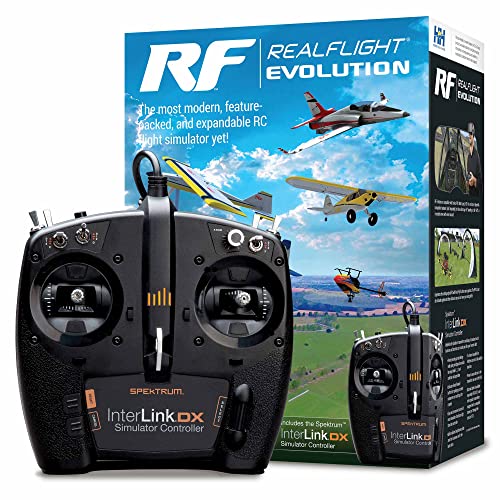
RealFlight Evolution is the industry standard for RC simulation. The physics engine is tuned by real pilots and models aircraft behavior accurately, including the Apprentice's flight envelope almost exactly. The bundled InterLink DX controller gives you real-radio stick feel before you ever hold a transmitter. Five hours here, one flight there.
What we like
Physics engine trusted by RC clubs and flight schools as true to life
Includes trainer aircraft matching popular beginner plane flight envelopes
★★★★☆Our rating· Only 12 left in stock - order soon.
If you already have the RealFlight software but need a dedicated controller, the InterLink DX is the purpose-built USB controller that ships bundled with every RealFlight retail box. It uses the same stick layout and feel as a Spektrum transmitter. Cheaper than buying the full bundle if you already own the software license.
What we like
Same stick geometry and feel as a real Spektrum TX for muscle memory
Cheaper standalone option if you already own the RealFlight license
What to know
Simulator-only: it does not bind to real aircraft as a transmitter
No advantage over the full bundle unless you already own the software
LiPo batteries can vent thermally if overcharged, punctured, or stored fully charged. A fireproof bag won't prevent a failure, but it contains one. Store and charge all your packs inside. If your first instinct is 'that seems paranoid,' it's the same instinct pilots had before their first puffed battery.
What we like
Contains cell venting or minor fires from spreading to surrounding gear
Three-pack covers a typical 2-3 pack rotation without extra trips
What to know
Not a substitute for correct charging practices; still charge at 1C
Bags degrade over time; replace if you see scorching or worn seams
Crashing on flight one is normal. Crashing on flight twenty means you skipped the simulator. Here's what actually happens, and when the hobby goes from frustrating to addictive.
Learning to fly RC planes has a sharper curve than most hobbies admit. The good news is the curve is well-mapped and the milestones are predictable. The bad news is that almost every beginner skips the first two hours of prep that would make the first two months significantly smoother.
This is what your first twenty hours actually look like, with the decisions that matter and the gear instincts you can ignore.
Before you fly: 5 hours on a simulator
This is not optional. RealFlight Evolution or a similar physics-based RC simulator will save you from crashing in your first three real flights. The muscle memory for left-stick throttle, right-stick aileron and elevator, and the disorienting experience of a plane flying directly toward you all transfer from simulator to real aircraft.
The specific thing the simulator teaches that nothing else can: orientation reversal. When your plane is flying toward you, the controls feel backwards. Left stick goes right, right stick goes left. Every beginner panics the first time this happens. On a simulator, you panic and crash and restart in ten seconds. On a real plane, you panic and watch $280 of foam auger into the ground.
Five hours of simulated flight before your first real flight is not being cautious. It’s the fastest path to actually enjoying the hobby.
Hours 1–3: Your first real flights
Get to a large open grass field. Not a park with trees, not a sports complex with soccer goals and parking lots nearby. Somewhere that when you lose control you’re likely to land in grass. AMA club fields are the gold standard: pre-authorized airspace, experienced pilots around to help, and grass landing areas.
On your first flight, ask an experienced club member to take the sticks for the first 60 seconds while you watch. Watch what level flight looks like on a real transmitter with a real plane at real distance. Then take the controls.
The three things that surprise every beginner on day one:
The plane doesn’t behave like a simulator at close range. The physics of an object thirty feet away and four feet wide feel completely different from a screen. Your perception of altitude and bank angle is much harder to read than you expected.
Trim matters immediately. Your RTF trainer came roughly trimmed at the factory, but “roughly” means it might bank left, dive slightly, or climb with neutral sticks. Before anything else, use the trim tabs on your transmitter to get the plane to fly level with your sticks centered. Takes five minutes, makes everything else easier.
Short flights are the right call. Your first flight should be 3-4 minutes, not the full 8-12 minutes the battery can handle. Land while you’re still calm. You can re-launch immediately.
Hours 4–8: The plateau
Around hour four, the initial adrenaline wears off and you hit the first real plateau. You’re not crashing every flight. You’re also not flying well. You’re flying in wide ovals and landing with more luck than skill.
This is normal. Push through it by focusing on one skill at a time:
Approach and landing. The most repeatable skill that separates competent pilots from struggling ones is the landing pattern. Every landing should follow the same sequence: reduce throttle on the downwind leg, turn base, align with the runway or landing strip, reduce power to idle at the threshold, flare (pull back gently) just before touchdown. Drill this pattern every flight. Even if you execute it imperfectly, the discipline of having a plan prevents panic landings.
Low passes. Once you can maintain altitude in a circuit, practice low passes: fly parallel to yourself at about head height, 50-100 feet away, at a steady altitude. This forces you to look at the plane from exactly the angle that’s most disorienting and trains you to hold altitude under pressure.
Around hour eight, your hands stop fighting the controls. You stop thinking about which stick does what. The plane starts feeling like an extension of what you intend rather than an adversary.
A few things become possible now:
The takeoff roll. If your trainer has ground-steering (most foam trainers have a steerable nose gear), takeoff rolls become fun. Align with the runway, advance throttle smoothly to about 75%, let speed build, pull back gently at roughly walking pace, and the plane climbs away. Do this correctly once and it’s satisfying every time after.
Wind awareness. Up to hour eight you probably flew in calm conditions. Now try a day with 8-10 mph wind. Crosswind landings, turbulence during the approach, the way a headwind makes your plane float seemingly forever above the runway, the way a tailwind makes it come in hot. Wind is the variable that keeps RC flying interesting at every skill level.
The circuit without panic. By hour ten, you can fly the full downwind-base-final circuit and land predictably. It doesn’t feel lucky anymore. This is the milestone.
Hours 15–20: Joining the community
Once you can reliably fly circuits and land, join whatever flying rotation the club has. Most AMA clubs have specific times when members bring their planes and fly in sequence. Show up. This is where the hobby gets social.
Watch what intermediate pilots do. Notice how they set up their approaches further out and slower than you think is necessary. Notice how they use the throttle constantly throughout the circuit, not just at takeoff and landing. Notice how their planes seem to be in exactly the right position at every moment, not scrambling to correct course.
A few things worth spending these hours on:
Touch-and-goes. Land, don’t stop, advance throttle, take off again. Compresses twenty approaches into one flight. The most efficient way to improve landing consistency.
Crosswind circuits. Deliberately fly in crosswind conditions. The crabbing technique (pointing slightly into the wind during approach) needs to become instinctive.
The most common crashes and why they happen
Every beginner crashes in the same handful of ways:
Overcorrection at low altitude. The instinct when something goes wrong is to move the stick fast and hard. At 30 feet of altitude, there’s no time to recover from an overcorrected bank. Train yourself to make small corrections. The plane responds faster than you think.
Losing orientation on a nose-in pass. When the plane is flying toward you, left is right and right is left on aileron. The simulator trains this muscle memory, but it still trips beginners up. If you feel disoriented, reduce throttle and let the plane settle before making inputs.
Powered-in stalls. Pulling back hard on elevator while at low throttle stalls the wing. The plane noses down or spins in. The cure: maintain flying speed at all times. If you’re not sure if you have flying speed, advance throttle.
Distracted batteries. Flying until the battery warning beeps, then trying to land quickly. Land with margin. A dead battery at altitude means the motor stops and you’re gliding.
What to do at hour twenty-one
You’re not a beginner at hour twenty. You’re an intermediate pilot with specific gaps. A few things change the slope from here:
Take a formal lesson. One 90-minute session with a certified AMA instructor now, when you have enough context to ask intelligent questions, is more valuable than ten more solo sessions grinding out the same bad habits.
Get your AMA Wings pins. The AMA Wings Achievement Program has five levels from beginner to expert. Working through the requirements gives you a structured curriculum that eliminates the aimlessness of intermediate flying.
Watch club competition. Pattern flying competitions, precision landings, aerobatic contests. Watching what controlled precision looks like reframes your practice goals entirely.
The skill ceiling in RC fixed-wing flying is absurdly high. Pilots spend decades getting better. Hour twenty is an excellent place to be.
Save your money
What you don't need yet
Beginners get pressured to buy a lot of stuff that doesn't help them play
better. Here's what we'd skip on day one.
FPV goggles and camera — Flying first-person view before you can fly line-of-sight confidently is a crash waiting to happen. Master orientation first. FPV is its own separate discipline and usually runs on different aircraft.
Sport or aerobatic aircraft — That sleek warbird or foamy Extra 300 is designed for experienced hands. Anything without a high wing and gentle stall characteristics will bite a beginner in the first five minutes.
Carbon fiber or balsa builds — Foam repairs with foam tape and CA glue in ten minutes. Carbon fiber and balsa repairs require epoxy, clamps, and patience. Start with foam.
A telemetry module — Useful once you're flying larger aircraft at altitude and want altitude and airspeed data. Your first trainer doesn't need this.
A dedicated field box or equipment trailer — A soft-sided field bag handles your trainer, two batteries, a charger, and tools for the first year. A rolling field station is for pilots with five planes and a club competition schedule.
A second trainer at the same time — One trainer, fixed and re-flown when damaged, teaches faster than two trainers splitting your attention.
First week
Your first seven days
A short, real plan to get from gear-on-doorstep to actually playing.
Join the AMA before your first flight. · Action
AMA membership · National governing body, ~$95/year, includes liability insurance
Order your RTF trainer so it arrives by the weekend. · Buy
Check FAA airspace rules before choosing where to fly. · Learn
FAA B4UFLY app · Check airspace restrictions before every flight
On your first real flight, ask a club member to hand-fly the first minute while you watch. Watching level control in real life is worth more than an hour of simulator. · Action
Order LiPo safety bags before your batteries arrive. You want them on hand before the first charge. · Buy
Yes, if it weighs over 0.55 lbs (250g). Most foam trainers weigh 2-4 lbs and require FAA registration ($5, good for 3 years) plus a label on the aircraft. AMA membership at a club provides additional regulatory coverage and insurance.
What's the difference between RTF, BNF, and PNP?
RTF (Ready to Fly) includes everything: plane, transmitter, receiver, battery, and charger. BNF (Bind-N-Fly) includes the plane and receiver but needs your own transmitter. PNP (Plug-N-Play) is the airframe, motor, and servos: you supply radio, receiver, and battery. Start with RTF.
How long does a LiPo battery last per flight?
A 2200mAh 3S LiPo in a trainer gives 8-12 minutes of moderate flying. Buy two to three packs so you can fly one while another charges. A balance charger at 1C brings a 2200mAh pack back to full in about 25 minutes.
Can I fly at any open field or park?
No. Check the FAA B4UFLY app before every flight. Class B, C, and D airspace requires prior authorization even for recreational RC. National parks prohibit unmanned aircraft. AMA-affiliated club fields are pre-cleared and the easiest place to start.
Do I really need a flight simulator before flying?
Five hours on a simulator will prevent crashing in your first three flights. Muscle memory for stick inputs and orientation recovery transfers directly to the real aircraft. It's a $60 investment that prevents $200 in trainer repairs. Yes, use a simulator first.
How long does it take to become a competent pilot?
Most pilots can fly a trainer confidently (takeoff, circuit, landing) after 10-15 hours of stick time. Sport flying and aerobatics add another 20-50 hours. The AMA's Wings Achievement Program structures this progression and is worth following.
Academy of Model Aeronautics (AMA) — The national governing body for RC flying in the US. Membership, club finder, Wings achievement program, and liability insurance. Join before your first flight.
FAA B4UFLY — Official FAA app for checking airspace authorization. Check before every flight in unfamiliar airspace.
RCGroups Forums — The oldest and most comprehensive RC community online. No editorial polish, but search any specific aircraft model or radio and you'll find repair threads and setup guides.
FliteTest (YouTube) — The most beginner-friendly RC content on the internet. Start with their Beginner Series for first-time pilot tutorials.
RCGroups Beginner Forum — If you have a specific question about your first purchase or a crash, this forum has the answer. Search before posting; it's been active since 2000.
RealFlight Simulator — The industry-standard RC flight simulator. Use for 5+ hours before your first real flight. The Apprentice STS is available as an add-on aircraft model.
As an Amazon Associate, JustBeginning earns from qualifying purchases.
We may also earn commission from other affiliate programs linked on this
page. Editorial recommendations are independent; we don't choose
products based on commission rates.
Product prices and availability are accurate as of the date and time
indicated and are subject to change. Any price and availability
information shown on Amazon at the time of purchase will apply.