Pedals are where a lot of guitarists find their sound, and also where a lot of money disappears into duplicates. A tuner, an overdrive, a delay and a reverb, powered properly on a small board, cover most of the music you'll ever play. Here's which to buy first, what order they go in, and how to stop chasing the next one.
By Colin B. · Published November 5, 2026 · Last reviewed November 5, 2026
A tuner and one great overdrive is about $135 and already changes how you sound. The core four (tuner, overdrive, delay, reverb) with an isolated power supply, a small board and patch cables comes to around $465.
We earn commission when you buy through links on this page, including
Amazon. See our affiliate disclosure.
Price tiers and budget totals shown above are editorial estimates;
actual prices vary.
At a glance
Our top pick in each category
The fastest path through this guide — each best-starter pick by category.
Scroll for the budget and upgrade alternatives.
Buy in this order: tuner, overdrive, delay, reverb. That covers most styles from blues to rock to ambient. Fuzz, modulation, compression and the rest are flavors to add once you know what's missing from your sound.
Power matters more than people think. Use an isolated power supply rated for every pedal's current draw, not a daisy chain from one wall adapter. Digital pedals like delays and reverbs draw more current and are the usual cause of hum and noise when underpowered.
Try before you buy, and buy used. Pedals hold their value, so buying used and reselling what you don't love costs very little. A pedal that sounds amazing in a demo video may not suit your guitar and amp.
The gear
What you actually need
Tuners
A pedal tuner is the first thing on every board. Stepping on it mutes your signal so you can tune silently between songs. Polyphonic tuners let you strum all strings at once and see which are out. A tuner with a buffer also helps keep your tone bright when you run long cables and lots of true-bypass pedals.
Best starter
TC Electronic
PolyTune 3 Polyphonic Tuner with Buffer
$63.90 as of Nov 5, 2026
★★★★★Our rating· In Stock
A tiny tuner that reads all six strings at once, with chromatic and strobe modes and a switchable buffer to keep your tone from going dull over long cable runs. About $64. 2,200+ reviews at 4.7 stars.
The tank-tough tuner on stages everywhere, with a bright 21-segment display, high-brightness mode and a power output that can run a few other pedals. About $90.
Overdrive gives you the warm grit of a cranked amp at any volume, and it's the pedal you'll use most. Low-gain overdrives also push an already-dirty amp harder for solos. The Boss SD-1 and Ibanez Tube Screamer are the two classics; nearly every overdrive on the market is compared to them.
Best starter
BOSS
SD-1 Super Overdrive
$69.99 as of Nov 5, 2026
★★★★★Our rating· In Stock
A $70 overdrive that's been on pro pedalboards for decades: warm, mid-focused grit that works in front of a clean amp or to push a dirty one. Built to survive being stomped. 3,200+ reviews.
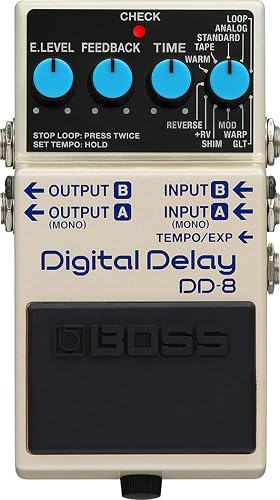
Delay repeats what you play, from a quick slapback echo to long, spacious repeats. It goes after overdrive. Digital delays are clean and versatile; analog-voiced modes sound darker and warmer. Look for tap tempo so the repeats match the song.
Best starter
TC Electronic
Flashback 2 Delay
$119.00 as of Nov 5, 2026
★★★★★Our rating· In Stock
A versatile delay with a range of modes including analog-style, tape and crystal, plus TC's pressure-sensitive MASH footswitch for expressive control, about $119. 780+ reviews.
Reverb adds space, like playing in a room, a hall or with a vintage spring tank. It's usually the last pedal before the amp. Even if your amp has reverb, a pedal gives you more types and more control.
Best starter
TC Electronic
Hall of Fame 2 Reverb
$129.00 as of Nov 5, 2026
★★★★★Our rating· In Stock
A compact reverb with spring, hall, plate, shimmer and more, plus the MASH footswitch and TonePrint presets, about $129. 580+ reviews at 4.7 stars.
Each pedal needs clean power. An isolated power supply gives every pedal its own output, which kills most hum and noise. Check each pedal's voltage (usually 9V) and current draw in milliamps, and make sure the supply has enough. Avoid running digital pedals off a daisy chain.
Best starter
Donner
DP-1 Guitar Power Supply, 10 Isolated Outputs
$39.99 as of Nov 5, 2026
★★★★★Our rating· In Stock
Ten isolated outputs for 9, 12 or 18 volt pedals, with short-circuit protection and cables included, for about $40. 7,900+ reviews. The supply most first boards use.
A pedalboard holds everything in place and lets you set up in a minute instead of ten. Start small; four pedals and a tuner fit on a 15 inch board. Short right-angle patch cables save space and reduce noise. The board's size naturally limits how many pedals you buy, which isn't a bad thing.
Best starter
Ghost Fire
Aluminum Pedalboard, 14.9 x 5.5 Inch, with Bag
$27.99 as of Nov 5, 2026
★★★★★Our rating· In Stock
A light aluminum board that fits four or five compact pedals, with hook-and-loop tape and a carry bag, about $28. 2,100+ reviews.
Building your first pedalboard, one pedal at a time
The best first pedalboard is built slowly. Here's the order to add pedals, how to set each one so it actually helps your playing, and how to power and wire the board so it stays quiet.
Most guitarists’ first boards end up as a pile of pedals that sound great alone and muddy together. The fix is adding one pedal at a time and learning each before buying the next. Here’s the order that works.
Step 1: Tuner, then overdrive
Put the tuner first in the chain. Then add an overdrive and spend a few weeks with just those two.
Set the overdrive like this:
Level so the pedal on is about as loud as off. That’s called unity gain.
Drive low at first. A little grit goes a long way, especially with a band.
Tone at noon, then adjust to your guitar and amp.
Try it two ways: with a clean amp for crunch, and with a slightly dirty amp, drive low and level up, to push it harder for solos. Learning this one pedal well teaches you more than buying three.
Delay goes after overdrive. Start with a short, single repeat (slapback) for country and rockabilly, or a medium delay mixed low to thicken leads. Use tap tempo to match the song.
The common beginner mistake is too many repeats, too loud. Turn the mix down until you barely hear the delay, then up a touch. It should sound bigger, not echoey.
Step 3: Add a reverb
Reverb goes last, before the amp. Spring sounds vintage and surfy, hall and plate sound big and smooth, and shimmer adds an octave-up halo for ambient playing. Like delay, less is usually more in a band; you can go wild at home.
Now put everything on a board. Mount the pedals with hook-and-loop tape in the signal order: tuner, overdrive, delay, reverb. Link them with short patch cables and power each pedal from its own output on an isolated power supply.
If you hear hum, check three things: that no pedal is on a daisy chain, that the supply has enough current for your digital pedals, and that power cables aren’t running right alongside audio cables.
What not to worry about yet
Don’t buy a fifth pedal until you’ve used the first four for a month. Don’t chase boutique versions of the same overdrive circuit. And don’t forget the best tone pedal of all is your hands. A small, well-tuned board you know inside out beats a giant one you don’t.
Save your money
What you don't need yet
Beginners get pressured to buy a lot of stuff that doesn't help them play
better. Here's what we'd skip on day one.
A multi-effects unit — Great value, but menus can bury the fun. Individual pedals teach you what each effect does.
A boutique overdrive — Learn what you like on a classic first. Most boutique pedals are variations on the same circuits.
A loop switcher — Useful for big boards. Four pedals don't need one.
Expensive cables — Solid, well-made cables matter; exotic ones don't. Buy decent and move on.
Every modulation pedal — Chorus, phaser and flanger are fun later. Start with the core four.
First week
Your first seven days
A short, real plan to get from gear-on-doorstep to actually playing.
A tuner, then an overdrive. After that, a delay and a reverb. Those four cover most music. Add fuzz, modulation or compression once you know what your sound is missing.
What order should guitar pedals go in?
A common order is tuner, compressor, overdrive or distortion, modulation, delay, then reverb, before the amp. It's a guideline, not a law; experiment once you know the basics.
What's the difference between true bypass and buffered pedals?
True bypass pedals connect input to output directly when off. With many of them and long cables, your tone can get dull. A buffered pedal, like most Boss pedals or a tuner with a buffer, keeps your signal strong. One good buffer early in the chain is usually enough.
Do I need an isolated power supply?
Once you have more than two pedals, yes. Isolated outputs prevent hum and noise, especially with digital delays and reverbs. Check that the supply has enough current for every pedal.
Are cheap pedals any good?
Many are. Budget brands make decent clones of classic circuits. The difference is usually durability, noise and switch quality, not tone. Buying used name-brand pedals is often the best value.
Overdrive vs distortion vs fuzz?
Overdrive is mild and amp-like. Distortion is heavier and more compressed. Fuzz is thick, buzzy and vintage. Most players start with overdrive because it's the most versatile.
JustBeginning earns commission from affiliate programs. As an Amazon
Associate, we earn from qualifying purchases. This costs you nothing
extra and doesn't change our recommendations.
Prices and availability are accurate as of the date and time
shown and can change; the price on Amazon when you buy is what
applies.
How this works.

 Best starter