A knitting machine turns a crank, or a carriage, into rows of stitches in seconds. Small circular machines like the Sentro knit tubes for hats and scarves in an evening, while flatbed machines make sweaters and blankets. Here's which machine to start with, the yarn that actually works, the first projects to try and how to rescue dropped stitches.
By Colin B. · Published November 8, 2026 · Last reviewed November 8, 2026
A 22-needle Sentro, two skeins of worsted yarn and a set of tapestry needles come to about $41. A 48-needle Sentro, a three-pack of yarn, crochet hooks for fixing stitches, needles and pom-poms are about $93.
We earn commission when you buy through links on this page, including
Amazon. See our affiliate disclosure.
Price tiers and budget totals shown above are editorial estimates;
actual prices vary.
At a glance
Our top pick in each category
The fastest path through this guide — each best-starter pick by category.
Scroll for the budget and upgrade alternatives.
Circular or flatbed? Circular crank machines like the Sentro and Addi knit tubes, and most can switch to flat panels. They're cheap, fun and great for hats, scarves and cowls. Flatbed machines knit wide, flat fabric for sweaters and blankets, but they cost hundreds and take real learning.
Needle count decides what you can make. A 22-needle machine makes narrow tubes for kids' hats, scarves and cords. A 40 to 48 needle machine makes adult-size hats and wider scarves. Buy the bigger one unless the machine is for a child.
Yarn weight matters more than brand. Most circular machines work best with smooth #4 medium worsted yarn. Thick, fuzzy or very thin yarn causes dropped stitches and jams. Start with a light-colored acrylic so you can see each stitch.
Circular knitting machines have a ring of hooked needles and a crank. Turn the crank and the yarn guide lays yarn across each needle, knitting a tube. Count rows to set the length, then remove the work and finish by hand. Stitches are always stockinette, which curls at the edges, so tubes are the natural shape for these machines.
Knitting machines — what's the difference?
A few common shapes, each making a different trade.
Circular crank
Sentro or Addi. Cheap, fast tubes and simple panels for hats and scarves.
Price
About $25 to $125
Best yarn
#4 medium worsted
Learning curve
An evening
Best for Hats, scarves, cowls, gifts, beginners
Tradeoff Only plain stockinette, tubes or narrow panels
Silver Reed, Brother and others. Wide fabric for garments and blankets.
Price
About $500 and up new
Best yarn
Depends on gauge
Learning curve
Weeks to months
Best for Sweaters, blankets, patterned fabric
Tradeoff Expensive, and new ones are best bought from a dealer
Best starter
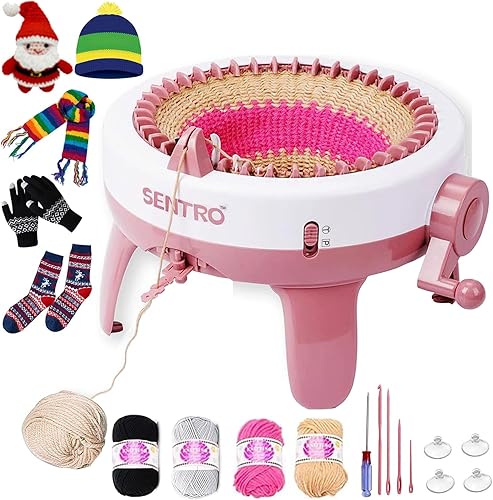
Sentro
48 Needle Knitting Machine with Row Counter
$49.99 as of Nov 8, 2026
★★★★★Our rating· In Stock
The classic Sentro-style circular machine with 48 needles, enough for adult hats and wide scarves, plus a row counter and a switch between tube and flat-panel knitting. About $50. 439 reviews at 4.1 stars.
The small 22-needle version, which makes narrow tubes for kids' hats, scarves, leg warmers and i-cord. A cheap way to try machine knitting, or a gift for a child. About $25. 2,700+ reviews at 3.9 stars.
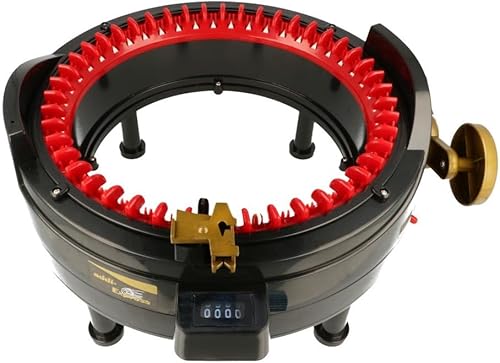
The original design from German needle maker addi that Sentro-style machines copy. It has 46 needles, a hand crank, a built-in row counter, and both tube and flat panel modes. Smoother and more reliable than budget machines. About $124. 4,800+ reviews at 4.4 stars.
Circular machines like smooth, consistent #4 medium worsted yarn. Acrylic is the easy choice: cheap, durable and smooth enough to glide over the needles. Wool blends are warmer and nicer to wear but can be a bit grabby. Avoid super bulky, very fuzzy, novelty or thin sock yarns until you know your machine well.
Best starter
RED HEART
Super Saver 3-Pack Yarn, Aran
$11.47 as of Nov 8, 2026
★★★★★Our rating· In Stock
Three skeins of #4 medium worsted acrylic, the yarn many Sentro owners use for first hats. Smooth, tough and cheap enough to practice with freely. About $11. 22,300+ reviews at 4.7 stars.
A single 7-ounce, 364-yard skein of the same #4 worsted acrylic, often enough for one adult hat on a 48-needle machine. About $4. 21,000+ reviews at 4.7 stars.
A soft #4 worsted blend of 80 percent acrylic and 20 percent wool. Warmer and softer than all-acrylic yarn, so it's a step up for hats you'll actually wear. About $5 per skein. 3,200+ reviews at 4.6 stars.
Machine knitting is fast, but finishing is done by hand. A crochet hook picks up dropped stitches and ladders, a blunt tapestry needle weaves in ends and gathers the top of a hat, and a pom-pom finishes it off. These small tools are what make machine-knit projects look handmade instead of unfinished.
Best starter
Yarniss
14 Size Ergonomic Crochet Hooks Set, 2mm to 10mm
$14.59 as of Nov 8, 2026
★★★★★Our rating· In Stock
Fourteen ergonomic crochet hooks from 2 mm to 10 mm. A mid-size hook is the standard tool for picking dropped stitches back up the ladder and fixing mistakes. About $15. 28,000+ reviews at 4.7 stars.
Blunt bent-tip yarn needles in a little storage tube, for weaving in ends and cinching the top of a hat closed. The bent tip slips through knit stitches easily. About $7. 864 reviews at 4.8 stars.
Twelve fluffy faux fur pom-poms to finish machine-knit hats. A pom-pom hides the gathered top and makes a quick hat look like a store-bought gift. About $10. 1,800+ reviews at 4.6 stars.
A circular knitting machine can make a hat in an hour, once you stop dropping stitches. Here's a one-week plan from setting up and casting on to fixing mistakes, finishing your first hat and choosing what to make next.
Circular knitting machines look like toys and work like magic, with one catch: the first few projects tend to come off the machine with holes. Almost every problem comes down to tension, yarn choice or cranking too fast. This week fixes all three.
Day 1: Set up and cast on
Clamp or suction the machine to a smooth, sturdy table. Use smooth #4 worsted yarn in a light color, so you can see each stitch. Follow your machine’s cast-on: usually yarn goes over every other needle on the first round, then every needle after that.
Turn the crank slowly for the first five or six rows while holding the yarn tail down with gentle tension, or clip a weight to it. Most dropped stitches happen here, before there’s enough fabric to pull down on its own.
Knit a long practice tube at a steady, moderate speed. Listen and watch: a skipped needle usually makes a different sound and leaves a loop sitting on top of the needle instead of in its hook.
Drop a stitch on purpose and fix it. Stop cranking, insert a crochet hook into the loose loop and pull each horizontal rung of the ladder through, one at a time, until you reach the top. Put the loop back on its needle and carry on. Once you’ve done this a few times, mistakes stop being scary.
Days 4 to 5: Your first hat
On a 48-needle machine, knit a tube about twice as long as you want the hat to be, often around 100 to 120 rows. Change color partway for stripes if you like, by knotting in the new yarn and continuing.
Remove the work using the machine’s release method, keeping the last row of live stitches on a length of yarn. Fold the tube in half so the cast-on edge meets the live stitches, creating a double-thick brim.
Thread the live stitches onto a tapestry needle, pull tight to gather the top, and knot securely inside. Weave in the ends. Sew a pom-pom on firmly. That’s a finished hat, and it probably took less than an evening.
Next, try a scarf from a flat panel, a cowl, or a striped hat in a wool blend. Count your rows for each project, and you’ll be able to repeat sizes for gifts.
What not to worry about yet
Don’t worry about flatbed machines, electric cranks or fancy yarn. Make five hats on a circular machine and you’ll know whether you want to go further.
Sentro-style machines are cheaper and fine for occasional hats and gifts. Addi Express machines are smoother, more reliable and longer-lasting. If you plan to knit a lot, the Addi is worth the extra; if you're trying the hobby, start with a Sentro.
How many needles do I need?
For adult hats and wider scarves, 40 to 48 needles. A 22-needle machine makes narrow tubes for kids' hats, scarves and cords. Most adults are happier with the bigger machine.
What yarn works best on a Sentro?
Smooth #4 medium worsted yarn, ideally acrylic or an acrylic-wool blend in a light color. Super bulky, very thin, fuzzy or textured yarns often cause dropped stitches and jams.
How do I fix dropped stitches?
Stop cranking. Use a crochet hook to catch the loose loop and pull each rung of the ladder through it, working back up to the needle, then place the loop back on the hook. Go slowly and keep tension on the yarn.
Can I make a sweater on a circular machine?
Not easily. Circular machines knit tubes or narrow panels, so a sweater means seaming many pieces together. Flatbed machines are designed for garments. Most people use circular machines for hats, scarves, cowls and blankets made in strips.
Why does my knitting curl?
Circular machines knit stockinette stitch, which naturally curls at the edges. That's why tubes and folded brims work so well. For flat panels, a crocheted border or blocking helps them lie flatter.
JustBeginning earns commission from affiliate programs. As an Amazon
Associate, we earn from qualifying purchases. This costs you nothing
extra and doesn't change our recommendations.
Prices and availability are accurate as of the date and time
shown and can change; the price on Amazon when you buy is what
applies.
How this works.
Our top pick48 Needle Knitting Machine with Row Counter


 Best starter