Beginner's guide

So you're getting into etymology

Etymology is the study of where words came from, and once it clicks, you can't stop. The word paradise originally meant a walled garden in Old Persian. Salary comes from salt (Roman soldiers were paid in it). This hobby costs almost nothing to start, and the payoff is a completely different relationship with every sentence you read or write.

By Colin B. · Published June 10, 2026 · Last reviewed June 10, 2026

The 60-second version

If you only buy 3 things to start:

  1. The Etymologicon — The Etymologicon is the best first etymology book: connected, surprising, impossible to put down.
  2. The Barnhart Dictionary of Etymology — The Barnhart is the workhorse reference dictionary; everything else on your shelf is supplemental.
  3. English from the Roots Up — English from the Roots Up teaches the Latin and Greek skeleton that holds most of English together.
Budget total
$15
Typical total
$55
One gateway book gets you started for under $20. A good etymological dictionary adds another $30-40. Total for a solid home reference shelf: under $60.

We earn commission on qualifying Amazon purchases — see our affiliate disclosure. Price tiers and budget totals shown above are editorial estimates; actual Amazon prices vary.

At a glance

Our top pick in each category

The fastest path through this guide — each best-starter pick by category. Scroll for the budget and upgrade alternatives.

CategoryTop pickPriceWhere to buy
Etymology DictionariesHarperCollinsThe Barnhart Dictionary of Etymology$$ See on Amazon →
Word-History ReadsBerkley BooksThe Etymologicon$ See on Amazon →
Classical Roots GuidesLiteracy UnlimitedEnglish from the Roots Up$ See on Amazon →
Language HistoryAvon BooksThe Mother Tongue: English and How It Got That Way$ See on Amazon →
Before you buy anything

A few things worth knowing first

Start with a narrative book, not a dictionary. Etymology dictionaries are reference tools, not reads. Beginning with The Etymologicon gives you the curiosity and context that makes the reference books pay off. Dictionary first is like buying a hammer before you know what you want to build.

Your public library likely gives free access to the OED Online. The Oxford English Dictionary is the gold standard for word history, costs $100 per year direct, and is not on Amazon. Most library systems include it with a free card. Check before paying.

Greek and Latin roots are a force multiplier. About 60% of English vocabulary has classical roots. Learning 200-300 core roots doesn't take long, and once you have them, word origins reveal themselves without looking anything up.

The gear

What you actually need

Etymology Dictionaries

An etymological dictionary is your core reference: look up any word and trace it backward through centuries of language. The key distinction is depth vs. accessibility. The Barnhart covers roughly 30,000 words in a single readable volume and is what most enthusiasts keep on their desk. The Oxford Dictionary of English Etymology goes deeper but is dense and harder to browse. Start with one accessible volume; you can add the heavy-duty scholarly edition later.

Etymology Dictionaries — what's the difference?

A few common shapes, each making a different trade.

Accessible one-volume

Readable prose, thousands of entries. The everyday desk reference.

Entry count
3,000-30,000
Style
Narrative prose
Best for
Hobbyists, writers

Best for Most hobbyist etymologists; writers building a home reference shelf

Tradeoff Less depth than scholarly volumes on obscure or archaic words

↓ See our pick
Comprehensive scholarly

Academic depth and dense abbreviation format. For serious research.

Entry count
100,000+
Style
Dense abbreviations
Best for
Advanced researchers

Best for Those who've exhausted accessible volumes and need academic-level depth

Tradeoff Hard to read casually; full benefit requires learning the abbreviation system

The Barnhart Dictionary of Etymology Best starter
HarperCollins

The Barnhart Dictionary of Etymology

$115.00 as of Jun 22, 2026

Our rating

The standard one-volume etymological dictionary for enthusiasts and writers. Robert Barnhart traced roughly 30,000 words back to their oldest known forms, with clear dates and source languages. Dense but readable, thorough without being academic. Most hobbyist etymologists keep this on their desk for years.

What we like

  • 30,000 entries tracing the full English vocabulary to oldest known forms
  • Readable prose style, not a wall of abbreviations like the OED
  • The reference most enthusiast etymologists keep on their desk

What to know

  • Out of print in some editions; verify the printing year before ordering
  • Expensive for a reference book; expect $35-60
Oxford Dictionary of Word Origins Budget pick
Oxford University Press

Oxford Dictionary of Word Origins

$6.27 as of Jun 22, 2026

Our rating · Only 1 left in stock - order soon.

Shorter and more accessible than the Barnhart, covering around 3,000 of the most interesting words with full narrative explanations. Less comprehensive but more fun to browse. Good if you want to dip in randomly rather than look up specific words systematically.

What we like

  • Narrative style makes it genuinely readable from cover to cover
  • Around $15, the lowest-cost entry point for a home reference shelf

What to know

  • Only 3,000 words; you'll outgrow it as a reference quickly
  • Not detailed enough for serious or comparative research
Oxford Dictionary of English Etymology Upgrade pick
Oxford University Press

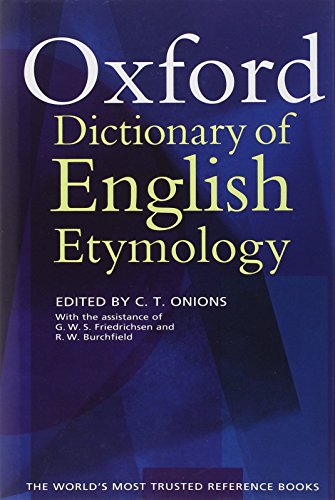
Oxford Dictionary of English Etymology

$69.22 as of Jun 22, 2026

Our rating · In Stock

The scholarly standard edited by C.T. Onions. Dense, thorough, and authoritative. This is what professional linguists and advanced enthusiasts consult. Not for casual reading, but for those who want the definitive entry when the Barnhart doesn't go far enough.

What we like

  • Definitive scholarly reference; cited in academic papers on language history
  • Covers more obscure and archaic words than any single-volume competitor

What to know

  • Abbreviation-heavy; hard to read without the key nearby
  • Overkill for hobbyist use in the first year

Word-History Reads

These are the books that hook people. Etymological dictionaries are reference tools; narrative word-history books are the reason people become obsessed. The Etymologicon chains together word origins in a connected journey that reads like a story. The Professor and the Madman tells how the OED itself got built, which reframes the whole hobby. Both are the kind of book you read in two sittings and then recommend to everyone you know.

The Etymologicon Best starter
Berkley Books

The Etymologicon

$18.64 as of Jun 22, 2026

Our rating · In Stock

Mark Forsyth connects word origins in a chain: one word leads to its Latin root, which leads to a French borrowing, which leads to an American slang term, and on it goes for 240 pages. The structure makes it impossible to put down. This is the book that converts people to etymology. Start here.

What we like

  • Chain structure connects hundreds of origins into one continuous narrative
  • Funny, specific, full of surprising connections most books miss

What to know

  • Not comprehensive; deliberately selects the best stories, not all of them
  • Out of print sometimes; check used copies if new price spikes
The Professor and the Madman Specialty pick
HarperCollins

The Professor and the Madman

$24.18 as of Jun 22, 2026

Our rating

Simon Winchester's account of how the Oxford English Dictionary was built. Part word-history, part true crime, and genuinely hard to put down. You'll finish it understanding not just where words come from but how the tools we use to study them got built. It reframes the whole hobby.

What we like

  • True story reads like a thriller; keeps etymology from feeling academic
  • Paperback widely available for under $15; easy gift

What to know

  • About the OED's creation, not word origins themselves
  • Some reviewers find the pacing slow in the middle third

Classical Roots Guides

Latin and Greek are the skeleton of English vocabulary. Medical, legal, scientific, and academic English is built almost entirely on classical roots, and even everyday words like manufacture (manus = hand, facere = make) reveal their full meaning once you know the parts. Learning 200-300 roots unlocks the logic of thousands of words. Unlike dictionaries, these books teach you to see the pattern, not just look up individual answers.

English from the Roots Up Best starter
Literacy Unlimited

English from the Roots Up

$40.52 as of Jun 22, 2026

Our rating

The most-recommended roots guide for adult self-learners. Joegil Lundquist covers 100 roots with clear explanations, example words, and exercises. The companion card set is especially useful for spaced repetition. If you want etymology to become intuitive rather than lookup-dependent, start here.

What we like

  • Card-based format works well for spaced repetition and daily practice
  • 100 core roots covers the foundation of most English academic vocabulary

What to know

  • Book alone is less effective than book plus companion cards; buy both
  • Designed for classroom use; self-pacing requires some discipline
Word Power Made Easy Budget pick
Pocket Books

Word Power Made Easy

$8.56 as of Jun 22, 2026

Our rating · In Stock

Norman Lewis's vocabulary builder has been in print for 70 years because it works. Built around root-and-pattern exercises rather than memorization lists, it teaches vocabulary through etymology. Cheaper than dedicated roots books and covers thousands of words through about 50 core concepts.

What we like

  • 70+ years in print; still the best value for etymology-based vocabulary
  • Self-paced format works for 20-minute daily sessions

What to know

  • Heavier on vocabulary building than pure etymology; not a roots reference
  • Some exercises feel dated; skip the chapter on psychology terms
An old, handwritten book is open to view.

Photo by Nick Russill on Unsplash

Language History

Etymology doesn't exist in a vacuum. Words change because languages collide, empires fall, and people borrow and mangle what they hear. Reading about English's actual history, from its Anglo-Saxon roots through Norman conquest through global spread, gives every word origin a story instead of just a date. Bill Bryson's account is the standard accessible entry point; McWhorter is the punchy argumentative follow-up for those who want more.

The Mother Tongue: English and How It Got That Way Best starter
Avon Books

The Mother Tongue: English and How It Got That Way

$10.01 as of Jun 22, 2026

Our rating · In Stock

Bill Bryson covers the entire history of English, from Germanic warrior-dialects through Latin influence through globalization, in a funny and accessible 250 pages. Not deep scholarship, but it gives every etymology you encounter a place in the larger story. The best English language history for non-specialists.

What we like

  • Bryson's voice makes language history feel like gossip, not a lecture
  • Wide paperback availability; usually under $15

What to know

  • Some scholars note occasional inaccuracies; read for sweep not detail
  • 1990 publication means no coverage of internet-era language change
Our Magnificent Bastard Tongue Specialty pick
Gotham Books

Our Magnificent Bastard Tongue

$9.32 as of Jun 22, 2026

Our rating · In Stock

John McWhorter's short, punchy argument for why English grammar evolved the way it did. More opinionated than Bryson, more current, and especially good on the Celtic and Norse influences that most textbooks skip. If you finish Bryson and want a sharper thesis, McWhorter is the next read.

What we like

  • Short (200 pages) and argumentative; makes a case, not a survey
  • McWhorter is one of the best popular linguists writing today

What to know

  • Focuses on grammar evolution, not vocabulary origins; less etymological
  • McWhorter's confidence can feel dismissive of competing scholarly views
Going deeper

Your first month of etymology study

The first word you look up will send you chasing three more. Etymology is like that. Here's how to channel that impulse into a habit that actually builds your knowledge, rather than just a collection of interesting facts.

woman reading book
Photo by Eliott Reyna on Unsplash

Etymology is one of those hobbies that starts without you noticing. You look up where the word “salary” came from (salt — Roman soldiers were paid in it), and then you wonder about “disaster” (bad star — ancient Romans blamed celestial alignment), and then “paradise” (a walled garden in Old Persian), and suddenly it’s an hour later and you’ve filled three pages of notes. That’s the hobby. Most people are doing it long before they have a name for it.

This is what the first month actually looks like if you want it to compound rather than stay a scattered collection of trivia.

Week one: the gateway read

Don’t start with a dictionary. This is the mistake that turns a fun curiosity into homework.

The single best first book is The Etymologicon by Mark Forsyth. It’s structured as a chain: each word origin connects to the next, and then to the next, for 240 pages. You cannot read just one chapter. It’s the etymology book that converts people, and it’s the one you’ll press on friends.

While you wait for it to arrive, bookmark Etymonline.com (the Online Etymology Dictionary). It’s free, authoritative, and updated continuously. Look up five words you use every day and see where they come from. “Candidate” comes from the white togas Roman candidates wore (candidus = shining white). “Muscle” comes from the Latin for mouse (musculus) because the movement under skin looks like a mouse running. “Hazard” came into English from Arabic through Spanish, where it meant a dice game.

Start a simple running list. Not a database, not a system. Just a note on your phone or a page in a notebook. Word, origin, what surprised you. You’ll come back to it.

person writing on white paper
Photo by Kelly Sikkema on Unsplash

Week two: understanding roots

Once the Etymologicon arrives and you’ve read a chunk of it, you’ll start to notice that the same pieces keep appearing. The root port in transport, import, report, portable. The root dict in dictate, predict, dictionary, verdict. The root rupt in disrupt, corrupt, interrupt, erupt.

This is when roots guides become valuable. English from the Roots Up by Joegil Lundquist covers 100 core Latin and Greek roots with example words and exercises. Learning these 100 roots takes maybe two weeks of 20-minute sessions, and the payoff is that you stop needing to look things up. You can parse an unfamiliar word by its parts.

Start with these five Latin roots if you want a quick win:

  • port (carry): transport, import, export, portable, deport
  • dict (say/speak): dictate, predict, dictionary, contradict, verdict
  • rupt (break): disrupt, erupt, corrupt, interrupt, rupture
  • vert (turn): convert, revert, invert, divert, subvert
  • scrib/script (write): describe, inscribe, prescription, manuscript

Five roots, about 30 words each. That’s 150 words whose structure you now understand rather than memorize.

Week three: the reference shelf

By week three you’ve read a gateway book, you know some roots, and you’ve been using Etymonline regularly. Now a reference dictionary starts to earn its place.

The Barnhart Dictionary of Etymology is what most hobbyists end up with. Robert Barnhart traced roughly 30,000 words back to their oldest known forms, with source languages and earliest recorded dates. It’s a desk reference, not a read, but you’ll use it constantly. Something will come up in reading — an interesting word, an uncertain origin, a claim you want to verify — and you’ll reach for it.

One thing about the Barnhart: it’s not always the last word. For words that are genuinely contested or obscure, it’s worth cross-referencing with Etymonline (which cites more recent scholarship) or, if your library card gives you access, the OED Online. Most US and UK public libraries include the Oxford English Dictionary with a free card. Check before paying the $100/year subscription directly.

books filed on bookshelf
Photo by Thomas Kelley on Unsplash

Week four: building the habit

The difference between people who stay interested in etymology and people who drift away from it is almost always about practice, not knowledge. Etymology is most alive when you’re doing it in context, not in isolation.

A few things that stick:

Mark words while you read. Any word whose origin you don’t know gets a quick circle. At the end of a reading session, look up two or three of them. Not all of them — just the most interesting. You’ll remember what you looked up because you encountered it in a sentence.

Write down what surprises you. The human brain retains surprise much better than facts. If you discover that “clue” originally meant a ball of yarn (the thread you’d follow out of a labyrinth), write it down. You’ll have it permanently.

Follow chains. When you look up a word and find it came from Latin, look up the Latin root. When you find it came from Greek before that, look up the Greek. See how far back you can trace it. The Proto-Indo-European roots, the ancient shared language of most European and South Asian languages, are the bottom of the well. The American Heritage Dictionary has a free appendix of them online.

At the end of the first month, you’ll have a working vocabulary of roots, a reference on your desk, and a few books you’ve recommended to people. That’s enough to keep going indefinitely.

Save your money

What you don't need yet

Beginners get pressured to buy a lot of stuff that doesn't help them play better. Here's what we'd skip on day one.

  • An OED Online subscription — The gold standard at $100/year, but your library almost certainly includes it free with a library card. Check before paying.
  • The scholarly Oxford Dictionary of English Etymology — The definitive academic reference. Dense, expensive, and hard to browse. The Barnhart handles 90% of hobbyist needs; wait until you've used that one thoroughly.
  • Multiple etymological dictionaries at once — One good volume is plenty to start. Buy the second after you've actually read and used the first.
  • Latin or Ancient Greek courses — Root guides give you 80% of the practical benefit in a fraction of the time. Full Latin study is useful eventually, but not on day one.
  • Specialized linguistic databases — JSTOR, subscription linguistics journals, Proto-Indo-European reconstruction tools. These are for academic research, not for enthusiasts.
First week

Your first seven days

A short, real plan to get from gear-on-doorstep to actually playing.

  1. Order The Etymologicon. It's the book that hooks most people. · Buy
  2. Check your library card for free OED Online access at oed.com. Most public library systems include it. · Action
  3. Bookmark Etymonline.com — free, authoritative, updated daily. Use it as your daily lookup while waiting for books to arrive. · Action
  4. Write down three words whose origins surprise you this week. Salary. Disaster. Panic. Start with words you use every day. · Learn
  5. Learn five Latin roots: port (carry), dict (say), rupt (break), vert (turn), scrib/script (write). Each appears in dozens of common English words. · Learn
  6. Read one chapter of The Etymologicon per day once it arrives. It chains into the next chapter, and the daily habit builds faster than marathon sessions. · Action
FAQ

Common questions

What is the best free resource for etymology?

Etymonline.com (the Online Etymology Dictionary by Douglas Harper) is the best free starting point. It covers tens of thousands of words with clear source information and is more accurate than Wiktionary for origin dates. Most serious enthusiasts use it daily even after buying physical dictionaries.

Is the OED Online worth the $100 per year?

Not before you've confirmed your library doesn't give it free. Most public library systems in the US and UK include OED access with a library card. If your library doesn't have it, wait until you've been reading etymology for six months before deciding whether the cost fits your use.

Do I need to learn Latin or Ancient Greek?

Not to enjoy etymology. Root guides like English from the Roots Up give you the 200-300 classical roots that explain most English vocabulary without requiring you to read Latin texts. Full Latin or Greek study is useful if you want to read primary sources, but most hobbyists never need it.

How is an etymological dictionary different from a regular dictionary?

A regular dictionary tells you what a word means today. An etymological dictionary tells you what it meant when it entered English, where it came from before that, and how the meaning has shifted over centuries. The Barnhart and the OED trace words back to their oldest known forms; your phone dictionary won't.

How long before etymology starts feeling intuitive?

Most people notice patterns within a few weeks of learning root systems. After you know 50-100 roots, unfamiliar words start revealing their structure without looking anything up. Reading one book and learning one root system in the first month usually gets you there.

Can I study etymology seriously without a linguistics background?

Yes. Most of the people who love etymology most are writers, lawyers, crossword solvers, and general readers. The books here require no background, and the analytical concepts like sound change and semantic shift are self-evident once you start seeing examples.

Going further

Where to next

Browse by category

Authoritative sources

  • Online Etymology Dictionary (Etymonline) — Douglas Harper's free etymological dictionary. The best free starting point and used by professionals daily. Updated continuously.
  • Oxford English Dictionary Online — The definitive scholarly resource for word history. $100/year direct, but free through most public library systems. Check before subscribing.
  • Wordorigins.org — Discussion forum with expert participation. Good for debunking folk etymologies and exploring contested word histories.
  • AHD Indo-European Roots Appendix — The American Heritage Dictionary's appendix of Proto-Indo-European roots. Free online; useful for tracing words back beyond Latin and Greek.
  • r/etymology — Active subreddit with a mix of curiosity and expertise. Good for specific questions and discovering interesting rabbit holes.
  • Language Log — Academic linguists writing accessibly about language. Not etymology exclusively, but excellent context for how language change works.