A real beginner microscope shows you rotifers, algae and cells in a drop of pond water, and a stereo microscope makes insects and crystals look like landscapes. Here's how compound and stereo scopes differ, why LED light and a mechanical stage matter, when oil immersion is worth it, and which toy scopes to skip.
By Colin B. · Published November 16, 2026 · Last reviewed November 16, 2026
An AmScope M150C, the PS50 prepared slide set, blank slides, methylene blue and a phone adapter come to about $175. Choose the OMAX binocular instead and add the SP-14 prep kit and immersion oil and you're near $370. A stereo microscope is another $220 or so.
We earn commission when you buy through links on this page, including
Amazon. See our affiliate disclosure.
Price tiers and budget totals shown above are editorial estimates;
actual prices vary.
At a glance
Our top pick in each category
The fastest path through this guide — each best-starter pick by category.
Scroll for the budget and upgrade alternatives.
Decide what you want to see. A compound microscope (40x to 1000x) looks through thin, flat samples on slides: pond life, cells, blood and bacteria. A stereo microscope (about 10x to 40x) shows solid objects in 3D: insects, rocks, coins, leaves and circuit boards. Many hobbyists end up with one of each, but pond water is the classic place to start, which means a compound scope.
Skip toy microscopes. Plastic lenses, dim lights and wobbly focus make most kits under $50 frustrating. Look for glass optics, a metal frame, LED lighting with a brightness control, an iris diaphragm or condenser for contrast, and a mechanical stage that moves the slide with knobs.
Ignore huge magnification claims. Anything over about 1000x is empty magnification: bigger but not sharper. For pond life, 40x to 400x does almost everything. 1000x needs immersion oil and good technique, so it can wait.
A compound microscope looks through thin samples on glass slides at 40x to 1000x. It's what you need for pond life, cells, blood and bacteria. Look for glass optics, a metal body, adjustable LED light, an Abbe condenser with an iris diaphragm for contrast, and a mechanical stage that moves the slide smoothly with knobs. Binocular heads are far more comfortable for long sessions. Ignore claims above 1000x.
Compound microscopes — what's the difference?
A few common shapes, each making a different trade.
Monocular
One eyepiece. Cheaper, lighter and fine for short sessions and kids.
A full-size binocular scope with glass objectives up to 100x oil, an Abbe condenser with iris, a mechanical stage and adjustable LED light. It's been a go-to first serious microscope for years. Usable magnification tops out around 1000x. About $278. 2,100+ reviews at 4.4 stars.
The cheapest microscope worth buying: a metal body, glass lenses, a rotating head and cordless LED light. It lacks a mechanical stage and condenser, but shows pond life clearly at 40x to 400x. About $115. 3,000+ reviews at 4.5 stars.
A research-style trinocular scope with a Siedentopf binocular head, a mechanical stage and a third port for a camera. Worth it if you plan to photograph or film what you see. About $280. 730+ reviews at 4.5 stars.
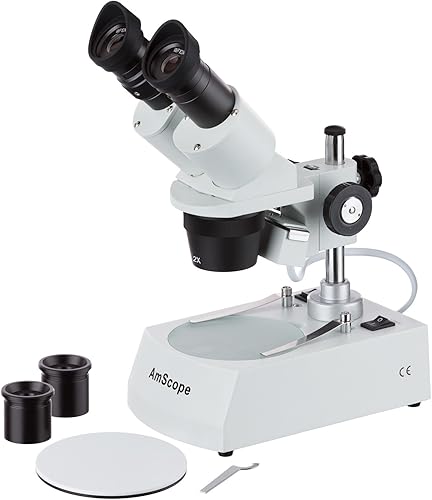
A stereo (dissecting) microscope gives a 3D view of solid objects at low power, usually 10x to 40x, with plenty of room under the lens. It's ideal for insects, flowers, seeds, rocks, coins and circuit boards, and for sorting pond samples before slides. Look for both top and bottom lighting and a zoom or two fixed magnifications. It complements a compound scope rather than replacing one.
Best starter
AmScope
SE306R-PZ Forward Binocular Stereo Microscope, 10x and 20x
$221.99 as of Nov 16, 2026
★★★★★Our rating· In Stock
A sturdy stereo scope with 10x and 20x magnification, top and bottom lights, and lots of working space. Insects, minerals and plant parts look sharp and three-dimensional. About $222. 320+ reviews at 4.5 stars.
A zoom stereo microscope that goes smoothly from 7x to 45x, with a camera port for photos. A big step up for insect, mineral and electronics work. About $380. 4.2 stars from a small number of reviews.
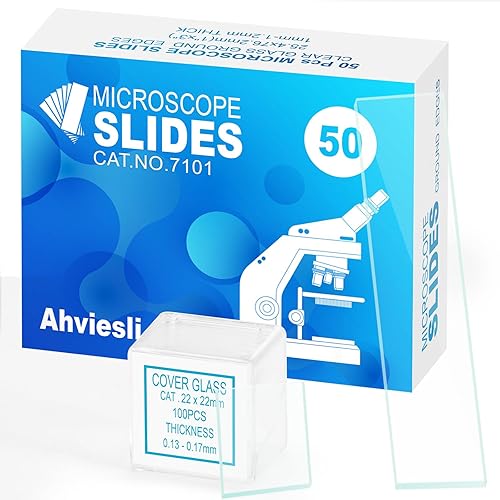
Prepared slides are professionally stained, permanent samples that are perfect for learning to focus. Blank slides and cover slips are for your own wet mounts of pond water, cheek cells and onion skin. A simple stain like methylene blue makes clear cells visible by coloring nuclei and cell walls. A preparation kit adds tweezers, droppers and stains so you can make your own permanent slides later.
Best starter
AmScope
PS50 Prepared Microscope Slide Set, 50 Slides
$32.99 as of Nov 16, 2026
★★★★★Our rating· In Stock
Fifty stained, labeled slides of plants, animals and human tissue in a storage box. Ideal for practicing focus and lighting before you make your own. About $33. 310+ reviews at 4.6 stars.
A kit with blank slides, cover slips, tweezers, droppers, a scalpel and several stains for making your own slides. A good next step after wet mounts. About $34. 790+ reviews at 4.6 stars.
A classic biology stain that colors cell nuclei blue. One drop makes cheek cells, onion skin and many pond organisms much easier to see. About $10. 830+ reviews at 4.5 stars.
A phone adapter clamps your phone over the eyepiece so you can take photos and videos of what you see, which is how most hobbyists share their finds. Line the phone camera up with the eyepiece and zoom slightly. Immersion oil is only for the 100x oil objective: a drop between lens and cover slip lets light pass cleanly for 1000x views. Keep lens paper on hand for cleaning.
Best starter
GOSKY
Universal Phone Adapter for Eyepieces
$19.99 as of Nov 16, 2026
★★★★★Our rating· In Stock
A clamp-style phone adapter that fits most microscope, binocular and spotting scope eyepieces and most phones. It holds the camera steady over the eyepiece for photos and video. About $20. 14,000+ reviews at 4.0 stars.
A good beginner microscope opens up a world in a drop of pond water. Here's a four-week plan: learn to focus and light a slide, make wet mounts of pond life, try simple stains, and photograph what you find with your phone.
The first time you see a rotifer spinning or a paramecium cruising across a drop of water, you’re hooked. The hardest part is the first week, when everything is blurry. These habits fix that fast.
Week 1: Focus and light
Start with a prepared slide. Put it on the stage, choose the lowest objective (4x), and raise the stage with the coarse focus while looking from the side so the lens never touches the glass. Then look through the eyepiece and lower the stage slowly until the image appears. Switch to fine focus, center what you want to see, then rotate to the next objective. A good microscope stays nearly in focus between objectives.
Light matters as much as focus. Close the iris diaphragm under the stage partway to add contrast to clear specimens. Wide open washes them out.
Collect water from a pond, puddle or a vase of old flowers, including a little scum and sediment from the bottom. Put one drop on a slide, lower a cover slip at an angle to avoid bubbles, and scan at 4x and 10x. Look for movement. Ciliates, rotifers, diatoms and algae are almost everywhere. A jar of pond water left on a windowsill grows different life every week.
Many cells are nearly transparent. A drop of methylene blue or iodine stain makes nuclei and cell walls stand out. Try a cheek cell swab (scrape gently inside your cheek with a toothpick), a thin layer of onion skin, and a slice of potato with iodine to see starch grains. Use a stereo microscope or a magnifier for insects, leaves, coins and crystals.
A phone adapter clamps your phone over the eyepiece so you can take photos and videos. Line the camera up with the eyepiece, use the phone’s zoom a little to remove the dark circle, and tap to focus. Keep a notebook or photo album of what you found, the magnification, and where the sample came from.
Focus on a prepared slide at 4x, then step up to 10x and 40x. · Action
Collect pond or puddle water with a little sediment in a clean jar. · Action
Make a wet mount: one drop on a slide, cover slip lowered at an angle. · Action
Close the iris diaphragm partway and watch clear organisms gain contrast. · Learn
Clamp your phone to the eyepiece and take your first photo. · Action
FAQ
Common questions
What magnification do I need to see bacteria?
About 1000x with oil immersion, and even then most bacteria are tiny dots or rods unless stained. Pond organisms like paramecia, rotifers and algae are easy to see at 40x to 400x, which is where most beginners spend their time.
Compound or stereo microscope first?
Compound if you're curious about pond life, cells and microorganisms. Stereo if you want to look at insects, rocks, plants, coins or electronics. A stereo scope is also great for kids and for sorting pond samples before putting them on a slide.
Why is everything blurry or dark?
Usually you're starting at too high a magnification. Always focus at 4x first, then switch up. Check the slide is right side up, raise the condenser near the stage, open the diaphragm for dark samples and close it for clear ones.
Do I need immersion oil?
Only for the 100x oil objective, which gives about 1000x. A drop of oil between the lens and the cover slip lets light through cleanly. Wipe the lens with lens paper afterward. Never use oil on the other objectives.
Where do I find interesting things to look at?
Pond scum, puddles, bird baths, the water in a vase of old flowers, moss soaked in water, and hay soaked for a few days (a hay infusion). Also try onion skin, cheek cells, salt and sugar crystals, pollen and insect wings.
Microbehunter Microscopy — A long-running site and free magazine for amateur microscopists, with guides to choosing scopes, slide preparation and pond life.
JustBeginning earns commission from affiliate programs. As an Amazon
Associate, we earn from qualifying purchases. This costs you nothing
extra and doesn't change our recommendations.
Prices and availability are accurate as of the date and time
shown and can change; the price on Amazon when you buy is what
applies.
How this works.
Our top pick40X-2000X Lab LED Binocular Compound Microscope


 Best starter